NA shapes legal thinking, institutional foundations for national development

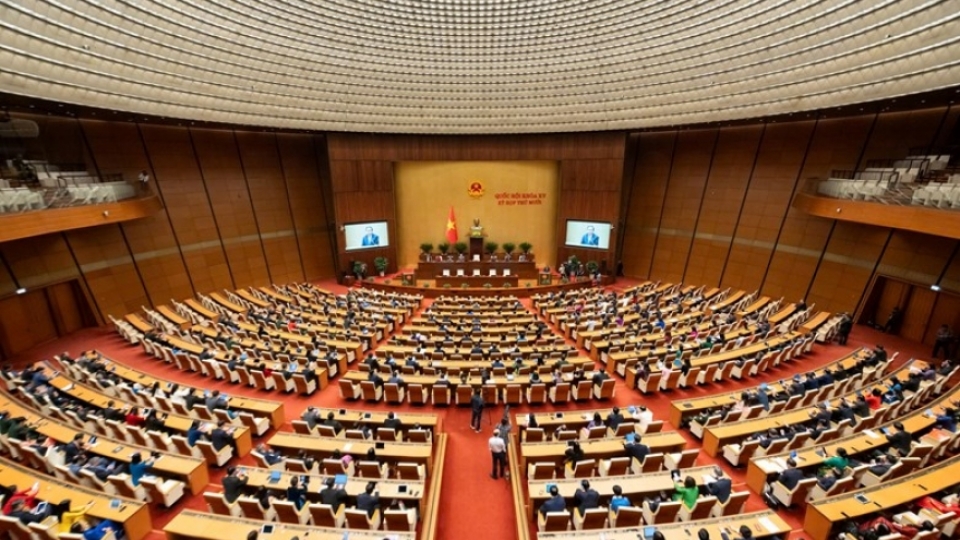
VOV.VN - The National Assembly of Vietnam has played a central role in shaping the country’s constitutional and legislative framework throughout its revolutionary history, contributing to social stability and sustainable development, experts said at a recent forum.
The evolution of Constitutional and legislative activities over time
From the 1946 Constitution to subsequent constitutions and laws, the National Assembly has continuously renewed legislative thinking and refined institutional frameworks to meet the demands of each historical period.

Speaking at a seminar reviewing the legislature’s institutional reform in a new development era organised by Dai Bieu Nhan Dan Newspaper, Deputy Editor-in-Chief Dr. Le Thanh Kim said the 1946 Constitution marked the birth of modern constitutional thinking in Vietnam.
Amidst countless difficulties in the early days of the national construction period, the 1946 Constitution was formulated, laying the foundation for Vietnam’s constitutional development. Since then, legislative activities have been inherited, supplemented and refined across different historical stages, Kim said.
Legal development has closely followed the country’s revolutionary trajectory, with each constitution and law reflecting practical requirements of national construction, defence and reform. Over time, the legal system has become a pillar of social stability, an engine for economic development, and a key instrument for safeguarding independence, sovereignty and international integration.
Participants agreed that after the 1946 Constitution, Vietnam’s legislative work continued to evolve alongside the country’s historical challenges.
In 1959, as Northern Vietnam embarked on socialist construction while supporting the struggle for national reunification, the National Assembly adopted the 1959 Constitution. Associate Professor Bui Thi An, director of the Institute for Natural Resources, Environment and Community Development, said the document provided a solid legal framework despite the country’s difficult circumstances and territorial division.
This flexibility and resilience enabled Vietnam to endure prolonged wars and ultimately achieve national reunification, she said.
During the Đổi Mới (Renewal) period, the National Assembly again demonstrated its pioneering role in institutional reform. Nguyen Dinh Cung, former director of the Central Institute for Economic Management, noted that even while the centrally planned 1980 Constitution remained in effect, the legislature introduced breakthrough laws following the 1986 reform policy.
These included the Law on Foreign Investment (1987), the Company Law (1990) and the Private Enterprise Law (1990), which laid the initial legal foundation for the development of the private sector.
A major turning point came with the 1992 Constitution, which fully institutionalised the reform agenda and established a multi-sector commodity economy operating under market mechanisms. Legal thinking, experts said, moved ahead of practice, paving the way for deeper economic transformation.
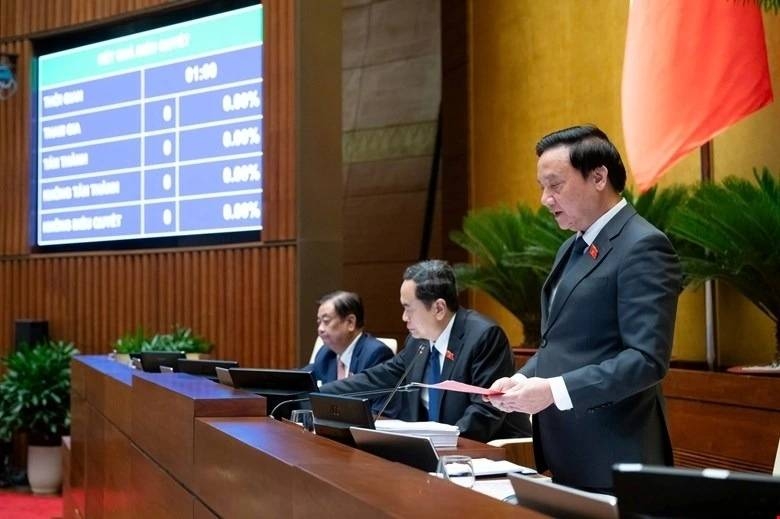
The 2013 Constitution is widely regarded as a milestone in modern legislative thinking. Nguyen Thi Mai Phuong, vice chairwoman of the National Assembly’s Committee on Law and Justice, described it as the “backbone” of the legal system in a new development phase.
She said the 2013 Constitution not only inherited the democratic and rule-of-law values of the 1946 Constitution but also introduced fundamental innovations, particularly the strong recognition of human rights and citizens’ rights. It has served as a guiding framework for administrative reform, institutional streamlining and the development of a modern legal system.
Sharing the perspective, Dr Le Thanh Kim said the 2013 Constitution created a strong constitutional basis for building a socialist rule-of-law state, while setting higher standards for the quality, effectiveness and enforcement of legislation.
Legislative reform in a new development era
As Vietnam enters a new development phase, the National Assembly faces the task of further refining institutions to ensure coherence, stability and flexibility, alongside supporting growth, speakers said.
According to Dr. Le Thanh Kim, legislative thinking is shifting from a management-oriented approach to one focused on enabling development. Improving law-making quality and expanding the use of digital technology in parliamentary activities have become strategic priorities.
Nguyen Dinh Quyen, former director of the Institute for Legislative Studies, said rapid technological change is outpacing existing legal frameworks, requiring more flexible and forward-looking legislative approaches. Based on this, the National Assembly is also fundamentally reforming its thinking on lawmaking, aiming to both ensure effective state management and encourage creativity, unlocking all resources for development.

In her view, Deputy Chairwoman of the National Assembly's Committee on Law and Justice Nguyen Thi Mai Phuong stated that in the face of these new shifts in the era, the National Assembly is truly acting, innovating its thinking and legislative and supervisory activities to meet practical demands.
The National Assembly has introduced regulatory “sandbox” mechanisms in several laws, including the 2024 Capital Law and the 2025 Law on Science, Technology and Innovation, to allow controlled experimentation in new sectors. Similar mechanisms are being considered for emerging areas.
Parliamentary oversight has also been strengthened. For example, although the Law on Environmental Protection took effect in 2022, the National Assembly conducted oversight in 2025 to address emerging challenges and implementation gaps, with resolutions setting clear deadlines for corrective actions.
These reforms reflect the National Assembly’s role in guiding innovation, promoting sustainable socio-economic development, and accompanying the country as it moves forward in a new era of development, said Phuong.
National Assembly leaves distinctive legacy amid profound changes
VOV.VN - Amid profound domestic and global changes requiring timely, flexible and forward-looking decisions, Vietnam’s 15th National Assembly has affirmed its role as the country’s highest representative and state power body during what has been widely described as an exceptional term.