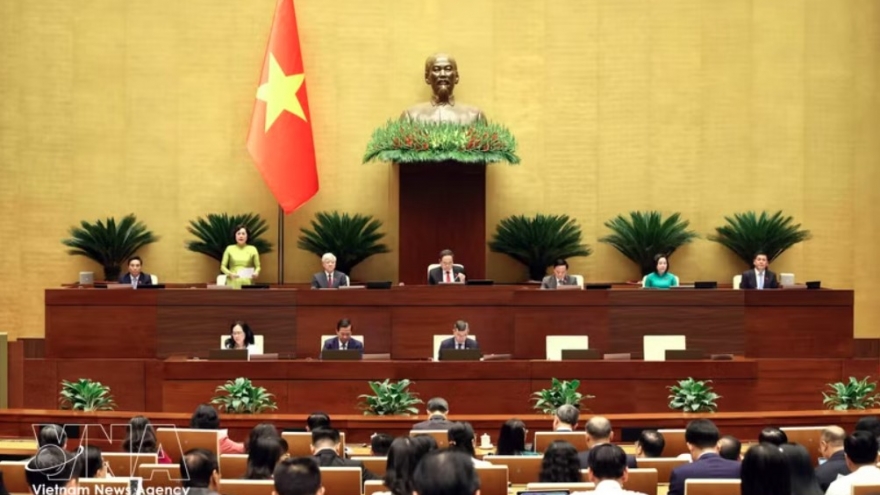
9 new laws promulgated to advance decentralisation, modern governance

VOV.VN - The Office of the President of Vietnam held a press conference in Hanoi on May 13 to announce the Presidential Order promulgating nine laws passed by the 16th National Assembly during its first session held last month.

Among the newly promulgated legislation, five revised laws - the Capital Law, the Law on Access to Information, the Civil Status Law, the Law on Belief and Religion, and the Law on Vietnamese Representative Missions Abroad - are expected to significantly impact institutional reform, citizens’ rights, digital governance, public data transparency, and Vietnam’s external relations in the coming years.
Revised Capital Law expands Hanoi’s autonomy
The revised Capital Law consists of nine chapters and 36 articles and will take effect on July 1, 2026.
It establishes a new legal framework enabling Hanoi to further develop as Vietnam’s political, economic, and cultural centre. It grants broader authority to the city administration in areas including urban planning, budgeting, administrative organisation, resource management, and infrastructure development.
Under the revised framework, Hanoi will have greater flexibility in mobilising resources, developing the Capital Region, and applying big data and artificial intelligence technologies in urban governance.
The city will also be permitted to adjust certain administrative procedures to improve governance flexibility and accelerate digital transformation, accompanied by stronger accountability and oversight mechanisms.
Revised access to Information Law promotes digital transparency
The revised Law on Access to Information contains four chapters and 31 articles and will come into force on September 1, 2026.
The law further institutionalises citizens’ rights under the principle of “people know, people discuss, people implement, people monitor, and people benefit.”
It expands categories of information required to be publicly disclosed, particularly data directly affecting citizens and businesses. The law also clarifies classifications of publicly accessible information, conditionally accessible information, and restricted information.
In addition, the legislation strongly encourages information disclosure through digital platforms to improve transparency and public access to government data.
Revised Civil Status Law introduces “one-time declaration” principle

The revised Civil Status Law includes four chapters and 30 articles and will take effect on March 1, 2027.
The law marks a major transition from manual administration toward digital governance. It grants commune-level People’s Committees authority over all domestic civil status registration procedures and allows citizens to register civil events regardless of place of residence.
Notably, the law establishes the principle that citizens should provide information only once, with state agencies responsible for sharing and synchronising data instead of repeatedly requesting paper documents.
Electronic civil status data will carry legal validity and be integrated with healthcare systems, paving the way for proactive digital birth and death registration.
Revised Religion Law balances religious freedom and digital governance
The revised Law on Belief and Religion comprises nine chapters and 61 articles and will take effect on January 1, 2027.
The law aims to further strengthen the legal framework protecting freedom of belief and religion while adapting state management mechanisms to new governance requirements in the digital era.
The law introduces provisions designed to better safeguard religious freedom, including activities conducted in digital environments. It also adjusts regulations in line with Vietnam’s evolving administrative structure, promoting decentralisation and simplifying administrative procedures in religious affairs.
At the same time, the law maintains safeguards related to national security, public order, and personal data protection.
Amended Law on overseas representative missions modernises diplomacy
The amended Law on Vietnamese Representative Missions Abroad is designed to address shortcomings in the 2009 law, which was revised in 2017, and to improve the effectiveness and professionalism of Vietnam’s overseas representative system.
The law focuses on strengthening institutional functions, responsibilities, and organisational structures, while promoting decentralisation in foreign affairs management. It also introduces improvements to policies and working conditions for diplomatic personnel and overseas representative offices.
The broader objective is to build a more modern, coordinated, and effective diplomatic system capable of meeting the demands of international integration and national development in the new era.
In addition to the five key laws highlighted, four other laws were also promulgated in this legislative package, further strengthening Vietnam’s legal and institutional framework across taxation, legal services, public incentives, and social support systems.
These include the amended Law on Emulation and Reward, the revised Tax Laws package covering Personal Income Tax, Value-Added Tax (VAT), Corporate Income Tax, and Special Consumption Tax, the amended Law on Notarisation, and the amended Law on Legal Aid.
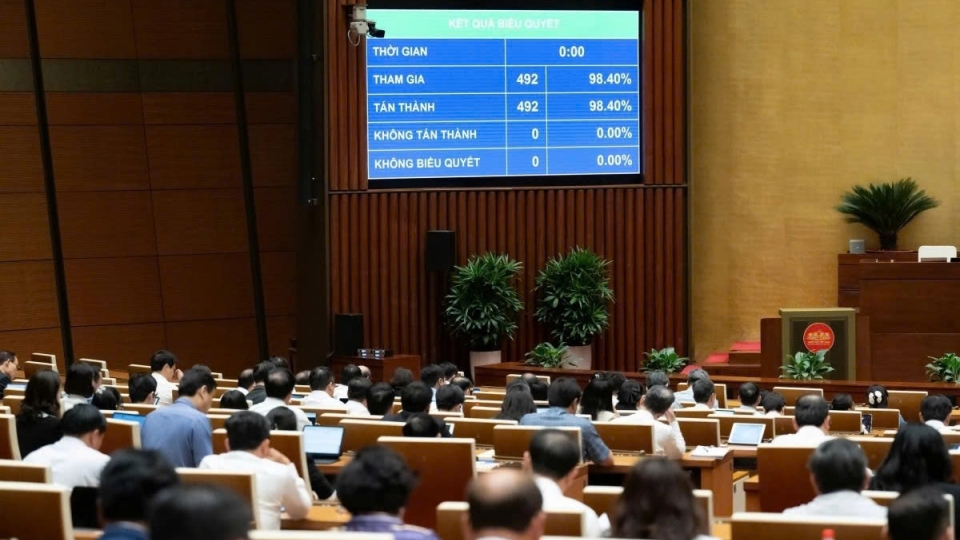
National Assembly approves revised Law on Belief and Religion
VOV.VN - The National Assembly on April 23 unanimously adopted the revised Law on Belief and Religion, reinforcing the legal framework for religious freedom and introducing provisions on online religious activities.