Lawmakers approve expanded power for Hanoi under revised Capital Law

VOV.VN - The National Assembly has adopted the revised Capital Law, granting Hanoi 199 special and enhanced powers while tightening oversight and accountability mechanisms.
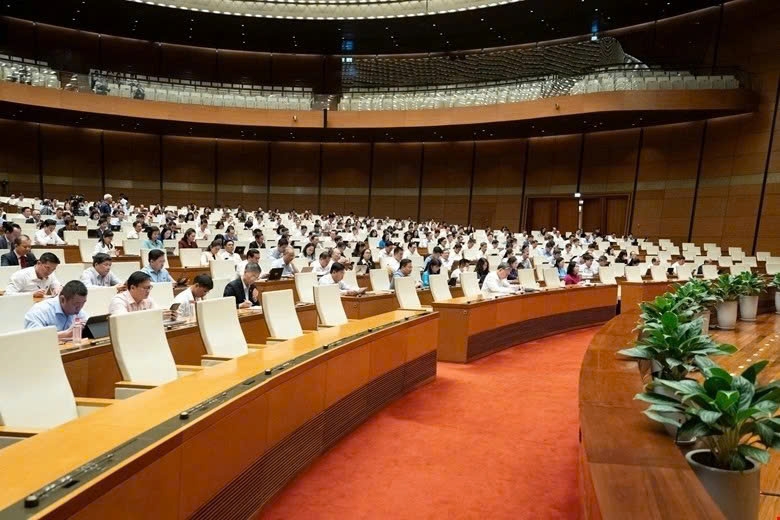
A total of 488 out of 492 deputies attending the ongoing session in Hanoi voted in favour of the law on April 23, reflecting strong consensus for a new governance framework for the capital.
The legislation is designed to increase the autonomy of Hanoi’s administration and ensure stricter control over pilot policies and the exercise of power. It reflects a shift in legislative thinking toward decentralisation combined with stronger checks and balances, as well as administrative reform and digital transformation.
Presenting the revised draft, Minister of Justice Hoang Thanh Tung said the law had been comprehensively refined to ensure constitutional consistency and alignment with the broader legal system, while placing citizens and businesses at the center of policymaking.
Under the new law, Hanoi authorities are given greater initiative in formulating and implementing policies, particularly in urban redevelopment, spatial planning, including underground space, and major infrastructure projects.
The law also introduces clearer provisions on regulatory authority, including the power of the municipal People’s Committee chairperson, and does not apply fast-track legislative procedures. It establishes enhanced mechanisms for inspection, supervision, and accountability, alongside limiting pilot policies to a maximum of five years and allowing for suspension in case of risks.
In the areas of finance and budgeting, the law maintains the principle of not exceeding the general tax policy framework, ensuring the central budget’s leading role. At the same time, it allows for more flexible budget management and targeted incentives to support priority sectors.
A notable addition is the introduction of a more open and flexible “Capital Region” model, enabling stronger regional linkages. The law permits the application of capital-specific mechanisms to inter-regional projects and allows local budgets to be used for cross-provincial investments in infrastructure, environment, and essential services.
The revised Capital Law is expected to provide a key legal foundation for Hanoi to develop in a more comprehensive and sustainable manner, reinforcing its role as the country’s political, economic and cultural centre.

Hanoi to begin phased rollout of low-emission zone from July 1
VOV.VN - Hanoi is preparing to implement a cautious, phased roadmap to regulate fossil fuel-powered vehicles, starting with the historic central area surrounding Hoan Kiem Lake.