Exhibition spotlights highland women’s role in climate-resilient ecotourism

The exhibition “Sowing green on cloudy peaks” opened at the Vietnamese Women’s Museum in Hanoi on March 27, showcasing the role of ethnic minority women in sustainable tourism and climate change adaptation.
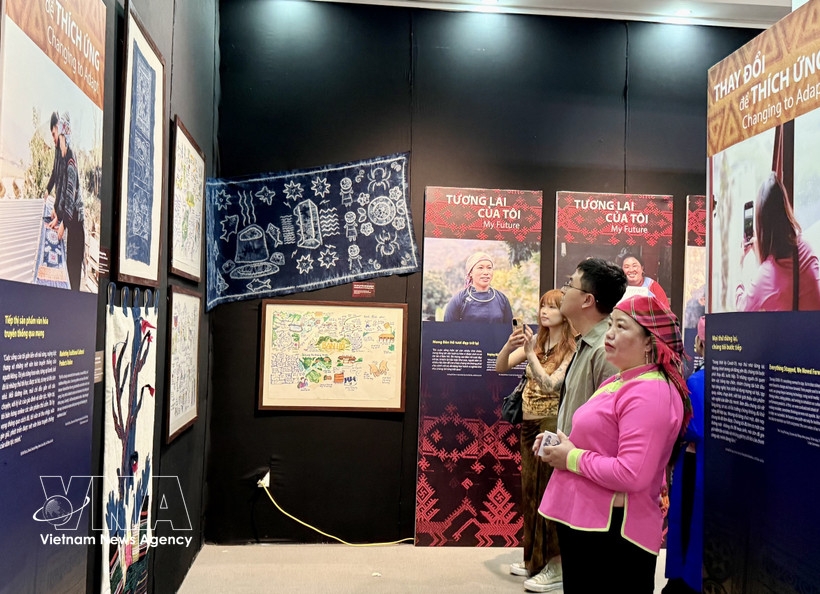
The exhibition comes as a result of a research project on ecotourism storytelling by Vietnamese women adapting to climate change, jointly conducted by the Central Institute for Natural Resources and Environmental Studies (CRES) under the Vietnam National University, Hanoi, the University of Hull, the Loughborough University, and the museum from July 2024 to December 2025.
It aims to support ethnic minority women in the buffer zone of Hoang Lien National Park in preserving natural and cultural heritage while recognising their pioneering role in developing livelihoods and sustainable tourism amid climate change challenges in Ta Van and Ban Ho communes of Lao Cai province.
Structured around three themes, the exhibition offers insights into both cultural identity and adaptation efforts. “On Cloudy Peaks” presents the living space, indigenous culture, and community life of ethnic groups including Mong, Dao, Giay, Thai, and Tay, highlighting the close ties between people, the nature, and long-standing traditions.
“Changing Skies and Earth – Changing Me” reflects the impacts of climate change and tourism on local life. It also underscores women’s adaptability, initiative, and creativity in sustaining livelihoods and preserving cultural values.
The final theme, “Sowing Green on Cloudy Peaks”, looks to the future of tourism, where community-driven efforts and women’s aspirations contribute to sustainable development.
In her opening remarks, Director of the Vietnamese Women’s Museum Nguyen Thi Tuyet said the exhibition reflects the trust and voices of highland women, who are quietly leading climate adaptation efforts through their daily lives.
They may not name their work as climate adaptation, but they are preserving cultural values, maintaining livelihoods, and promoting harmony with the nature, she said, noting that their changes are closely linked to the restoration of community heritage.
She added that the exhibition aims to foster public understanding of the human – nature relationship, the value of indigenous knowledge, and the growing role of women in climate change adaptation.
Associate Professor Dr. Bui Ngoc Quy, CRES Deputy Director, said the project, implemented over nearly two years in Ta Van and Ban Ho communes, explores how women contribute to biodiversity conservation and ecotourism development through traditional knowledge sharing and creative storytelling.
He noted that the exhibition serves not only to present research findings but also as a public dialogue space where highland life is conveyed through images, stories, and emotions.
Quy described it as an inspiring journey of Sa Pa’s women, whose efforts are helping preserve natural and cultural heritage while promoting sustainable tourism. He expressed his hope that visitors will better recognise the irreplaceable role of ethnic minority women, the challenges they face, and the potential for more balanced development between nature, culture, and livelihoods.

Exhibition spaces seen as untapped assets for Vietnam’s tourism industry
VOV.VN - Exhibition spaces in Vietnam are increasingly being seen as untapped assets for the tourism sector, as policymakers and experts explore ways to turn underused venues into experience-driven destinations.