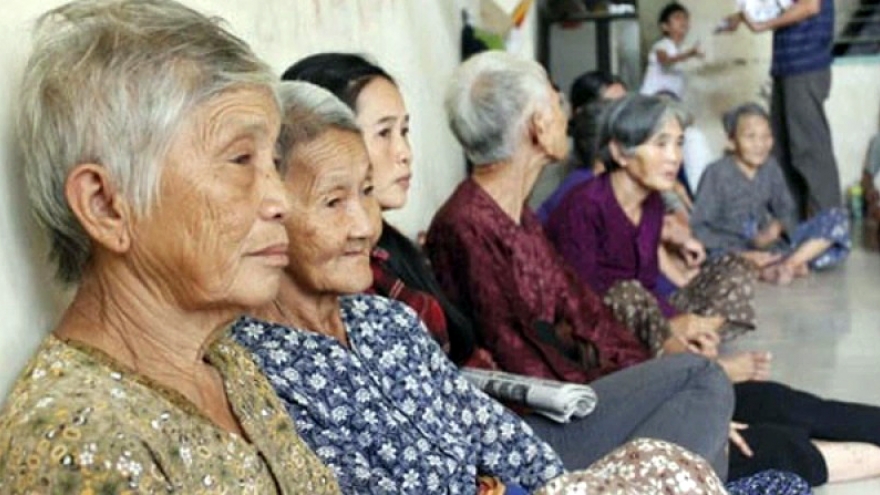
Vietnam faces population aging challenge as birth rate falls below replacement level

VOV.VN - Vietnam is facing growing concerns over a rapidly aging population as the country’s fertility rate remains below replacement level despite a slight recovery in 2025.
Demographic experts warn that without stronger long-term support policies for young families and the elderly, the country could face the risk of “getting old before getting rich,” a challenge that threatens future economic growth and social stability.
According to a five-year review report covering the 2020-2025 period released by the Ministry of Health, the national fertility rate declined from 2.11 children per woman in 2021 to just 1.91 in 2024, falling below the replacement threshold needed to maintain population stability.
The report shows significant regional disparities across the country. Eleven provinces and cities recorded fertility rates below two children per woman, while 19 localities remained above 2.2 children. Ho Chi Minh City reported the country’s lowest fertility rate at 1.51 children per woman, and Dien Bien recorded the highest at 2.91.
Rising costs and social pressure discourage young families

As living costs continue to rise and work pressure intensifies, many young Vietnamese couples are delaying childbirth or choosing not to have additional children. Experts said financial burdens linked to housing, education, health care and childcare have become major obstacles for young families, particularly in large urban centers.
Dr. Hoang Tu Anh, director of the Center for Creative Initiatives in Health and Population (CCIHP), said policies encouraging childbirth would only succeed if they directly address the real challenges facing younger generations.
According to her, reducing financial stress, childcare pressure and career concerns is more important than symbolic campaigns encouraging people to have more children. She emphasised that authorities need to better understand the needs and concerns of young families before designing effective population policies.
Dr. Tu Anh noted that concerns vary significantly depending on income levels, living conditions and social perspectives. In industrial zones, where large numbers of young workers are employed, many couples hesitate to have children due to the lack of affordable childcare facilities, schools and healthcare services.
She explained that many industrial parks still lack public daycare centres, while private childcare services are often expensive and inconsistent in quality. As a result, some parents are forced to send their children back to rural hometowns to be raised by relatives.
Vietnam should require childcare infrastructure to be integrated into industrial zone planning while encouraging businesses to provide family support services for workers, she suggested.
Financial incentives alone may not reverse falling birth rates
Several Vietnamese localities have introduced cash rewards and financial incentives to encourage childbirth. However, experts cautioned that such measures are unlikely to create lasting demographic change.
According to Dr. Tu Anh, international experience shows that one-time financial support programmes often encourage couples to have children earlier rather than increasing the total number of children they choose to have throughout their lives.
She pointed to the Republic of Korea, which has spent hundreds of billions of dollars on childbirth incentives since 2006, including cash payments, housing support and tax benefits. Despite these efforts, the country’s fertility rate fell to just 0.72 children per woman in 2023, the lowest level in the world.
Countries such as Japan and Netherlands have also introduced major financial support programmes with only temporary effects.
Beyond direct financial costs, Dr. Tu Anh highlighted the “motherhood penalty” faced by many women after childbirth. She explained that becoming a mother often affects women’s careers, income and promotion opportunities, making one-time financial incentives insufficient to offset long-term disadvantages.
Citing research from the International Labour Organisation published in 2022, she said 63% of women either quit their jobs or reduced working hours after giving birth, compared to just 8% of men.
She stressed that Vietnam needs a comprehensive strategy to sustainably encourage childbirth, including expanding daycare systems, reducing education costs, promoting shared parenting responsibilities and creating more family-friendly workplaces.
Vietnam’s population is aging rapidly

Vietnam is running out of time to fully benefit from its “golden population” period as the workforce begins to shrink while the elderly population expands rapidly. If low fertility trends continue over the next two decades, Vietnam could face serious pressure on healthcare systems, pension funds, social welfare programs and long-term economic growth.
According to forecasts, Vietnam could have approximately 18 million elderly citizens by 2045, accounting for 18% to 20% of the national population.
Dr. Tu Anh noted that older adults often suffer from multiple chronic illnesses, with people over the age of 80 commonly living with more than six medical conditions. The fact is that Vietnam’s geriatric healthcare system and specialised workforce remain limited, with only one central-level geriatric hospital currently operating nationwide.
She also warned that long-term elderly care services are severely underdeveloped. Fewer than 1% of older adults currently have access to public care facilities, while most caregiving responsibilities continue to fall on family members, particularly women.
In many rural communities, younger workers have migrated to major cities or overseas for employment, leading to situations where elderly people are increasingly caring for one another without professional support.
By 2045, Vietnam will need hundreds of thousands of professionally trained caregivers to meet the demands of an aging society, Dr. Tu Anh warned.
Experts call for long-term economic and workforce reforms
Economist Nguyen Tri Hieu said population aging is a global trend affecting countries from Japan to Germany. However, Vietnam faces a particularly difficult challenge because aging is occurring while average income levels remain relatively low.
As the elderly population expands, pressure on pension systems, healthcare spending and national budgets will continue to increase, potentially reducing resources available for younger generations and slowing long-term economic development, he explained.
At the same time, the economist argued that older adults should not simply be viewed as an economic burden. With advances in digital technology, remote work and artificial intelligence, many elderly citizens could continue contributing to society if given opportunities for retraining and flexible employment.
He said Vietnam should begin developing policies focused on reskilling older workers, expanding suitable employment opportunities and building a more age-inclusive economy.
As demographic pressures intensify, experts said Vietnam’s response over the next decade could determine whether the country successfully transitions into an aging yet prosperous society, or faces the long-feared scenario of “getting old before getting rich.”

Population aging in Vietnam opens major opportunity for ‘silver economy’ growth
VOV.VN - Vietnam’s rapidly aging population is expected to reshape the economy, creating both challenges and major opportunities for a fast-growing “silver economy” driven by senior consumption, healthcare, and workforce participation.