


Education Minister addresses xix key challenges facing the sector

VOV.VN - Education and Training Minister Hoang Minh Son has outlined measures to address six key challenges facing the education sector, including school facilities, teacher shortages, textbooks, examinations, school safety and strategic workforce development.
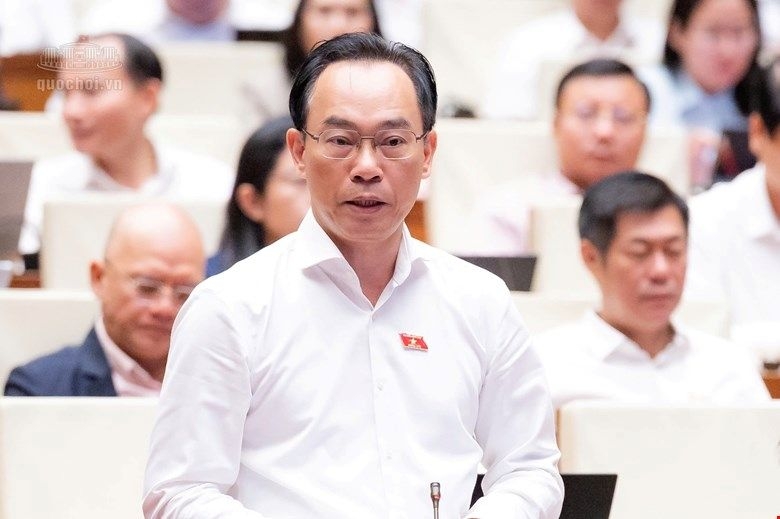
Speaking on October 31 during a National Assembly debate on socio-economic development and the state budget, Minister Son responded to deputies’ concerns and proposals, stressing the need for coordinated solutions to improve education quality, ensure equitable access and meet the country’s development needs.
Nearly 30,000 education managers reassigned to teaching
On school infrastructure, Son said the Ministry of Education and Training has instructed localities to review and prepare classrooms, facilities and teaching equipment in anticipation of the goal of universal upper secondary education.
A total of 108 multi-level boarding schools have been inaugurated in the first phase, with the model being expanded in disadvantaged and border areas. The ministry has also proposed criteria for prioritising resources under the National Target Programme to help localities upgrade schools and improve learning conditions.
To address teacher shortages, the education sector has reviewed staffing arrangements and reassigned nearly 30,000 education managers to direct teaching. The ministry is also guiding localities on the flexible redeployment of teachers between schools and areas to address localised imbalances in staffing.
In addition, the ministry is preparing a circular revising teacher staffing norms. This is intended to provide a more accurate assessment of workforce needs using sector-wide data and support proposals for additional recruitment quotas. Guidance has also been issued to help local authorities engage artisans, artists and sports coaches in educational activities under appropriate arrangements.
Free textbooks planned for the 2028–2029 school year
Regarding curricula and textbooks, Minister Son said the ministry has introduced a plan for a comprehensive review and revision. The curriculum revisions are expected to be completed in 2026, with the revised textbook series finalised in 2027 for nationwide use from the 2028–2029 school year.
Under the Prime Minister’s direction, students are expected to receive free textbooks from the 2028–2029 school year, one year earlier than the timeline stipulated in the Government’s decree.
On examinations and admissions, the minister assured that the ministry would continue improving assessment quality and strengthening measures to prevent cheating and misconduct. It has advised the Prime Minister to issue a directive reinforcing efforts to prevent fraud in examinations and the assessment of learning outcomes.
National Assembly deputies also raised questions about how the high school graduation examination should be evaluated alongside continuous assessment, university admissions and student streaming. Any changes to examination and admissions policies, they argued, should be carefully assessed and introduced according to a suitable roadmap so that students, parents and schools can prepare.
Strengthening school safety and online child protection
Addressing concerns about school safety, Minister Son informed that the ministry is seeking feedback on a forthcoming circular governing meals for boarding and semi-boarding students, including food hygiene and safety requirements.
To tackle school violence and online safety risks, the ministry is working with the Ministry of Public Security and other relevant agencies to strengthen the legal framework and clarify responsibilities for protecting students.
The ministry plans to propose amendments to the Government’s Decree No. 80, with a view to strengthening school violence prevention and clarifying the responsibilities of schools, families and local authorities in creating safe, healthy and supportive learning environments.
Training talent for strategic industries
On workforce development, Son said the ministry has advised the Government to issue Decree No. 179 on scholarships for students pursuing basic sciences, key engineering disciplines and strategic technologies. The policy aims to make these fields more attractive to students and help meet the country’s long-term development needs.
For sectors such as agriculture and biotechnology, localities and relevant ministries can use commissioned training arrangements linked to employment outcomes and practical workforce demand. This approach is expected to help bridge the gap between training and employers’ needs while developing highly skilled personnel for strategic sectors.
In his response to the National Assembly, the minister underscored the need for coordinated action on infrastructure, teacher staffing, curricula and textbooks, examinations, school safety and workforce development to improve the quality and effectiveness of Vietnam’s education system.
National Assembly to review 2026 socio-economic performance, 2027 targets
VOV.VN - The National Assembly of Vietnam is scheduled to discuss the implementation of the country’s 2026 socio-economic development plan and the proposed plan for 2027 on October 30, alongside the state budget and public investment, as lawmakers review economic performance and consider priorities for the coming year.


