




Vietnam’s first strategic health technology product completes Japan transfer early

VOV.VN - Cell technology, a national strategy approved by the Government, has been transferred to the Tam Anh General Hospital Group by Japan’s Grandsoul Group on an exclusive, comprehensive and in-depth basis. The transfer took place on Nov. 9, witnessed by Party General Secretary and State President To Lam and senior Vietnamese and Japanese leaders.
The Tam Anh General Hospital Group has become the first and only institution in Vietnam to be selected, on an exclusive basis, for the comprehensive transfer of core stem cell and immune cell technologies from a leading Japanese group, opening up new opportunities for treating cancer and chronic diseases and improving the health of people in Vietnam.
Mastering cell technology (stem cells and immune cells) to treat cancer, chronic diseases and intractable diseases is a national strategy approved by the Government for implementation from 2026 to 2030. The comprehensive and in-depth transfer of core cell technology from Japan is good news: Vietnam has its first strategic technology product to “reach the finish line” early, with the technology transfer completed.

Japan is one of the pioneering countries in researching and developing stem cell and immune cell technologies in regenerative medicine and cancer treatment, with three Nobel Prizes in Physiology or Medicine in the field to its name. Receiving the transfer of immune cell technology from Japan is the next step forward in Tam Anh’s strategy to build a high-tech healthcare ecosystem, particularly in oncology.
Earlier, Tam Anh General Hospital beat out dozens of leading institutions in Asia to be selected by Japan’s Grandsoul Medical Group as its sole partner in Vietnam for investment cooperation and the comprehensive transfer of core stem cell and immune cell technologies in line with high-level Japanese standards, ushering in a “revolution” in technology for treating cancer and many chronic diseases and for improving health.
Mr. Ngo Chi Dung, Chairman of the Board of Directors of the Tam Anh General Hospital Group, said the result was made possible by the resolutions of the Party Central Committee and the Government, which have helped private enterprises boldly invest in national strategic technologies. Receiving the full transfer of a new technology not only signifies mastery of core technology in a field but could also pave the way for a process of Vietnam-Japan strategic cooperation in joint research, investment and development.
Prof. Matsuo Yoshinobu, PhD, a leading scientist at the Grandsoul Medical Group and Senior Technology Expert at the Grandsoul Research Institute for Immunology in Nara, said stem cell and immune cell technologies impose particularly stringent requirements for expertise and quality control. In his assessment, the Tam Anh General Hospital Group has a technology platform, personnel and quality control processes that are rigorous and systematic, providing favorable conditions for acquiring and developing advanced technologies from Japan in a highly professional and rapid manner.

The two sides chose to transfer new-generation cell technologies that have been researched, developed and applied by Japan’s Grandsoul Medical Group. The technologies have been approved by Japan’s Ministry of Health, Labour and Welfare (MHLW) and licensed for official application in the country for many years. The focus is on two groups: technology for the isolation, culture and selective differentiation of adipose-derived mesenchymal stem cells (MSCs), and technology for the isolation, culture and selective differentiation of innate immune cells known as natural killer (NK) cells for cancer treatment.
Mesenchymal stem cell (MSC) technology is currently being researched and developed for a range of applications related to cardiovascular and neurological conditions (stroke, dementia), diabetes, chronic obstructive pulmonary disease (COPD) and skin rejuvenation, among others. The solution using innate immune NK cells opens up new opportunities for application in immunotherapy and can be combined with other methods of multimodal cancer treatment, such as surgery, chemotherapy, radiotherapy and targeted therapy.
According to Pham Xuan Dung, MD, PhD (Specialist Level II), Director of the Oncology Center at Tam Anh General Hospital Ho Chi Minh City, immunotherapy is becoming one of the important avenues of progress in modern cancer treatment. This technology is now being applied increasingly widely in cancer treatment, contributing to changes in treatment strategies and improved outcomes in many types of cancer, such as lung, stomach, colorectal, bladder, kidney, liver and breast cancer. The advantage of immunotherapy lies in its ability to recognize cancer cells and help the immune system destroy them selectively.
Prof. Ta Thanh Van, MD, PhD, Chairman of the Professional Council of the Regenerative Medicine and Cell Therapy Center at Tam Anh General Hospital Hanoi and a leading Vietnamese expert in stem cells and immune cells, said Tam Anh General Hospital has built its tissue and cord blood bank, licensed by the Ministry of Health to operate since 2019. In parallel, the Regenerative Medicine and Cell Therapy Center has also been built and vigorously developed.

Each year, Vietnam records about 180,000 new cancer cases and more than 120,000 deaths; about 1.6 million people have heart failure, and the stroke rate stands at 1,541 per 100,000 people. In addition, about 8 million people have diabetes, and more than 5% of people over 60 have dementia, among other conditions.
According to Prof. Ta Thanh Van, the cell technologies are intended to be applied at five facilities of the Tam Anh General Hospital Group in Hanoi and Ho Chi Minh City, which handle more than 10,000 patient visits a day, helping Vietnamese people access modern technology right in their own country at a reasonable cost and promoting medical tourism.
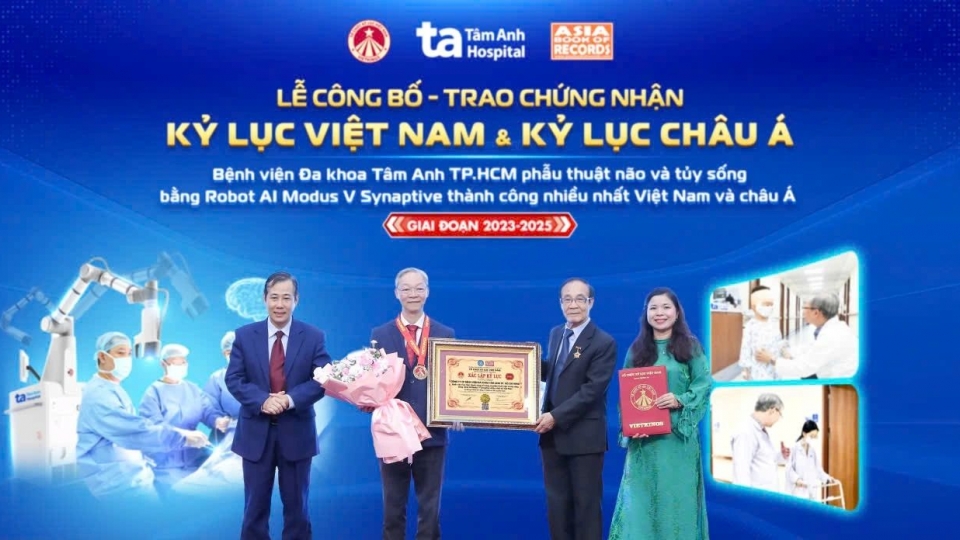
Tam Anh Hospital sets Asia record in AI-assisted neurosurgery
VOV.VN - Ho Chi Minh City-based Tam Anh General Hospital has been recognised by the Asia Book of Records and the Vietnam Book of Records for performing the highest number of AI-assisted cranial and spinal surgeries in Vietnam and Asia.


