Vietnam, Laos boost investment ties to enhance East–West Corridor connectivity

Efforts to strengthen economic, trade and tourism cooperation between Vietnam and Laos were highlighted at a forum on investment, trade and tourism cooperation to promote East–West Economic Corridor (EWEC) connectivity, held on April 3 in Champasak province, southern Laos.
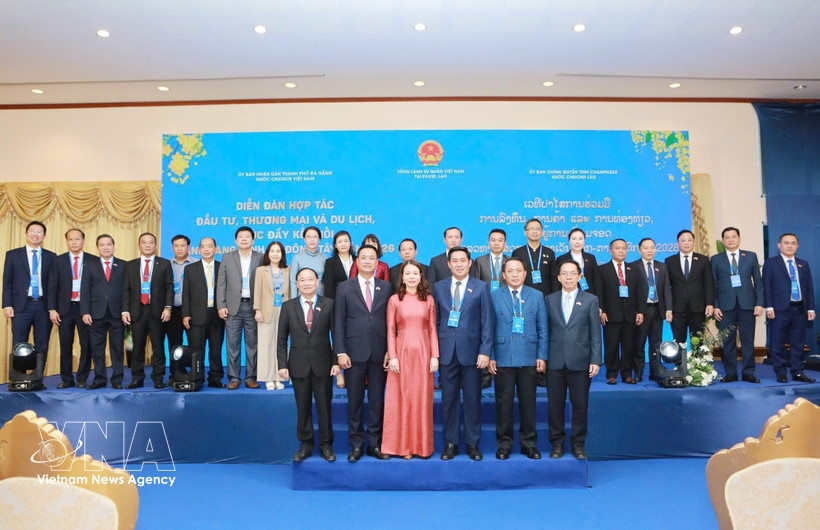
The event was jointly organised by Da Nang city, the Consulate General of Vietnam in Pakse and the Champasak provincial authorities, drawing nearly 400 delegates from ministries and agencies of both countries, representatives from 12 Vietnamese localities, five south-central Lao provinces of Champasak, Sekong, Salavan, Attapeu and Savannakhet, as well as Thailand’s Ubon Ratchathani province.
The forum served as an important platform to enhance connectivity and promote investment, trade and tourism ties along the EWEC, while supporting businesses in market exploration, product promotion and export expansion to Laos and Northeast Thailand.
In his opening remarks, Vice Chairman of the Da Nang People’s Committee Phan Thai Binh underscored that the EWEC is not only a trans-Asian transport route but also a dynamic development space with geo-economic, geopolitical and cultural advantages. Stretching from Myanmar through Thailand and Laos to Vietnam, the corridor plays a vital role in strengthening regional connectivity, expanding trade, attracting investment and promoting sustainable tourism.
He stressed that amid rapid global shifts in economic structures, technology and supply chains, enhancing intra-regional connectivity and unlocking the corridor’s full potential has become more urgent than ever. This presents both an opportunity and a shared responsibility for localities in Vietnam and Laos to build an open, flexible and efficient cooperation space.
As the eastern gateway of the EWEC, Da Nang has identified its role in driving regional connectivity and bringing into full play existing advantages. The city has also prioritised fostering its special ties with the five south-central Lao provinces, with collaboration spanning investment and trade, particularly in agriculture, services and logistics, as well as education, healthcare, culture, social welfare and infrastructure development.
The forum provided an open and practical dialogue platform for policymakers, local authorities and the business community to exchange visions, propose innovative solutions and strengthen partnerships, he added.
At the event, participants proposed measures to improve policies in investment, trade, tourism and logistics to better tap the corridor’s potential.
Tourism was identified as a sector with significant growth potential, capable of generating added value for localities along the 1,450-km corridor linking Vietnam, Laos, Thailand and Myanmar.
A highlight of the event was the signing of more than 20 memoranda of understanding between Da Nang, Vietnamese localities and Lao partners for the 2026–2030 period.
On the sidelines, the Vietnam–Laos Trade and Tourism Fair 2026 took place from April 3-5, featuring around 60–70 booths showcasing OCOP (One Commune One Product) and ODOP (One District One Product) products, national-brand goods, garments, electronics, machinery, handicrafts and consumer services.

Quang Tri: Trade fair connects with EWEC countries
A fair on industry and trade in the Northern Central Coastal region was launched in Dong Ha City, Quang Tri province, on July 8, featuring around 500 exhibition booths run by nearly 240 domestic and international businesses.