Two earthquakes recorded in Quang Ngai on May Day

VOV.VN - Two earthquakes were recorded in the central province of Quang Ngai on May 1, indicating that seismic activity in the region shows no signs of abating.
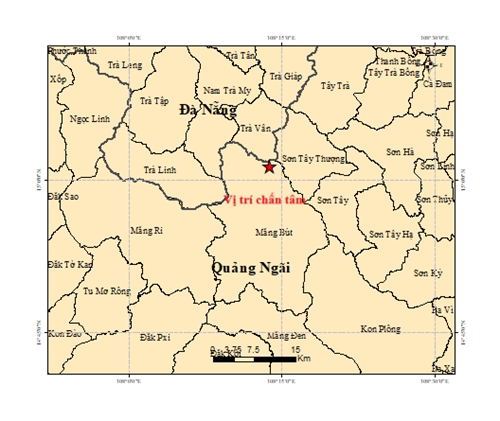
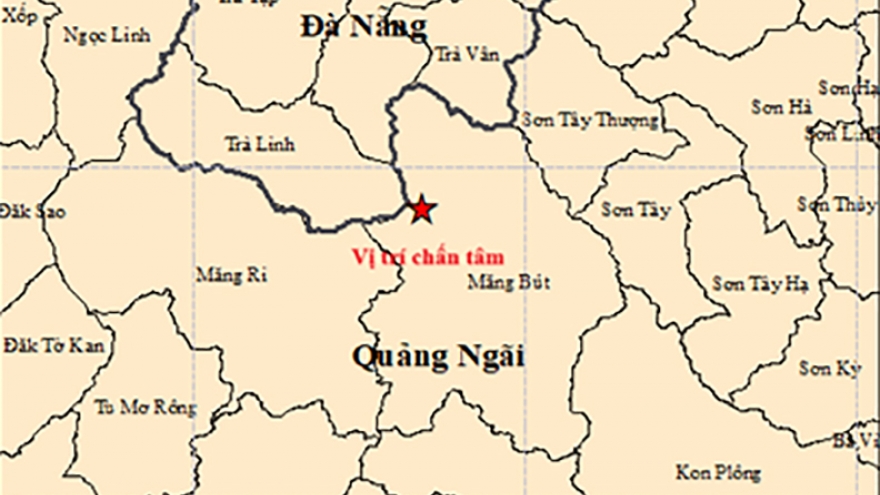
The tremors occurred in Mang But commune, with magnitudes of 3.0 and 3.1 respectively, and the focal depths were measured at approximately 8.1 to 8.2 kilometers, according to the Earthquake Information and Tsunami Warning Centre under the Vietnam Academy of Science and Technology’s Institute of Earth Sciences.
Authorities assessed both events as level 0 natural disaster risk, indicating no significant threat.
Earlier in April 2026, the system recorded around 20 earthquakes in Quang Ngai province, affecting several communes including Mang But, Mang Den, Mang Ri, Son Tay Thuong, and Kon Plong.
The recent tremors are not isolated events. Since early 2026, multiple earthquakes have been recorded in the Mang But area, at times occurring in clusters within a single morning. Magnitudes have generally ranged between 2.5 and 4.0, with occasional stronger events approaching magnitude 5.0.
This pattern suggests not only repeated seismic activity but also a clustered behavior, with periods of heightened frequency followed by relative calm.
Over the longer term, Mang But, located near the border with Kon Plong, has recorded hundreds of small earthquakes since 2021. The strongest event to date has reached approximately magnitude 5.0, showing that the region is no longer experiencing only minor, isolated tremors.
According to experts, most earthquakes in Mang But are classified as induced seismicity, potentially linked to hydropower reservoir operations in the region.
The accumulation of large water volumes in reservoirs is believed to increase pressure along geological fault lines, triggering small-scale fault movements and resulting in tremors. Such seismic activity typically occurs in cycles, alternating between periods of relative calm and bursts of frequent earthquakes.
Although most recent tremors remain minor and have not caused significant damage, experts caution that the phenomenon is likely to persist in the long term. The possibility of earthquakes exceeding magnitude 5.5 is considered low, but continued high-frequency activity could still pose indirect risks.
Local authorities and scientific agencies are maintaining close monitoring of the situation, while also calling for further research and improved risk assessment frameworks.
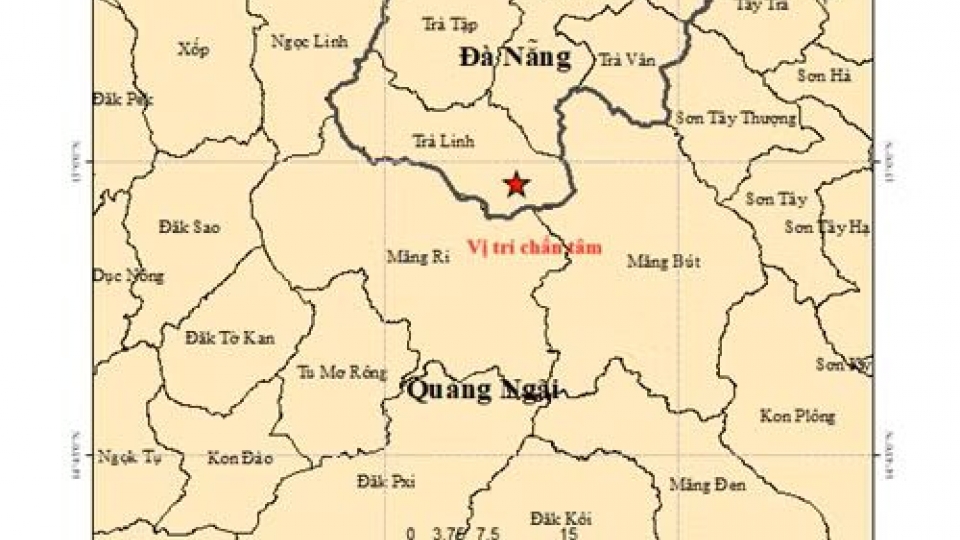
Five earthquakes hit Da Nang, Quang Ngai early on April 22
VOV.VN - Five earthquakes were recorded in Tra Linh commune in Da Nang city and Mang But commune in Quang Ngai province between around 5 a.m. and after 8 a.m. on April 22.