Unit performance measures leaders’ capacity and integrity

VOV.VN - Early implementation of the 14th National Party Congress Resolution requires a strong renewal in thinking on lawmaking and law enforcement, the promotion of socialist democracy, and the personalization of accountability of those in charge.
Turn institutions from bottlenecks into drivers of development
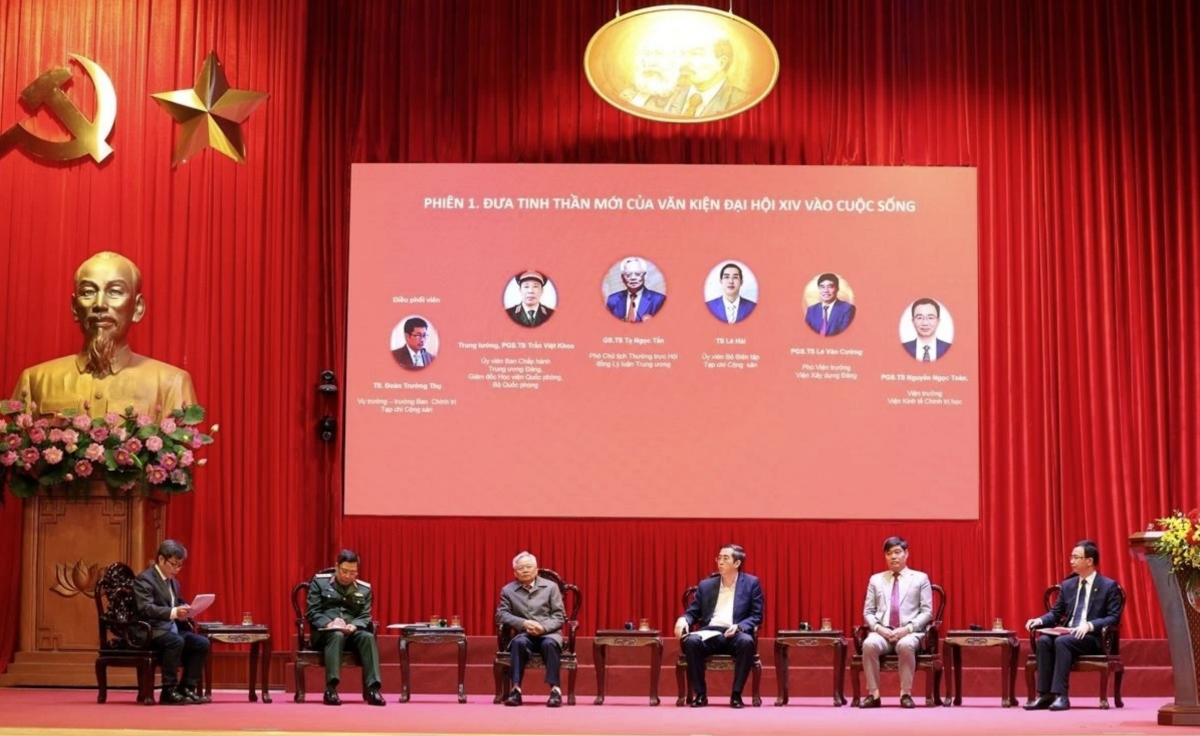
Speaking at a seminar on solutions to bring the 14th National Party Congress Resolution into life, Assoc. Prof. Dr. Nguyen Ngoc Toan, Director of the Institute of Political Economics, said institutional reform must be identified as a breakthrough, turning institutions from a bottleneck into a driver of development, even a national competitive advantage.
“When we speak of institutions, we are referring to lawmaking and law enforcement. The Party Central Committee and the Politburo have issued many resolutions on this issue. However, I want to stress the responsibility of advisory bodies involved in drafting laws and agencies that promulgate them. That responsibility must be closely tied to the quality of each policy and each legal document issued.
Lawmaking and enforcement must take practical effectiveness as the yardstick and thoroughly grasp the spirit of a facilitating and service-oriented State. When issuing a guideline, policy or legal document, we must place ourselves in the position of citizens and businesses to consider: Is this policy truly enabling? Does it create favorable conditions for development, or does it generate additional barriers, costs and difficulties?” Nguyen Ngoc Toan said.
He agreed with developing key performance indicators for the issuance and enforcement of laws. There must be tools to assess whether a policy or legal document truly supports development and creates conditions for citizens and businesses, or merely exists on paper.
In practice, some legal normative documents have encountered obstacles immediately after implementation, causing difficulties. A typical example is regulations related to agricultural import and export activities at border gates. This shows that shortcomings remain in policy drafting and review and require timely adjustment. The legal system therefore needs to be reviewed regularly. Provisions that cause difficulties must be dealt with immediately. Areas that remain lacking, particularly new fields, require prompt guiding documents and appropriate pilot mechanisms.
Assoc. Prof. Dr. Pham Thi Thuy Nga, Director of the Institute of State and Law, also said the approach to drafting and evaluating laws needs to change. It should shift from issuing laws based on plans, programs or proposals of agencies such as the Government, ministries and sectors to issuing laws to operate and resolve practical problems.
Evaluation should not stop at whether a law is promulgated on schedule. More importantly, it must consider whether the law removes bottlenecks and what socio-economic results are achieved after it takes effect.
She also emphasized the need to build mechanisms for feedback, supervision and policy evaluation from society. A policy only truly enters practice when mechanisms allow citizens, businesses and the community to participate in feedback, supervision and evaluation. Through opinions from enterprises and the public, it is possible to accurately assess the effectiveness of the legal and policy system, whether a policy enters life, gains social support, and truly brings benefits to citizens and businesses.
Legal system ensures democracy is implemented effectively
At the same seminar, Dr. Le Hai of the Communist Review said the promotion of socialist democracy continues to be emphasized in the documents of the 14th National Party Congress. The content inherits previous congresses while being elevated to a new level.
In the context of the requirement to build a socialist rule-of-law State, consolidating and promoting socialist democracy is not only a long-term objective but also a regular and urgent task. Democracy must be guaranteed by effectively operating institutions, in which the supervisory and social criticism roles of the Vietnam Fatherland Front and socio-political organizations are very important.
Le Hai said that when the country sets the goal of becoming a developed, high-income country by 2045, democracy must also reach a new level. The people’s right to mastery must be exercised in a more substantive manner, avoiding manifestations of formalistic democracy.
At the same time, the legal system of the socialist rule-of-law State needs to be built to be truly progressive, civilized and modern. The practice of democracy should go hand in hand with strengthening the rule of law and ensuring social discipline.
The legal system is the condition that ensures democracy is implemented effectively. Democratic practice should advance to a level where socialist democracy and respect for the law become cultural values throughout society. This is a step-by-step process associated with overall social development.
However, in the new era, it needs to be promoted more strongly for democracy and respect for the law to truly become cultural norms.
Assoc. Prof. Dr. Nguyen Hoang Hien, Party Secretary of the Academy of Social Sciences, said that to bring the 14th National Party Congress Resolution into life soon, mechanisms for inspection and supervision are needed so that heads bear responsibility.
The performance of a unit serves as a measure of the leader’s capacity and integrity. If the Resolution does not take effect in a locality or sector, the head must bear political responsibility and may even have to resign.
“Responsibility of heads must be linked to the results of implementing the Resolution and regarded as an important criterion in cadre evaluation, planning, appointment and promotion. Those who perform well and see tasks through must be rewarded promptly, while heads who are sluggish or who ‘say without doing’ must be replaced immediately.
In addition, the supervisory role of the people, the Vietnam Fatherland Front, the press and socio-political organizations must be promoted, creating positive social pressure that prevents heads from acting in a perfunctory manner or evading responsibility,” Nguyen Hoang Hien said.

Strategic priorities for national infrastructure under 14th National Party Congress
VOV.VN - Identifying infrastructure development, particularly multimodal transport, as one of the strategic breakthroughs, the Resolution of the 14th National Party Congress sets out to build a solid foundation for rapid and sustainable socio-economic growth, strengthen national competitiveness and improve people’s quality of life.
Vietnam releases all 14th National Party Congress documents
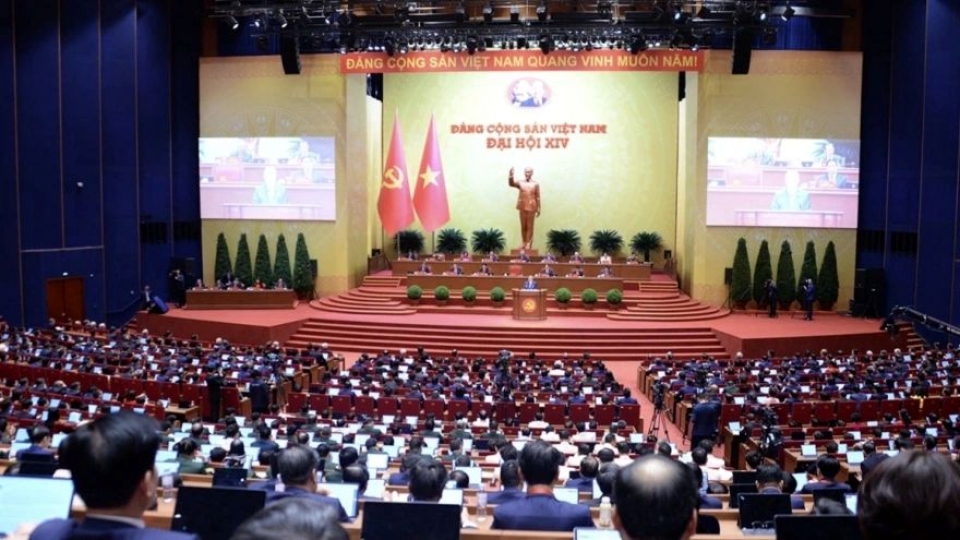
VOV.VN - The Office of the Communist Party of Vietnam Central Committee on February 6 published the full documents of the recent 14th National Party Congress, including the Congress Resolution, the Political Report, a report reviewing 40 years of Đổi mới (Renewal), and a report on the Party Charter.