Vietnam deepens rule-of-law reforms to strengthen accountability

VOV.VN - Vietnam is stepping up efforts to strengthen its rule-of-law state, with policymakers emphasising legal clarity, institutional accountability and greater citizen engagement as central pillars of governance reform.

In an interview with VOV.VN, National Assembly deputy and Ho Chi Minh City Justice Department Director Nguyen Thi Hong Hanh said Vietnam’s next phase of legal reform must move beyond formal compliance to ensure that laws are practical, transparent and responsive to social and economic realities.
She pointed to recent Party resolutions acknowledging persistent challenges in lawmaking and enforcement, including overlapping regulations, administrative complexity, inconsistent decentralisation and gaps between policy design and enforcement. Addressing these bottlenecks, she said, is essential to improving state effectiveness and public trust.
Ho Chi Minh City, Vietnam’s largest economic hub, has identified institutional reform as a priority for 2026. Local authorities are refining legislative drafting procedures, separating policy design from technical drafting, and strengthening impact assessment to ensure that new regulations are coherent and enforceable. The city is also expanding public communication on major policies and encouraging feedback from citizens, businesses and civil society organisations.
Hanh pointed out that improving implementation is as important as drafting new legislation. Authorities are increasing dialogue with businesses and residents, conducting post-implementation reviews of legal documents and expanding digital tools to detect and resolve regulatory obstacles more quickly.
Vietnam’s long-term objectives, outlined in the Politburo’s Resolution 66, include building a legal system that is transparent, unified and aligned with international standards by 2030, and developing a high-quality, modern legal framework by 2045. The reform agenda seeks to balance state management with economic dynamism, placing citizens and enterprises at the centre of policy formulation.
In the economic sphere, Hanh said, lawmakers are prioritising regulatory simplification, lower compliance costs and improved access to capital, land and skilled labour, particularly for small and medium-sized enterprises. Legal frameworks are also being updated to support innovation, digital transformation, artificial intelligence, green transition and emerging financial models.
At the same time, decentralisation is being expanded under a principle that local authorities should have clearer decision-making power alongside stronger accountability mechanisms.
Power control and anti-corruption safeguards remain integral to the reform agenda. Recent internal regulations emphasise clearer delineation of authority, enhanced transparency in sensitive sectors such as land management and public investment, and strengthened oversight, auditing and inspection mechanisms. Officials say digitalisation of public administration is expected to improve transparency and reduce opportunities for misconduct.
Hanh stressed that grassroots democracy is critical to ensuring that governance reforms translate into tangible benefits. Expanding public consultation, strengthening social supervision and ensuring that citizens can access information and provide feedback are viewed as essential to reinforcing legitimacy and trust.
Vietnam’s reform strategy reflects a broader effort to modernise state institutions while sustaining economic growth. Policymakers argue that effective rule-of-law governance, combined with accountable power structures and meaningful public participation, will be key to supporting the country’s next stage of development.
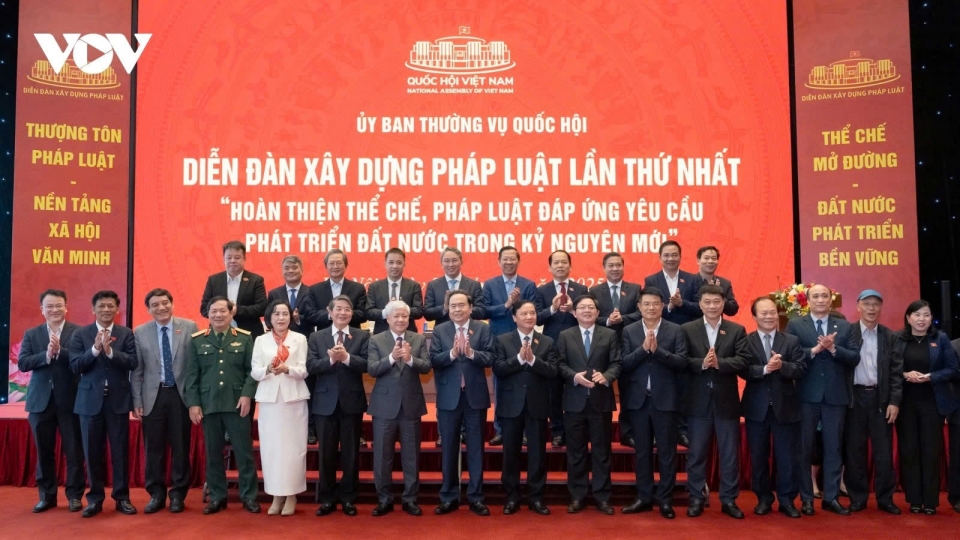
Lawmaking forum seeks to strengthen legal system for sustainable development
VOV.VN - National Assembly Chairman Tran Thanh Man presided over the first lawmaking forum in Hanoi on November 22, aiming to evaluate legislative work, strengthen institutional frameworks, and enhance the implementation of laws amid international integration and digital transformation.