NA Chairman attends groundbreaking ceremony for Hanoi mega infrastructure project

VOV.VN - National Assembly Chairman Tran Thanh Man, alongside senior officials of Vietnam and Hanoi, attended a groundbreaking ceremony for the National Highway 1A Urban Corridor Project in Hanoi on May 19.
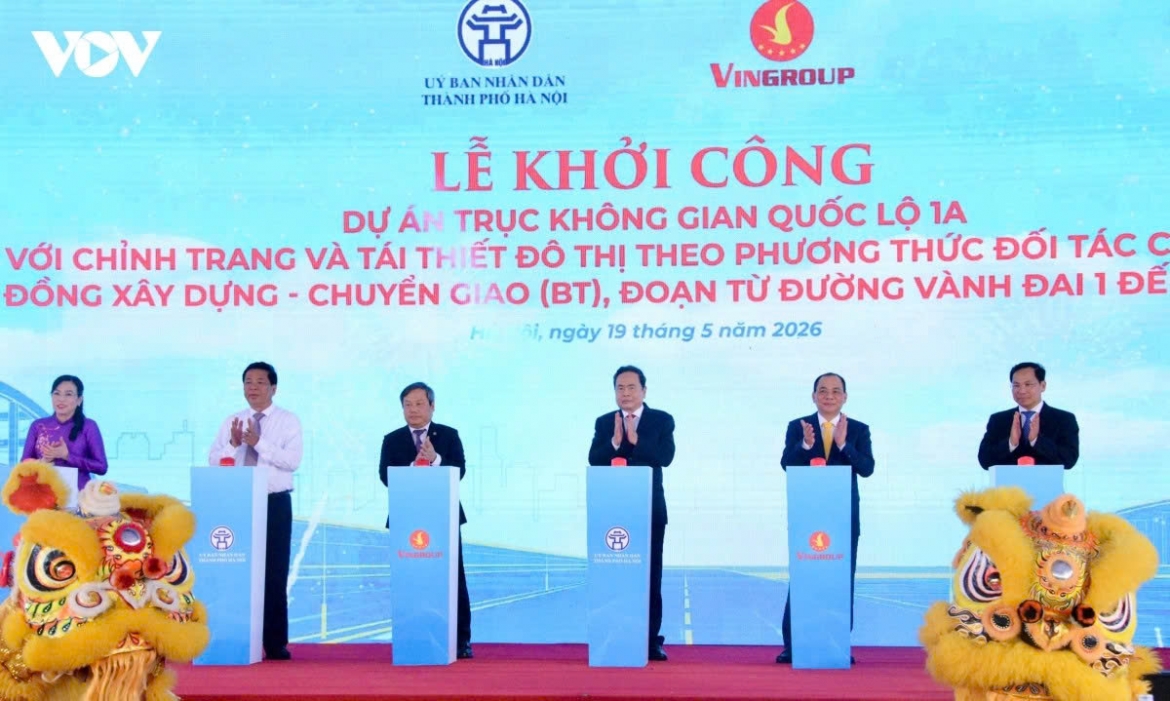
The project, an ambitious infrastructure and urban redevelopment initiative implemented under the public-private partnership (PPP) model using a build-transfer (BT) contract format, stretches from Ring Road 1 to the Phap Van–Cau Gie interchange and is regarded as one of the most strategically significant transport infrastructure projects for southern Hanoi in the coming development phase.
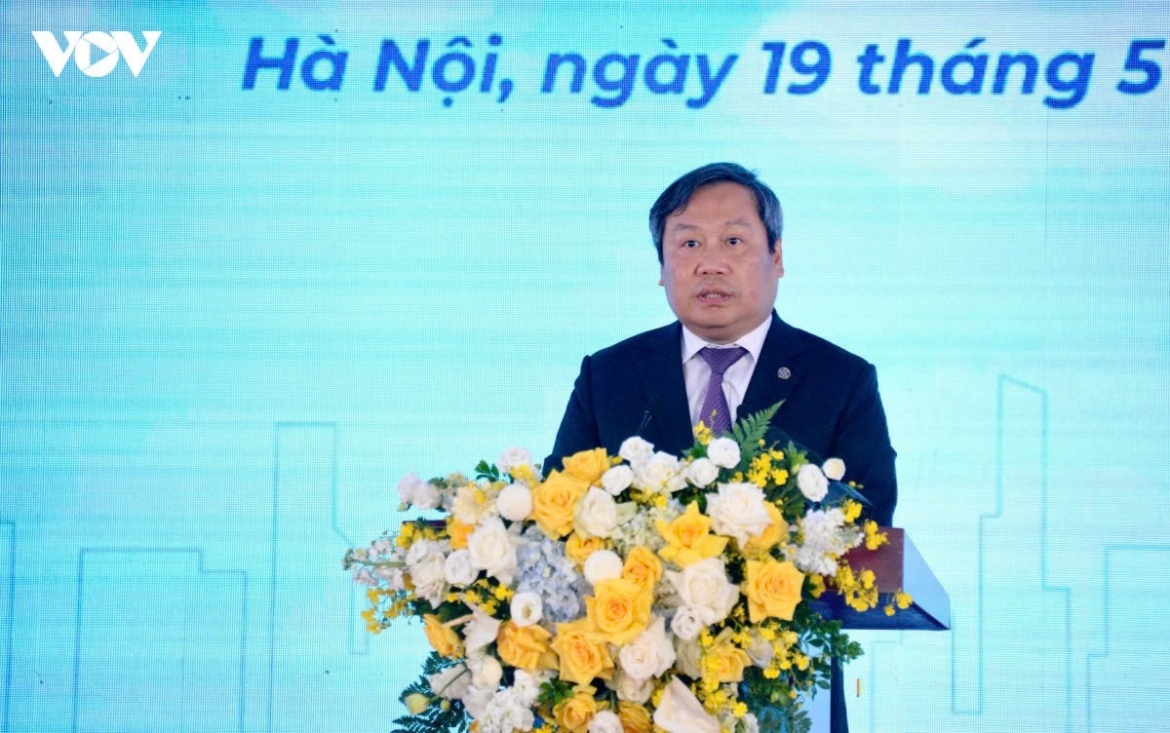
Speaking at the ceremony, Chairman of the Hanoi People’s Committee Vu Dai Thang emphasised that the project holds special importance for Hanoi’s urban spatial development strategy, regional connectivity, and modernisation of the capital’s southern infrastructure system.
According to him, transportation infrastructure has always played a foundational role in economic growth and urban transformation. Modern transport corridors not only improve mobility but also create new development spaces, stimulate commerce, logistics, and services, and enhance both quality of life and urban competitiveness.
As Hanoi enters a new development stage, the city faces increasing pressure to restructure its urban space toward a greener, smarter, and more interconnected model. Rapid urbanisation, strong population growth, and rising regional connectivity demands have placed significant strain on the existing infrastructure network, particularly at key gateway areas of the capital.
The southern area of Hanoi is considered strategically important as a transport hub connecting the capital with major economic centres nationwide. However, the National Highway 1A section passing through Hanoi has faced severe congestion for many years, negatively affecting traffic capacity, logistics operations, and urban planning.
Thang stated that the launch of the project demonstrates the city’s strong determination to address infrastructure bottlenecks and establish the foundation for a more synchronised and modern development phase with a long-term vision.
The project has a total length of approximately 36.3 kilometers, passing through 18 wards and communes in Hanoi, with total investment estimated at nearly VND162 trillion. The corridor is designed as a modern integrated urban infrastructure project that combines transportation development with urban redevelopment and spatial economic planning.
City authorities expect the new corridor to become a major growth driver for southern Hanoi, helping form new economic development zones, expand logistics and commercial activities, and improve overall urban living standards.
The Hanoi leader also highlighted the city’s continued efforts in recent years to develop strategic infrastructure, including ring roads, bridges across the Red River, urban railway systems, and other key transportation projects. However, he stressed that future development requires stronger mobilisation of social resources, particularly through public-private partnerships.
The Hanoi chairman praised Vingroup’s proactive role and commitment in proposing and implementing the strategic project, describing the group’s participation as a demonstration of corporate responsibility and confidence in Hanoi’s future development.
The city is committed to facilitating the project’s implementation to ensure construction quality, safety, and timely completion, he said.
According to project plans, the corridor is expected to be completed by 2027 with a total of 16 lanes. The route will feature a cross-section width of up to 90m, including 10 main traffic lanes and six parallel service lanes, with a designed speed of 80km per hour.
Nguyen Viet Quang, Vice Chairman and CEO of Vingroup, stated Vingroup is honoured to participate in the project, which aims not only to improve transportation but also to comprehensively reshape a modern and synchronised urban development corridor at Hanoi’s southern gateway.
The National Highway 1A–Phap Van–Cau Gie corridor has been identified in Vietnam’s national planning framework as a key economic axis linking Hanoi with southern provinces and coastal regions, supporting the development of logistics, supporting industries, and multimodal transport systems.
In future phases, Hanoi and Vingroup are expected to study extending the route further north from the Le Duan–Dien Bien Phu intersection in Ba Dinh Ward to Dai Co Viet Street, increasing the total corridor length to approximately 38.8km and linking Hanoi’s historic centre with emerging southern growth zones.
The project is also expected to integrate advanced technologies throughout construction and operations. Survey work will utilize UAV and aerial imaging technology, while design processes will apply modern 3D modeling systems. Construction supervision will be conducted through online monitoring platforms, and the corridor will eventually operate under a smart transportation management system using SCADA, CCTV, and international-standard traffic control solutions.

Hanoi unveils unprecedented interregional transport network plan
VOV.VN - Hanoi has announced an ambitious new master plan featuring large-scale interregional transport corridors and railway systems designed to reshape the capital’s long-term development landscape.