Hanoi approves capital master plan with 100-year vision

VOV.VN - Chairman of the Hanoi People’s Committee Chairman Vu Dai Thang signed a decision on May 13, 2026 approving the Hanoi Capital Master Plan with a 100-year vision, outlining development under an open urban model with a “multi-layered, multi-polar and multi-centered” structure, with the Red River serving as the city’s main ecological and cultural landscape axis.
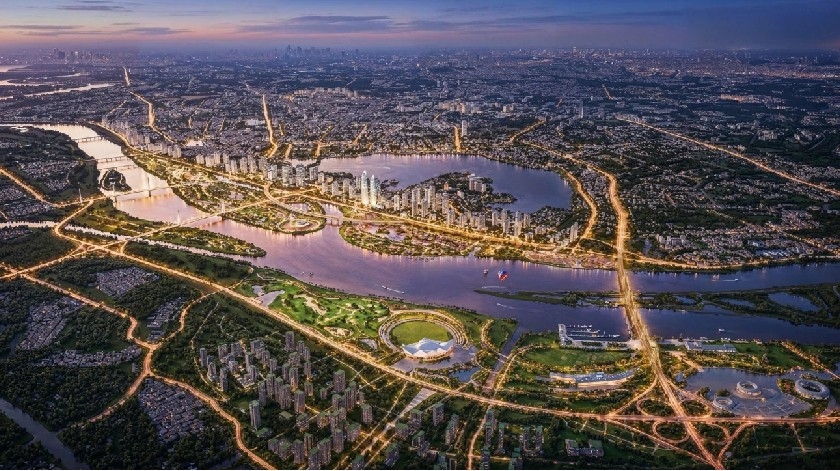
The plan covers Hanoi’s entire administrative area of about 3,360 sq.km while strengthening links with the Hanoi Capital Region, the Red River Delta, the Northern Midlands and Mountainous Region, and national and international economic corridors, with Hanoi positioned as the core driver of the wider region.
Under the plan, Hanoi’s population is projected to reach around 14-15 million by 2035 and 17-19 million by 2065, while long-term population levels are intended to remain below 20 million. The city could also accommodate up to 22-25 million people, including temporary residents, workers, tourists and visitors coming for study and healthcare services.
The plan emphasizes green growth, environmental protection, biodiversity conservation and climate adaptation. Hanoi is also expected to coordinate regional efforts to control environmental pollution.
By 2035, the capital is expected to become a green, smart and modern city with high competitiveness and greater international integration. It is also envisioned as home to major centers for education, healthcare, finance, trade, innovation and research at the national, regional and international levels.
Looking ahead to 2045, Hanoi is envisioned as a major innovation hub in the Asia-Pacific region with modern infrastructure and urban governance. By 2065, the city is expected to become a global city with a high and sustainable level of development and among the world’s capitals with a high quality of life.
Transport infrastructure remains one of Hanoi’s strategic priorities under the plan. The city will develop an integrated transport system, promote multimodal transport and expand urban railway links to neighboring localities including Bac Ninh, Hung Yen, Ninh Binh, Phu Tho and Thai Nguyen.
The master plan also promotes Transit Oriented Development (TOD), with around 5-10 national and inter-regional TOD centers, 20-30 city-level TOD centers and 120-150 regional TOD sites. The TOD zones are envisioned as new urban growth hubs linked to urban railway lines, commercial centers, services and large public spaces.
In addition, Hanoi plans a second airport for the capital region in the southern area with a designed capacity of around 30-50 million passengers per year under an “airport city” model integrating logistics, trade and modern services.
The master plan also places Hanoi at the center of several international economic corridors linking Vietnam with China and Laos.
Hanoi to develop 6-8 key night-time economy zones by 2035
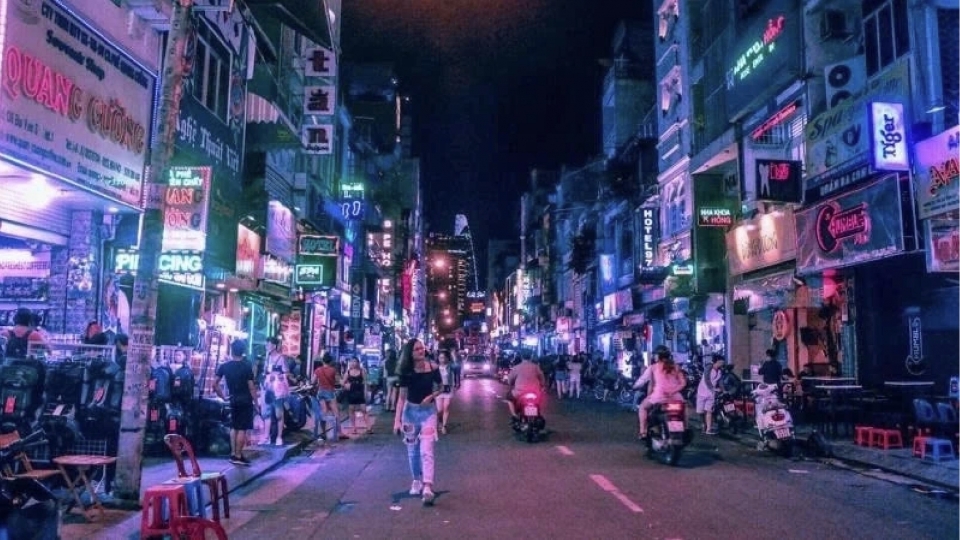
VOV.VN - Hanoi plans to develop 6-8 key night-time economy zones and 15-20 late-night streets and public spaces operating after midnight by 2035 under a newly approved project on developing the capital’s night-time economy for the 2026-2030 period with a vision to 2045.