Vietnam, Guangxi step up logistics, border-gate and supply-chain links

VOV.VN - Vietnam and China’s Guangxi Zhuang Autonomous Region will move beyond conventional trade towards deeper economic integration, with a focus on logistics, smart border gates, rail and road connectivity, supply chains, science and technology, and emerging areas of cooperation.
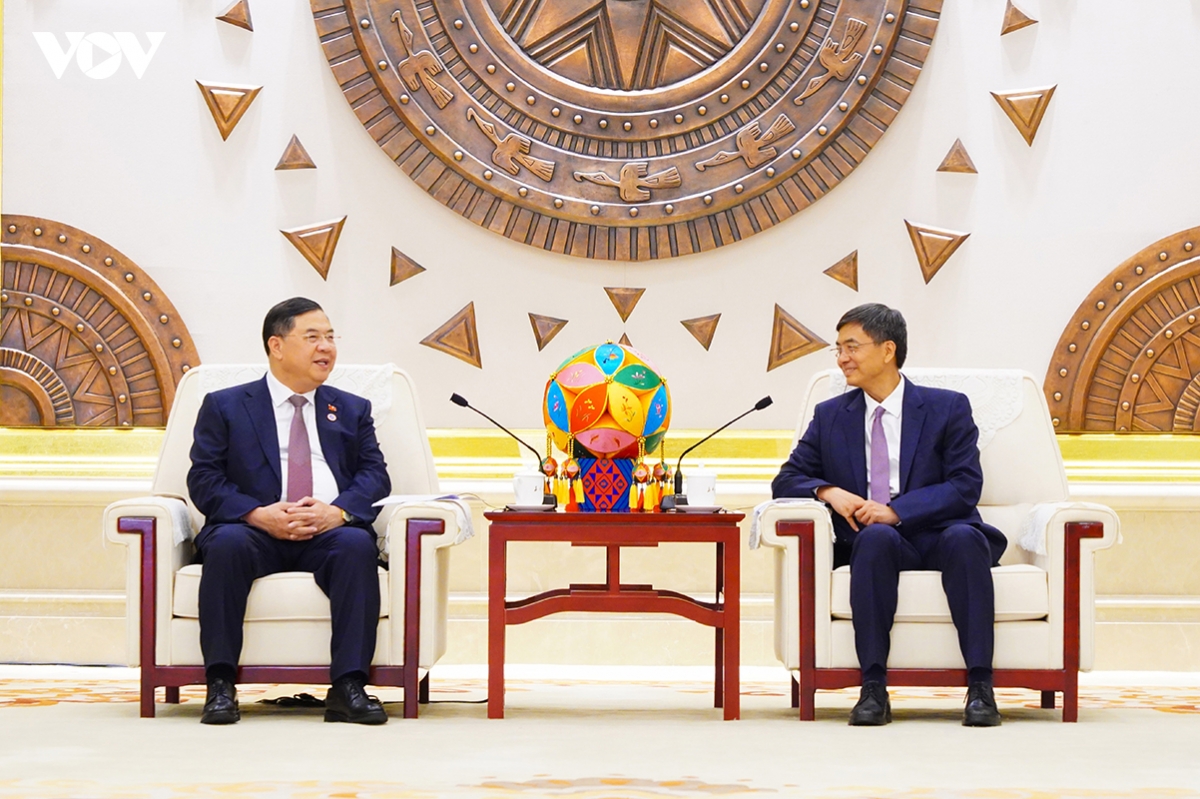
The agreement was reached during a meeting in Nanning, Guangxi, China, on September 16 between Pham Gia Tuc, Standing Deputy Prime Minister of Vietnam, and Chen Gang, Secretary of the Guangxi Zhuang Autonomous Regional Party Committee, during the former’s trip to attend the 23rd China-ASEAN Expo (CAEXPO) and the 23rd China-ASEAN Business and Investment Summit (CABIS).
They welcomed progress in cooperation between Vietnamese ministries, sectors and localities and Guangxi, and agreed on the need to make better use of the potential and advantages of their neighbourly ties, strengthen connectivity and improve the quality of economic cooperation.
From border trade to deeper economic integration
Tuc reaffirmed Vietnam’s consistent policy of attaching importance to relations with China, including cooperation with Guangxi, and encouraged Guangxi to take the lead in translating high-level common understandings into action by moving from conventional trade towards deeper economic integration.
Under this approach, Guangxi was encouraged to continue facilitating the import of Vietnamese goods into China and their onward shipment to third countries, encourage capable Guangxi businesses to expand high-quality investment in Vietnam, and promote cooperation among localities on both sides.
Infrastructure and logistics connectivity emerged as a key area of cooperation. Vietnam proposed that Guangxi work closely to ensure the progress of the standard-gauge Lang Son-Hanoi and Mong Cai-Ha Long-Hai Phong railway lines connecting with Guangxi, and move towards early operation of the smart border-gate model and the development of a cross-border economic cooperation zone.
These initiatives are intended to improve connectivity among production centres, border gates, logistics networks and maritime and inland waterway transport routes, facilitating the movement of goods and gradually creating more closely integrated supply chains.
Expanding cooperation into technology and supply chains
Beyond trade and infrastructure, Standing Deputy Prime Minister Pham Gia Tuc proposed stepping up cooperation in science and technology, including the application of artificial intelligence (AI) and digital transformation in areas such as education, healthcare, transport and agriculture.
The two sides also agreed to continue strengthening links between supply and production chains.
Chen, for his part, expressed Guangxi’s readiness to work with Vietnamese ministries, sectors and localities to implement high-level common understandings, and proposed stronger cooperation in rail and road connectivity, further improvement of border-gate infrastructure and greater facilitation of customs clearance.
He voiced Guangxi’s readiness to facilitate trade in agricultural and aquatic products with Vietnam, encourage Guangxi businesses to make high-quality investments in Vietnam, and expand cooperation in education, human-resource training, tourism and people-to-people exchanges.
The two sides noted that five strategic connections — political and development policies; economic and trade ties; infrastructure and logistics; science and technology; and the social foundation — are being advanced, providing a stronger basis for elevating cooperation between Vietnam and Guangxi.
Facilitating cross-border connectivity
Standing Deputy Prime Minister Pham Gia Tuc also held that the two sides continue to operate the Ban Gioc - Detian Waterfalls tourism landscape zone effectively, accelerate the upgrading and opening of agreed border-gate pairs, and coordinate closely in managing the land border and building a peaceful, cooperative and developing border.
Chen agreed with the Vietnamese side’s proposals and said Guangxi gives priority to developing friendly and substantive cooperation with Vietnamese ministries, sectors and localities, with a focus on implementing key common understandings reached by the senior leaders of the two Parties and two countries.
The coordinated development of transport infrastructure, border gates, logistics and supply chains is expected to create greater space for trade, investment and production cooperation between Vietnam and Guangxi, while strengthening the border area’s connectivity with wider markets.

China’s Guangxi fosters AI cooperation with Vietnamese localities
The Guangxi Zhuang Autonomous Region of China is stepping up substantive cooperation in artificial intelligence (AI) with Vietnamese localities, focusing on practical needs, building stable cooperation chains and establishing regular and multi-level cooperation mechanisms.