


Vietnam's economy posts record 10-month figures, faces final-stretch challenges

VOV.VN - The Vietnamese economy recorded landmark milestones in the first 10 months of 2026, as total import-export turnover crossed US$1 trillion for the first time, registered foreign direct investment surged 74%, and public investment disbursement reached 74.1% of the annual plan, though rising inflationary pressures and trade deficits impose final-stretch headwinds.

According to the Ministry of Finance, macroeconomic stability was maintained amid global economic complexities, prompting the International Monetary Fund (IMF) to upgrade Vietnam's 2026 growth forecast from 7.1% to 8.4%, while rating agency R&I granted the country an investment-grade rating for the first time.
Bright spots in production, trade, and investment
Industrial production maintained strong growth momentum. The Index of Industrial Production (IIP) in October rose an estimated 15% year-on-year, pushing the 10-month gain to 12.4%, led by a 13% expansion in processing and manufacturing. The Purchasing Managers' Index (PMI) reached 52.3 points, marking the 16th consecutive month above the 50-point threshold.
Foreign direct investment remained a primary driver. Registered FDI reached US$54.85 billion, up 74% year-on-year,while disbursed capital rose 13.1% to US$24.08 billion. Total trade turnover exceeded US$1.01 trillion, up 32.3%, with exports reaching US$499.24 billion, a 27.5% increase that surpassed full-year targets.
State budget revenue reached VND2.44 quadrillion, equivalent to 96.4% of the annual estimate. Public investment disbursements totaled VND708.57 trillion, meeting 74.1% of the target, while 243,600 businesses entered or re-entered the market during the reviewed period.
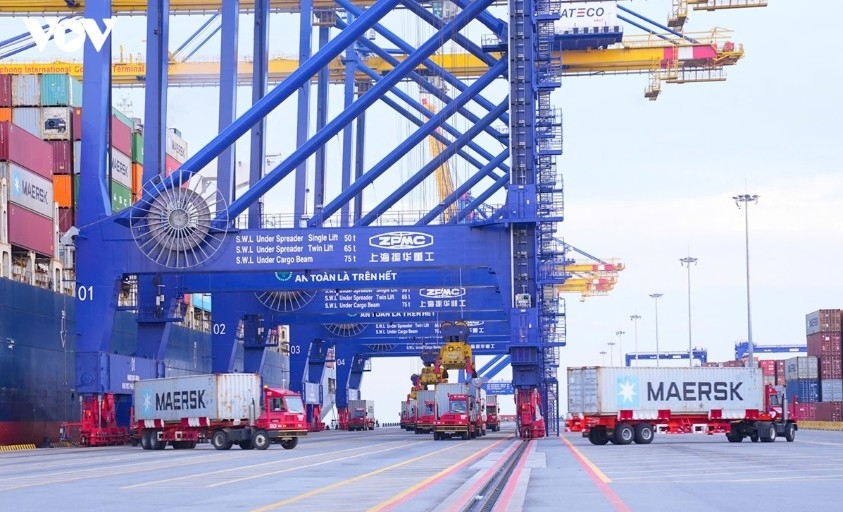
Macroeconomic pressures and business hurdles
Despite strong growth indicators, production and business operations face persistent pressures. Ten-month consumer price inflation averaged 4.57%, with October inflation reaching 5.09% year-on-year, exceeding the full-year target of approximately 4.5% due mainly to energy prices.
Despite high total trade turnover, the trade balance remained skewed. The 10-month trade deficit stood at US$12.07 billion, stemming largely from heavy imports of computers and electronics at US$65.84 billion (up 82.8%) and raw materials and fuel at US$26.43 billion (up 49.4%).
A stark imbalance also persisted between business sectors. Domestic enterprises recorded a trade deficit of US$36.9 billion, a 92.2% surge, while the foreign direct investment (FDI) sector posted a US$24.83 billion trade surplus, down 35.8%."
Financial and monetary markets faced tightening conditions. Credit growth stagnated in October as new lending rates passed 10% per annum, while capital mobilization from economic organizations edged up just 5.83% as of October 21, indicating corporate liquidity strains.
Investment bottlenecks also demand resolution, with 1,206 stalled capital projects totaling VND873 trillion awaiting clearance. In public investment, key transport infrastructure projects achieved a disbursement rate of 66.8%, with 24 out of 103 component projects failing to reach 40%.
Accelerating public investment disbursement, stabilizing macroeconomic fundamentals, and removing business bottlenecks are critical to achieving full-year growth targets over the final two months.

Vietnamese economy at crossroads as 2026 opens new growth cycle
VOV.VN - As Vietnam enters 2026, a pivotal year marking the start of a new growth cycle, the economy is poised for acceleration on the back of a stabilised foundation built during 2021–2025, while also facing growing challenges that will require decisive policy action and a focus on improving growth quality.

