Vietnam’s aquatic product exports aim for US$12 billion target

Vietnam’s aquatic product exports continued to show positive recovery signs in the first four months of 2026 and are moving towards the goal of US$12 billion for the whole year.
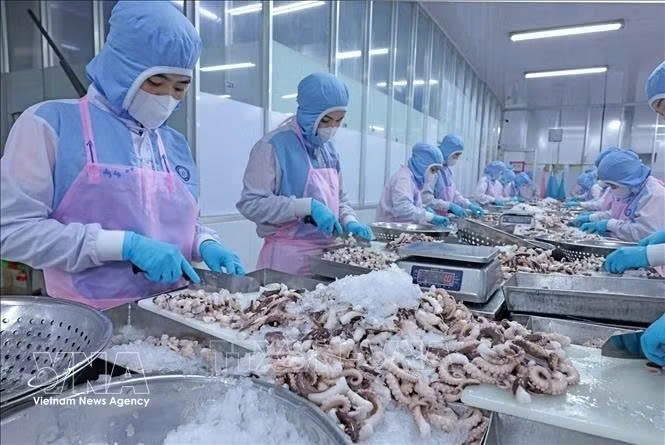
According to the Vietnam Association of Seafood Exporters and Producers (VASEP), the seafood export turnover during the January-April period was estimated at US$3.7 billion, up nearly 15% year-on-year.
The result reflected a positive start for the sector, especially in key exports such as shrimp, tra fish, squid, octopus, crab, molluscs and other high-value aquatic products. However, growth remained uneven across products and markets. While exports to China surged by more than 50%, shipments to some other markets recovered slowly. Exports to the US notably declined over 7% due to increasing trade barriers.
Shrimp remained the leading export item, earning about US$1.5 billion in the first four months, up 15% year-on-year and accounting for more than 40% of total aquatic product export value. Growth was driven by the recovery of several Asian markets, rising lobster exports and positive signals from processed and value-added shrimp products.
Despite the rebound, Vietnamese shrimp continued to face fierce price competition from Ecuador, India and Indonesia. In the US market, the shrimp industry remained under pressure from anti-dumping and countervailing duties, administrative reviews and cautious purchasing behaviour among importers.
Mai Van Hoang, Chairman of the Vietnam Shrimp Association, said shrimp remains Vietnam’s largest aquatic export item, generating more than US$4.6 billion in 2025, with further growth potential ahead. However, he warned that shrimp farming areas are shrinking, particularly in central coastal provinces, while expanding farming zones remains difficult due to land planning for real estate and tourism projects.
Hoang stressed that Vietnam must improve self-sufficiency in breeding stock to maintain the competitiveness of its aquatic product sector. Currently, the country imports up to 90% of parent shrimp stock. Farming areas should also shift from traditional extensive farming to intensive, high-tech models to improve productivity and reduce costs, he added.
Meanwhile, tra fish (pangasius) exports were valued at US$734 million in the reviewed period, up 19% year-on-year, maintaining their position as the second-largest export category. With consumers tightening their spending and becoming more price-sensitive, tra fish retained an advantage thanks to their affordability.
Growth opportunities for tra fish remain strong in China, the Association of Southeast Asian Nations (ASEAN), the Middle East, and the EU. However, import markets are also tightening technical barriers related to farming standards, traceability and food safety.
In contrast, tuna exports fell about 6% to an estimated US$286 million due to rising raw material costs and stricter technical requirements, including regulations regarding traceability and illegal, unreported and unregulated (IUU) fishing.
VASEP General Secretary Nguyen Hoai Nam said global aquatic product demand remains stable, particularly in major import-dependent markets such as the US, EU, Japan and China, creating room for Vietnam’s seafood exports to grow by 8-10% this year.
However, the sector still faces mounting challenges, including shortages of raw materials and labour, high production costs, disease outbreaks, trade defence investigations and increasingly stringent environmental and sustainability standards in key export markets.

Seafood exports poised to rise by US$1 billion this year
Vietnam’s seafood exports are projected to increase by about US$1 billion in 2026 compared to 2025, driven by recovering global demand and businesses’ efforts to adapt to changing market conditions.