Businesses seek stable policies to unlock private sector growth

VOV.VN - More than a year after the Politburo issued Resolution 68 on private sector development, Vietnam’s business community has begun to see positive signals from institutional reforms, capital flows and improvements in the investment environment.
However, according to many entrepreneurs, what businesses need most today is not merely short-term incentives or easier access to capital, but rather a stable market, transparent policies and a predictable investment environment capable of supporting long-term strategies.
Businesses do not fear hardship, only instability
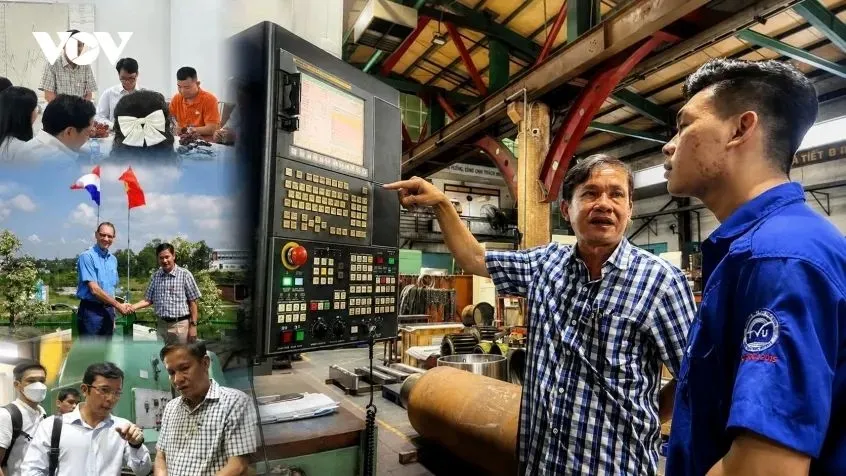
After more than 20 years operating in the mechanical engineering and manufacturing sector, Nguyen Ngo Long, director of Nhat Long Mechanical Trading Co. Ltd., shared many manufacturing enterprises are still facing major pressure from rising input costs and heavy dependence on imported materials.
According to him, a precision manufacturing production line may require investment worth tens of billions of Vietnamese dong and several years to recover capital. Yet specialised steel, technical materials, machinery and industrial software still largely depend on imports.
Even minor fluctuations in exchange rates, rising logistics costs or delays in imported supplies can significantly disrupt production plans.
Long argued that the biggest challenge facing manufacturers today is no longer simply access to capital, but the absence of a strong industrial ecosystem, from supporting industries and machine-tool suppliers to supply chains and stable markets that allow businesses to invest confidently over the long term.
In his view, the spirit of Resolution 68 should go beyond helping businesses overcome short-term difficulties and instead focus on building a transparent, stable and long-term competitive environment. Businesses are not afraid of difficulties. What they fear is investing for 10 years only to see policies change after one political term.
“I also hope policymakers will stand from the perspective of the business community so there can be stronger interaction with the government and society, allowing the voices of businesses to be heard more clearly. From there, more effective support can be provided for the healthy and sustainable development of the private sector, in line with the spirit of Politburo Resolution 68,” Long said.
Many enterprises in Southeast Vietnam share similar concerns, noting that the biggest challenge at present is no longer financing, but declining market demand and weakening consumer spending.
Recent surveys show that more than 60% of businesses are under significant pressure in finding customers as slowing consumption directly affects production and commercial activity.
Entrepreneur Nguyen Van Hien, chairman of the Board of Directors of Chavi Long An Company in Tay Ninh province, said businesses currently need stronger support in market expansion, product promotion and administrative reform in order to strengthen confidence for long-term investment.
According to him, what enterprises want most is policy stability, streamlined procedures and a supportive business environment that enables Vietnamese brands to grow sustainably and expand internationally.
“Like many other businesses, we have had to struggle just to survive. Enterprises hope that mechanisms, policies and administrative procedures will become faster and more streamlined, while additional support for product promotion and market expansion will help businesses invest with greater confidence and bring Vietnamese brands to the global market,” Hien said.
Predictability matters more than incentives

According to Ngo Quang Phuc, director general of Viet My Dental Lab, one of the clearest changes after more than a year of implementing Resolution 68 is the shift in policy thinking toward the private sector. More investment projects have been launched, while the overall business climate has shown signs of improvement.
However, behind these positive signals, small and micro-sized enterprises continue to face considerable difficulties.
Each month, around 32,000 businesses either enter or re-enter the market, but more than 30,000 also withdraw, reflecting the fragile resilience of the private sector.
Phuc noted that most private enterprises in Vietnam are small in scale, limited in internal capacity and highly vulnerable to market fluctuations and legal or regulatory changes. As a result, many businesses are choosing to maintain their current scale rather than expand investment.
Amid rapid global economic shifts, businesses need more than administrative simplification. They also require timely support policies, targeted assistance and a transparent institutional environment stable enough to support long-term planning.

Lu Nguyen Xuan Vu, director general of Xuan Nguyen Joint Stock Company and chairman of the Saigon Entrepreneurs Club, echoed the view, arguing that capital is no longer the primary bottleneck.
According to him, interest rates have eased, credit access has improved and many incentive mechanisms are already in place. Yet businesses are cautious about expanding investment due to concerns over unpredictable market conditions and the long-term stability of the investment environment.
Vu stressed that what businesses need most is a transparent and highly predictable business environment that allows them to confidently develop long-term strategies and effectively utilise available capital.
Although businesses acknowledge improvements in administrative reform in recent years, many still expect the process to continue becoming simpler, faster and more practical.
Restoring confidence for long-term investment
Resolution 68 is creating new expectations for Vietnam’s private sector, which is increasingly recognised as one of the key drivers of economic growth.
Yet, many business leaders emphasise that investment decisions depend not only on short-term incentives or temporary capital support, but more importantly on confidence in the long-term stability of the investment environment.
When markets operate more smoothly, policies are implemented transparently and the business environment becomes more predictable, enterprises will feel more secure expanding production, pursuing long-term investment and improving competitiveness.
This is also considered a crucial condition for the sustainable development of Vietnam’s private sector and for enabling it to contribute more strongly to national economic growth in the years ahead.

Vietnam launches first-ever index measuring private sector’s health
VOV.VN - After more than two decades of using the Provincial Competitiveness Index (PCI) to assess the quality of local economic governance, Vietnam is introducing a new approach, by directly measuring the actual performance of the private sector.