Largest architectural foundations discovered at Thang Long Imperial Citadel

VOV.VN - Archaeologists have uncovered the largest architectural foundations ever found in Vietnam at Kinh Thien Palace, the major part of the Thang Long Imperial Citadel, revealing six cultural layers spanning more than a millennium.
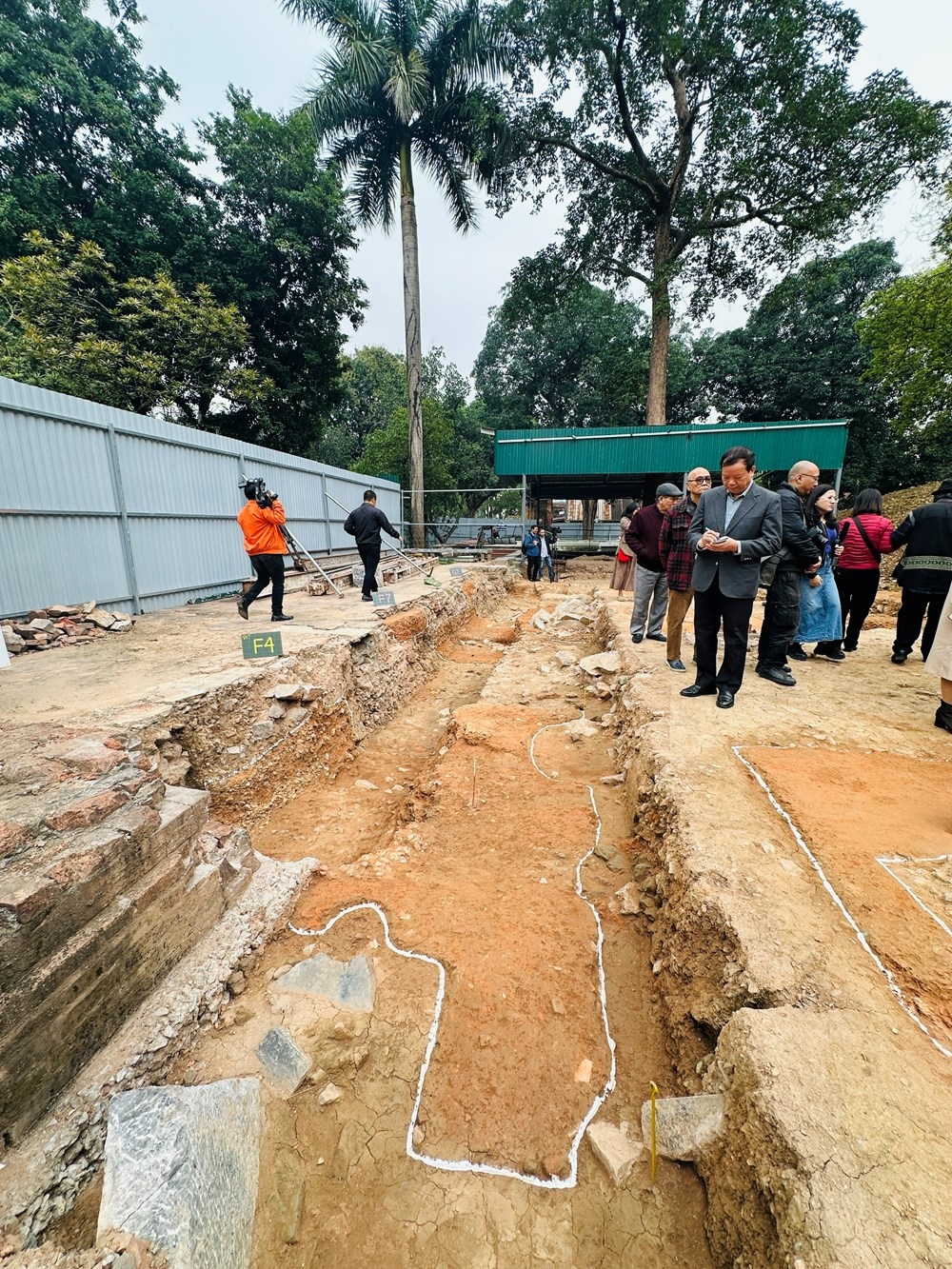
The breakthrough findings were unveiled at a scientific workshop held in Hanoi on December 29 by the Thang Long–Hanoi Heritage Conservation Centre in collaboration with the Vietnam Institute of Archaeology.
According to the preliminary report, the 2025 excavation revealed a cultural stratigraphy measuring up to 6m in depth, comprising six cultural layers spanning from the Pre–Thang Long period (7th–10th centuries) to the modern era (19th–20th centuries). Among these, the Le Dynasty layer is the thickest, nearly 3m deep, consisting of the Early Le and the Revival Le periods.
Corresponding to these cultural layers are significant architectural remains, including a red brick row from the Tran Dynasty (13th–14th centuries), a gray brick row from the Early Le period (15th–16th centuries), a stone-paved Royal Path, and 14 foundation bases of Kinh Thien Palace from the Revival Le period (17th–18th centuries).
These discoveries increase the total number of identified column foundations of Kinh Thien Palace, uncovered in excavations conducted in 2011, 2023, and 2025, to 30 out of 36, comprising both single and double foundation types.
For the Nguyen Dynasty (19th century), archaeologists uncovered two drainage systems and 26 out of 64 column foundations belonging to Long Thien Palace. The layout of these foundations and drainage structures confirms that Long Thien Palace followed the Nguyen Dynasty’s characteristic “multi-tiered, overlapping-roof” architectural style, with a front hall and main hall built on a shared platform and connected by an intermediate bay. Notably, the east–west extent of Long Thien Palace coincides exactly with the footprint of the former French-era Artillery Building.
According to Associate Professor Tong Trung Tin, Chairman of the Vietnam Association of Archaeologists, the foundation of Kinh Thien Palace during the Le Dynasty was entirely artificial, constructed by compacting clay and broken materials, after which the column foundations, most fully developed during the Revival Le period, were carefully planned and installed.
Single foundations measure approximately 2.8–3.5 x 2.5–3.5m, while double foundations measure 5.4–6.1 x 2.7–3m. Built with 81 compacted layers reaching a thickness of 4m, these foundations represent the largest architectural column bases ever identified in the history of Vietnamese architecture.
Single foundations are mainly distributed within the interior of the structure, while double foundations are located along the outer perimeter. Based on the currently exposed remains, researchers have provisionally determined that Kinh Thien Palace extended nine bays along the east–west axis. Further research is required to determine the north–south extent of the palace.
The excavation also uncovered a brick bearing a clear inscription dated to 1466, from the Early Le period, indicating the participation of military units in producing construction materials for Kinh Thien Palace. Researchers noted that some central column foundations cover an area of 15–18m2, comparable to the size of a small house, and are arranged with remarkable regularity, reflecting a strict hierarchical order within the imperial architectural complex.
The findings confirm that the foundations of Kinh Thien Palace from the Early and Revival Le periods were built atop earlier clay foundations dating to the Tran, Ly, and Early Ly periods. Historical records indicate that the Le Dynasty’s Kinh Thien Palace was constructed on the site of Thien An Palace from the Ly and Tran dynasties. Archaeological soundings have verified the presence of cultural remains from these earlier periods.
Due to UNESCO conservation requirements and the complex condition of the site, the excavation was conducted on a probing basis, focusing on identifying the six overlapping architectural layers from the Dai La period through the modern era, rather than fully exposing earlier Ly–Tran structures.
These discoveries mark a significant step forward in identifying the precise location, structure, and scale of Kinh Thien Palace during the 15th–18th centuries, while also demonstrating the continuous cultural layering at the heart of the Thang Long Imperial Citadel. They further reaffirm the exceptional historical and symbolic significance of the Kinh Thien Palace site in the cultural history of Thang Long (now Hanoi) and Dai Viet (now Vietnam) over more than a millennium.
Festival Thang Long-Hanoi 2025 honours heritage and creativity
VOV.VN - Festival Thang Long-Hanoi 2025 officially opened at Van Mieu- Quoc Tu Giam (Temple of Literature) on the morning of November 1, with the ‘Converging heritage’ ceremony honouring the capital’s heritage and inspiring creativity across the community.