


Craft villages need mentors to keep traditions alive

Artisan-led classes are keeping folk crafts alive and feeding Hanoi’s cultural industry ambitions, but the model works best when training is tied to income and market demand.

Talent pipeline starts with artisans
In Duong Lam ancient village, Meritorious Artisan Nguyen Tan Phat has spent years teaching lacquerware, a craft where skilled hands are only part of the job. Products embed generations of knowledge, technique and aesthetic judgment. Students must learn materials and master every step, from building the base and treating the surface to lacquering, polishing and finishing.
“Artisans should not be merely the last ones holding a technique”, Phat said. “They need to be pathfinders so younger generations can keep creating on a traditional foundation”.
In Xuan La to-he figurine village, Phuong Duc commune, artisan Dang Van Hau teaches by level. Students start with simple shapes and gradually face harder tasks. For children, the first goal is exposure to folk culture; for those aiming to make a career, the goal is mastery of technique and the ability to create new product designs.
The same model extends beyond handicrafts as water puppetry in Dao Thuc village, Thu Lam commune is being carried forward through classes directly led by artisans.
Artisan Nguyen The Nghi said the activity has run for about five years, with at least one session a year and sometimes two. Parents who once saw water puppetry as impractical now sign their children up. Joining the puppet troupe is not a short course as newcomers face a two-year trial, take part in collective activities and follow troupe rules. They learn not only performance technique but also the community’s way of life and spirit.
Training must connect to markets, policy
Trinh Quoc Dat, chairman of the Vietnam Craft Village Association, shared that craft hubs with strong production, market access and decent incomes tend to attract young workers. Bat Trang commune draws labour from nearby areas, and some families send children to study ceramics before they return to develop the craft and study new designs and glaze lines. By contrast, low-income crafts with unstable outlets struggle to retain young people.
To create a long-term career path, Phat proposed stronger links among artisans, training facilities, businesses and cultural tourism spaces. That will let learners move from exposure to practice, product creation and job search. He said short-term experiential activities must be clearly separated from deep training for those who truly choose the craft as a long-term career.
The issue also belongs to cultural industry policy. According to the draft Law on Cultural Industry Development submitted to the 16th National Assembly’s second session, the Government suggested a workforce competency framework by job position; policies to attract artists, artisans and experts into training; and support for learners through scholarships, tuition waivers, living cost support and credit.
Dat also stressed that formal training must be tied to artisans and real production. Training facilities should build suitable curricula, artisans should teach techniques directly, authorities should support mechanisms and resources, and associations and businesses should connect production with markets.
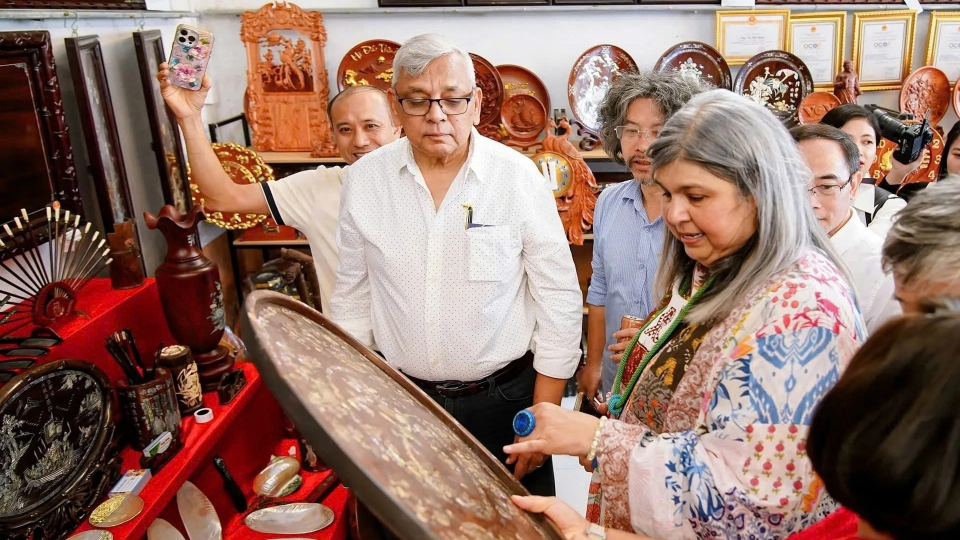
Two more Hanoi craft villages join World Craft Cities Network
VOV.VN - Two more traditional craft villages in Hanoi have officially joined the World Craft Cities Network, further strengthening Vietnam’s global profile in traditional handicrafts and creative culture.

