


Vietnamese female athletes: Trailblazers on the front lines of national sports

VOV.VN - On Vietnamese Women’s Day (October 20), Vietnam honours its female athletes, the core force carrying performance targets and continually establishing historic milestones for national sports.
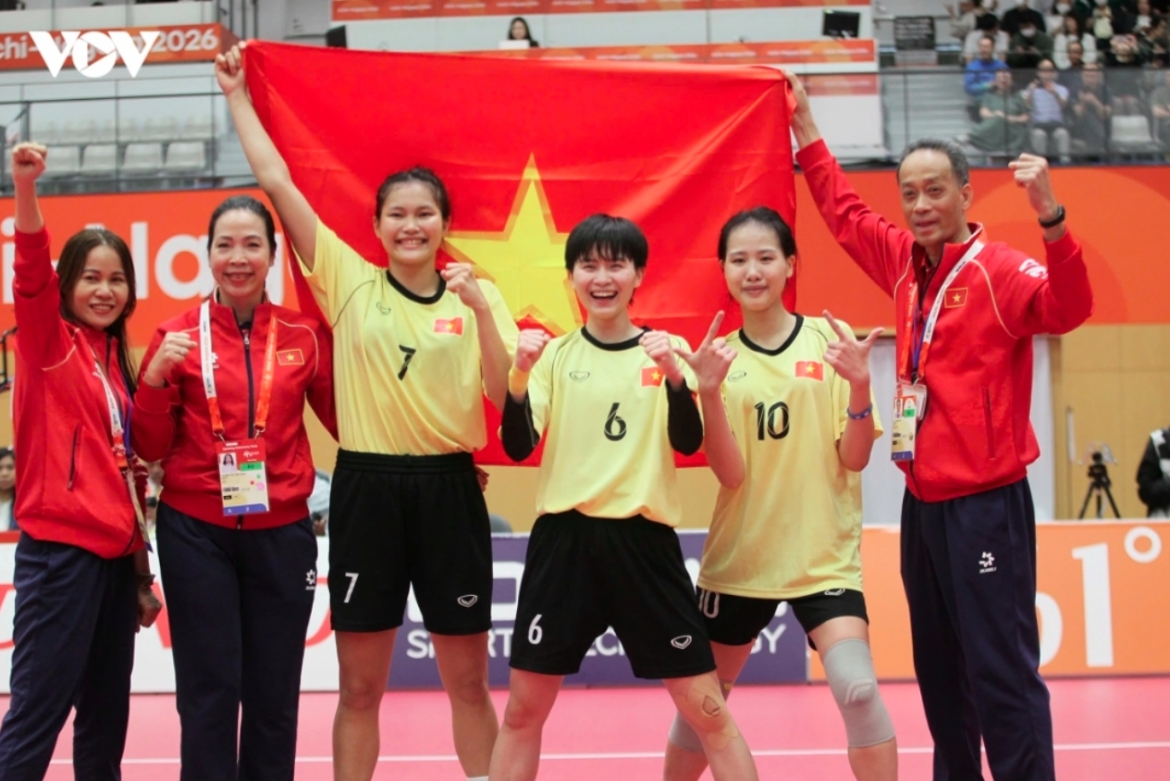
Throughout more than half a century of international integration, female athletes have consistently stood at the forefront. As Vietnam rejoined the regional arena at the 15th SEA Games in 1989, shooter Ngo Ngan Ha secured the country's first gold medal.
On the global stage at the Sydney 2000 Olympic Games, Taekwondo fighter Tran Hieu Ngan made history by winning Vietnam's first Olympic silver medal. Globally, Wushu legend Nguyen Thuy Hien captured seven world championship titles starting at age 14 in 1993, while the women's sepak takraw team became the country's first world champions in the sport.
Other landmark achievements include the women's national football team competing at the 2023 FIFA Women's World Cup, the women's volleyball team winning two Asian Volleyball Confederation (AVC) Cup titles, and the beach handball team securing three Asian championships. At the SEA Games, female athletes steadily account for over 40% of Vietnam's total gold medal tally.
Their dominant role is even more pronounced at the continental Asian Games (ASIAD). At ASIAD 20 in Japan, all three gold medals won by the Vietnamese delegation came from female athletes in karate (women's team kata) and sepak takraw (securing a double gold), alongside a courageous silver medal won by boxer Nguyen Thi Tam.
Vietnam's sports also feature enduring icons. Runner Nguyen Thi Oanh made history by winning 15 gold medals across five consecutive SEA Games in middle- and long-distance events.
Swimmer Nguyen Thi Anh Vien was named "Best Athlete of the 2015 SEA Games" after winning eight gold medals and breaking eight games records. At the 33rd SEA Games, shooter Trinh Thu Vinh emerged as the most outstanding athlete with four gold medals and three games records; rower Nguyen Thi Huong secured four gold medals (raising her total to 12 gold medals over three SEA Games); the women's 4x400m relay team dominated the region for a sixth consecutive games since 2015; and the women's futsal team won gold, helping Tran Thi Thuy Trang set an unprecedented record of four consecutive SEA Games gold medals in both 11-a-side football and futsal.
Beyond these accolades are international breakthroughs, including cyclist Nguyen Thi That competing professionally in Europe and at the Paris 2024 Olympics, footballer Huynh Nhu playing in Europe, badminton player Nguyen Thuy Linh ranking in the world's Top 20, and volleyball players competing in Turkey, Japan, and the Republic of Korea (RoK).
Physical and physiological traits make Vietnamese female athletes well-suited for events requiring precision and dexterity (shooting, archery), weight-category martial arts (karate, boxing, taekwondo, wushu), and endurance sports (sepak takraw, rowing), categories with strong medal prospects at ASIAD and the Olympics.
Consequently, establishing specialized support policies, including gender-specific nutrition, specialized sports medicine, psychological support, and post-retirement career transition training, represents a smart allocation of resources.
Despite contributing the bulk of key achievements, female athletes continue to face distinct disadvantages, including short career spans, social prejudices, physical injuries, and family obligations, a fundamental factor that cannot be overlooked in Vietnamese sports life.

ASIAD 2026: Vietnam beat Thailand to defend women’s Sepak Takraw gold
VOV.VN - Vietnam defeated Thailand 2-1 in a thrilling women’s quadrant final at ASIAD 2026 on October 3, successfully defending the gold medal won in Sepak Takraw at the previous Asian Games.

ASIAD 2026: Vietnam claims second gold with women's sepak takraw victory
VOV.VN - Vietnam has secured its second gold medal at the 20th Asian Games (ASIAD 2026) in Japan after Nguyen Thi Thu Trang and Nguyen Thi Khanh Ly defeated their Philippine opponents in the women’s doubles Sepak Takraw final in Nagoya on September 29.

