Human capital central to Vietnam’s international financial centre drive

A modern financial centre will help upgrade capital markets, connect directly with global capital flows, diversify financial products, advance green and digital finance, and channel funding into infrastructure, technology and clean energy projects – all key pillars for sustainable development.
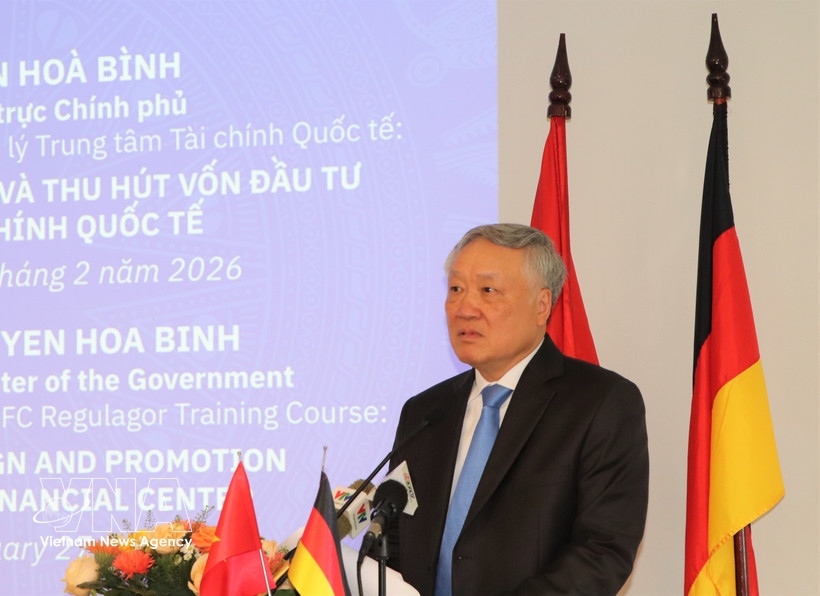
Speaking at the opening ceremony of the International Financial Centre Regulator Executive Training Programme - Training Course No.3 (IFCR03) held in Ho Chi Minh City on February 27, Permanent Deputy Prime Minister Nguyen Hoa Binh, who also serves as Chairman of the Executive Board of the Vietnam International Financial Centre, described the successful establishment and operation of the IFC as a strategic component of the country’s growth model transformation.
He noted that the IFC’s development must be built on five core pillars, namely strong global connectivity; a stable and transparent legal framework; high-quality human resources; robust governance and management capacity; and a supportive development ecosystem. Among these, human capital plays a decisive role in ensuring the safe, efficient and competitive functioning of the system.
Training programmes for the IFC workforce, he said, should be upgraded and expanded into priority areas such as artificial intelligence, big data, financial technology, energy and semiconductors, with the longer-term goal of developing a high-quality finance and STEM training hub in Vietnam aligned with German standards.
The IFCR03 course, themed “Financial product design and promotion in an International Financial Centre”, is organised by Vietnamese-German University (VGU) and runs from February 27 to March 1. The programme centres on specialised financial product design and capital mobilisation strategies, regarded as essential to strengthening the IFC’s global competitiveness.
The IFC programme at the VGU forms a key component of the national project on developing high-quality human resources for the centre. It is structured around three pillars: training management personnel; providing advanced professional updates; and delivering internationally accredited bachelor’s and master’s programmes in finance, economics and management.
Designed by VGU experts in collaboration with German professors and specialists, the curriculum aims to equip financial managers with in-depth expertise and practical skills to meet the demands of deeper international integration and development.
IFCR03 is the third course in the IFC training series, which has previously laid foundations in institutional models, operational mechanisms of financial centres, financial market structures and macroeconomic stability. Following this series, the VGU plans to introduce 12-week micro-credential programmes focusing on advanced quantitative analytical skills in finance and economics to meet the practical requirements of building Vietnam’s IFC.
Beyond training, the VGU is expected to spearhead a closer university–business–Government linkage model, ensuring that education and research align with market demand and effectively support policymaking.
Int’l Financial Centre to attract billion-dollar capital inflows
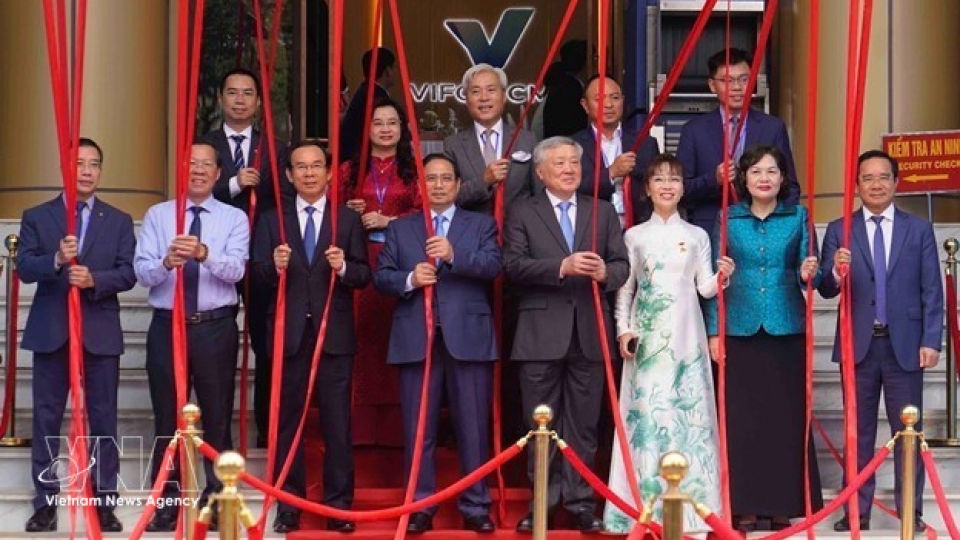
Though only recently operational, the Vietnam International Financial Centre in HCM City (VIFC–HCMC) has reported encouraging initial results, signalling strong investor confidence and positioning itself as a gateway for large-scale capital flows into Vietnam.