


Ho Chi Minh City steps up cooperation with BPC cities for sustainable growth

The 2026 Business Partner City (BPC) Roundtable Conference in Ho Chi Minh City on October 23 brought together member cities to explore innovation and sustainable development as drivers of growth and international cooperation.
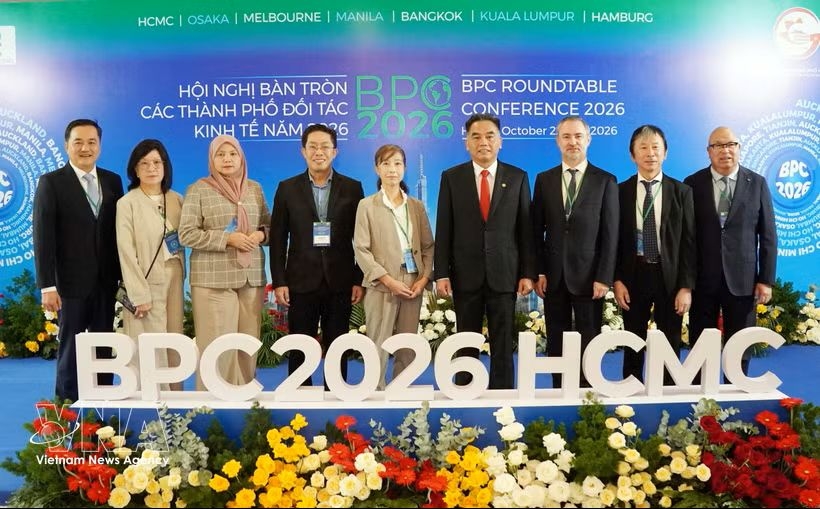
Jointly organised by the municipal People’s Committee and Japan’s Osaka Business Partner City Council (BPC Council), the event is the third of its kind hosted by Ho Chi Minh City, following the 2002 and 2016 editions.
This year’s conference builds on the outcomes of BPC 2025 in Osaka and the joint declaration on carbon emission reduction and sustainable development, seeking to translate common commitments into practical initiatives involving member cities, partner organisations and the business community.
Kenjiro Mori, secretary-general of the Osaka Business Partner City Council (OBPC), highlighted two core principles of the declaration: strengthening cooperation and connectivity among BPC cities and partner organisations, and addressing environmental challenges through business activities.
Nguyen Loc Ha, standing vice chairman of the Ho Chi Minh City People’s Committee, said cities must balance economic growth and competitiveness with innovation, climate adaptation, emissions reduction and improved quality of life. He stressed that innovation must be linked to commercialisation and business development; economic growth must go hand in hand with the efficient use of resources; and urban development must be aligned with public transport and modern infrastructure.
The conference goes beyond experience-sharing to identify common challenges, potential areas of cooperation and practical initiatives that deliver tangible benefits to businesses and residents of member cities, he said.
In 2026, Ho Chi Minh City maintained its growth momentum, with gross regional domestic product (GRDP), and industrial production increasing 9.06% and 10.9%, respectively, in the first nine months. The city is conducting greenhouse gas inventories at 360 facilities, of which 240 have developed emission reduction plans for 2026-2030. Around 68% of its buses already run on electricity or other green energy, with the city targeting 100% by early 2027. It is also participating in the roadmap for operating the national carbon market.
It is pursuing sustainable industrial development, carbon emission reduction and transit-oriented development (TOD), focusing on shifting industry towards greener, circular and lower-emission models, expanding support for innovative start-ups, particularly SMEs.
According to the Australian Industry Group (Ai Group), carbon emission reduction could become a competitive advantage if sustainability commitments were translated into business growth. It also highlighted common challenges facing SMEs, including emissions measurement, transition costs and access to green finance.
Meanwhile, a representative of the Hamburg Chamber of Commerce shared the Germany city’s experience in developing an innovation ecosystem and supporting start-ups, scale-ups and SMEs in building capacity, selecting markets and expanding international activities.
Ayako Moriyama, director general for Economic Strategy Bureau of the Osaka City Government, proposed four areas for joint action: sharing information on environmental challenges and business opportunities in partner cities; integrating green considerations into existing policies and programmes; publicising business events open to foreign companies and considering preferential mechanisms for BPC cities; and strengthening regular coordination among BPC partner organisations.
Launched by the Osaka City Government in 1988, the BPC network promotes economic cooperation among cities, initially in the Asia-Pacific region. It aims to facilitate business exchanges, support small and medium-sized enterprises (SMEs) in expanding overseas and foster mutual understanding among residents in member cities.
The network currently comprises 15 members, namely Osaka, Hong Kong (China), Singapore, Bangkok (Thailand), Kuala Lumpur (Malaysia), Manila (the Philippines), Jakarta (Indonesia), Seoul (the Republic of Korea), Shanghai and Tianjin (China), Ho Chi Minh City, Mumbai (India), Melbourne (Australia), Auckland (New Zealand) and Hamburg (Germany). Held annually since 1990 on a rotating basis among member cities, the roundtable provides a forum for local authorities, trade promotion organisations, associations and businesses to exchange policies, urban development experience and cooperation opportunities.
Ho Chi Minh City to host 2026 Business Partner City Roundtable
VOV.VN - Ho Chi Minh City will host the 2026 Business Partner City (BPC) Roundtable Conference, with a focus on promoting international cooperation in innovation, green industrial development, business support, and sustainable growth.

