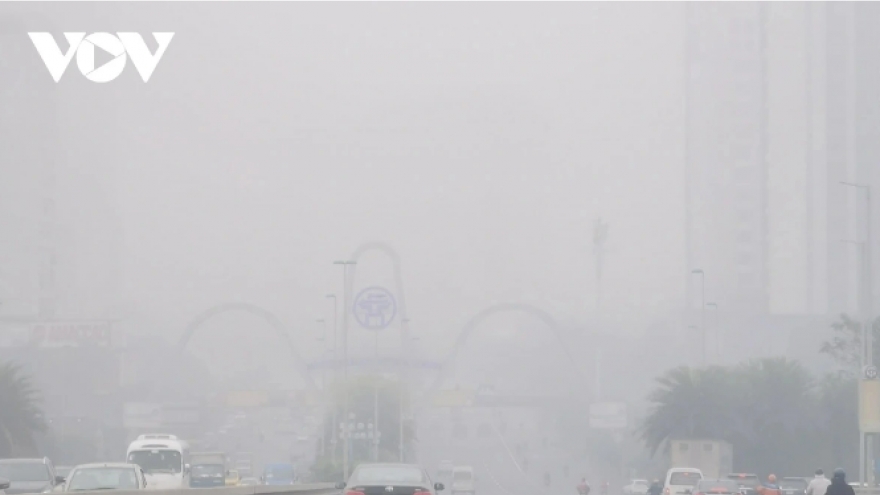
Hanoi’s air quality worsens again after brief improvement

VOV.VN - Air quality in Vietnam’s capital Hanoi has deteriorated again after two days of improvement, with air quality index (AQI) levels in several areas rising to unhealthy levels, posing potential health risks, local data showed.

A strong cold air mass accompanied by rain and northeasterly winds helped disperse fine dust and improve air quality from late December 13. However, as wind intensity weakened, AQI levels began to rise again on December 15, reaching unhealthy levels by the evening.
As of the morning of December 16, with northeasterly winds continuing to weaken, the dispersion of pollutants has declined markedly, causing air pollution to re-emerge in the capital city and spread to several northern localities.
Pollution has been most pronounced in the early morning and late afternoon to evening, when temperature inversions form and trap fine dust particles close to the ground.
Data from IQAir show that at around 8:15 a.m. on December 16, Hanoi ranked ninth among cities worldwide with the highest levels of air pollution. The capital’s AQI at that time stood at 155, corresponding to the poor level, which may affect health if people are exposed outdoors for prolonged periods.
Monitoring data from stations across the city indicate variations in pollution levels between areas. At the monitoring station near the gate of Hanoi University of Science and Technology on Giai Phong Street, AQI was recorded at 117, posing clear risks to sensitive groups such as children, the elderly, and those with respiratory conditions.
Meanwhile, the station at Nhan Chinh Park on Khuat Duy Tien Street recorded an AQI of 68, classified as moderate. While considered acceptable, this level still carries potential health risks if outdoor exposure is prolonged.
Hanoi has repeatedly ranked among the world’s most polluted cities in recent weeks. On the night of December 12, AQI levels reached their highest point so far this year, approaching hazardous thresholds at several monitoring stations.
In response, Hanoi authorities on December 10 issued a number of urgent measures in an attempt to curb air pollution.
The Department of Construction was tasked with tightening supervision and requiring all construction sites to fully implement dust-control measures. Loose construction waste must be properly covered at storage sites and during transportation to limit dust dispersion.
Notably, authorities ordered a temporary suspension of permits for road and pavement excavation toward the end of the year, except for emergency repairs, in order to reduce dust emissions during periods of severe air pollution.
In addition, they instructed the education sector to guide schools in minimising outdoor activities when AQI levels are in the poor range. If air quality deteriorates to the “very hazardous” level, 301 or higher, schools are advised to consider adjusting teaching plans, temporarily suspending in-person classes, or shifting to alternative formats to ensure students’ safety.

Gov't asks Hanoi, HCM City to act towards safe air quality levels within 5 years
The Government has set a goal for Hanoi and Ho Chi Minh City to bring air pollution levels within the safe threshold for human health within the next five years.