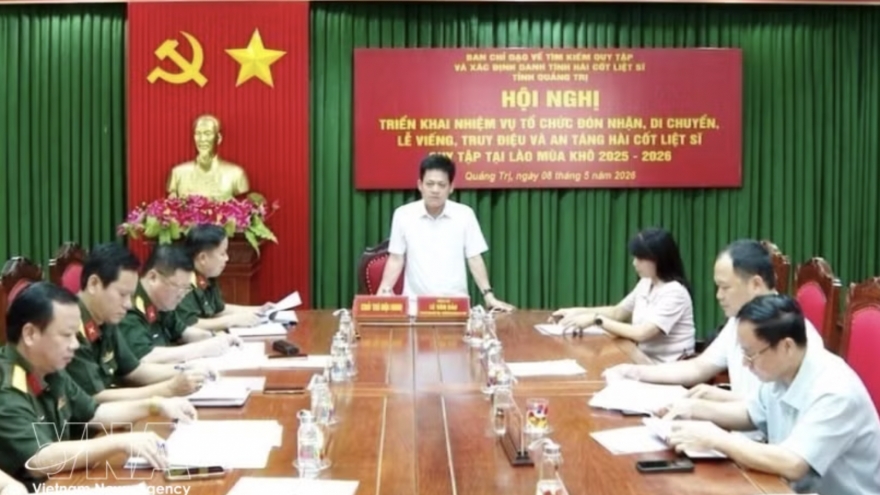
358 sets of martyrs’ remains recovered between March 15 and May 6

A total of 358 sets of martyrs’ remains were recovered between March 15 and May 6 as part of the “500-day-and-night campaign to accelerate the search, collection and identification of martyrs’ remains,” heard a conference in Hanoi on May 11.
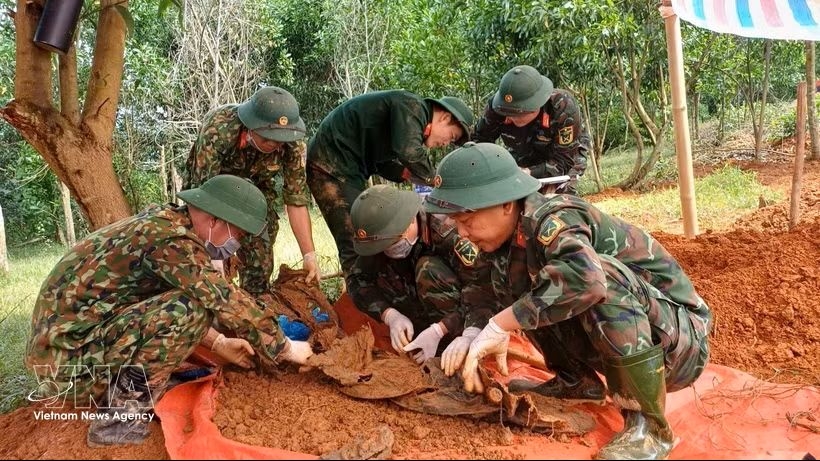
The event was organised by the General Department of Politics of the Vietnam People’s Army under the chair of Senior Lieutenant General Le Quang Minh, Vice Chairman of the General Department of Politics and member of the National Steering Committee for the search, collection and identification of martyrs’ remains (Steering Committee 515).
According to the Department of Policy and Social Affairs under the General Department of Politics and the Office of the National Steering Committee, all seven military-region steering committees, the Command of Army Corps 34, and steering committees of 34 provinces and centrally-run cities have issued plans for the search and collection of martyrs’ remains.
To date, 17 provinces and cities have established teams responsible for collecting samples from martyrs’ remains, while 23 search and collection teams are being maintained nationwide.
The General Staff of the Vietnam People's Army has temporarily established a search and collection team in Lao Cai with 39 personnel and supplemented forces for the team in Tuyen Quang. Military Region 7 has proposed setting up two temporary teams in Ho Chi Minh City and Lam Dong, while Military Region 5 has proposed two more in Khanh Hoa province and Da Nang city.
From March 15 to May 6, agencies and units recovered 358 sets of martyrs’ remains, including 51 in Vietnam, 36 in Laos and 271 in Cambodia.
Addressing the conference, Minh described the campaign as a particularly important political task of profound political, social and humanitarian significance, contributing to honouring fallen heroes and martyrs while strengthening public trust in the Party, the State and the military.
He requested relevant agencies and units to continue finalising plans and mechanisms related to the campaign, including inspection plans, cooperation programmes with Laos and Cambodia, and preparations for the 2025–2026 dry-season search missions.
The officer also called for stronger coordination with the US, China and the Republic of Korea to access documents, artefacts and belongings related to Vietnamese soldiers who died or went missing during wartime.
At the same time, Minh urged agencies and localities to accelerate the development of software systems serving sample collection, transfer and campaign management, while promoting communications activities to raise public awareness and consensus on the campaign’s significance.
Under the campaign, authorities aim to recover around 7,000 sets of martyrs’ remains, complete sample collection from approximately 232,000 unidentified graves by the second quarter of 2027, and conduct DNA testing on around 18,000 sets of remains.
The campaign also seeks to build and operate a genetic database of relatives of unidentified martyrs to support identification efforts, while intensifying bomb and mine clearance activities in key localities, including Tuyen Quang, Lao Cai and Lang Son provinces.
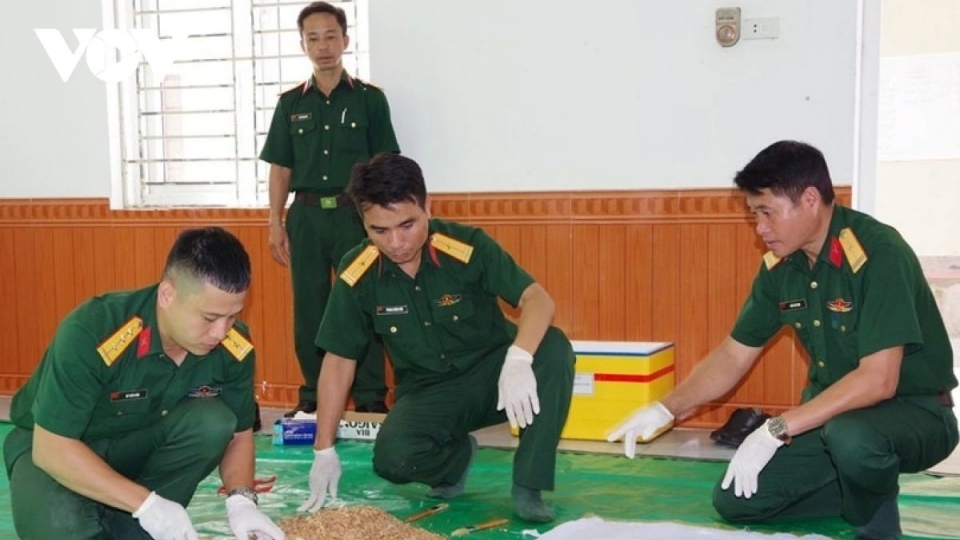
Ha Tinh to bury remains of 8 Vietnamese martyrs repatriated from Laos
VOV.VN - Central Ha Tinh province is preparing to receive and bury the remains of eight Vietnamese volunteer soldiers and experts who died in Laos during wartime missions.