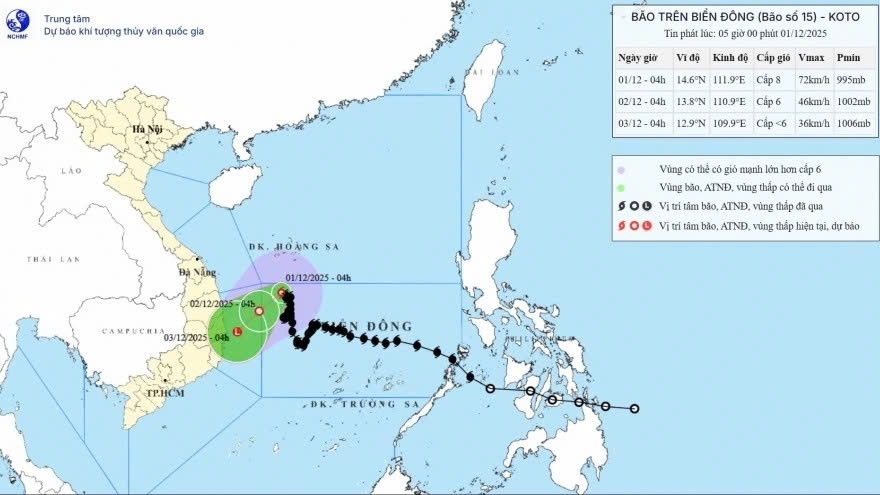
2026 storm season seen as less severe than 2025

VOV.VN - The number of storms and tropical depressions active in the East Sea and affecting Vietnam in 2026 is likely to be lower than in 2025, particularly in the final months of the year, as the ENSO cycle is expected to gradually shift toward an El Niño phase, according to Vietnam’s National Centre for Hydro-Meteorological Forecasting (NCHMF).

Hoang Phuc Lam, Deputy Director of the National Centre for Hydro-Meteorological Forecasting, said ENSO is currently in a weak La Niña state and is likely to move toward neutral conditions in the coming months, before tilting toward a warm phase by late 2026 and early 2027.
Under El Niño–leaning conditions, rainfall across Southeast Asia, including southern Vietnam, is likely to fall below the long-term average in the latter part of the year.
From February to July 2026, the number of storms and tropical depressions in the East Sea and those affecting Vietnam is expected to remain close to the long-term average.
From August to December, storm activity is forecast to fall below average, though the risk of strong-intensity storms remains. Storm impacts are expected to be concentrated in northern Vietnam during August and September, before shifting toward central and southern regions later in the year.
The rainy season nationwide in 2026 is expected to remain broadly in line with long-term averages. The number of widespread heavy rainfall events is likely to be at or below average, beginning around June in the north and tapering off by around November in central provinces.
Along Vietnam’s southeastern coast, several high-tide events are forecast in 2026, with water levels at the Vung Tau station potentially exceeding 4.3 metres during peak tides in November and December.
During the early dry season of 2026, saltwater intrusion in the Mekong Delta is expected to stay close to long-term averages and remain lower than in the 2024-2025 dry season, with limited impacts anticipated on livelihoods and agricultural production.
According to the Department of Meteorology and Hydrology, weather conditions in 2026 may be more moderate than in 2025 overall, but the year will still carry risks of hazardous and abnormal weather, particularly during transitional periods.
Heatwaves are likely to be more intense, while cold spells and unseasonal rainfall may continue to occur in the early months of the year.

Vietnam likely to brace for more typhoons as La Nina appears
VOV.VN - Meteorologists have warned that Vietnam would probably face more super typhoons in the coming months as El Nino has shifted to La Nina which is anticipated to make the stormy season this year more complicated.