Ho Chi Minh Thought remains guiding value for Vietnam in new era of development

VOV.VN - As Vietnam enters a period of profound transformation in its development model, Ho Chi Minh Thought continues to be viewed not merely as a historical legacy, but as a guiding value system for innovation, international integration and sustainable development.
Ho Chi Minh Thought and Vietnam’s development vision
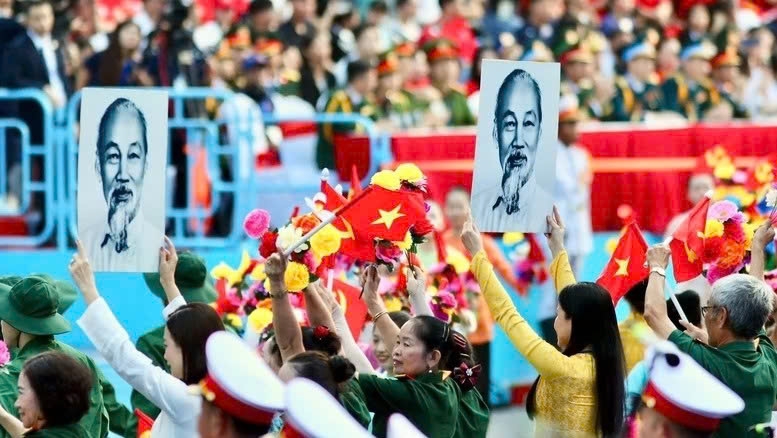
One hundred and thirty-six years after President Ho Chi Minh’s birth, his ideas on national independence, self-reliance, people-centred development, and combining national strength with the strength of the times hold enduring relevance for Vietnam’s development journey today.
In a world marked by rapid change, intensifying strategic competition and accelerating digital transformation, these values are increasingly regarded as an intellectual foundation enabling Vietnam to pursue innovation and deeper global integration while preserving its identity, independence and distinct development orientation.
Not only revered as the great leader of the Vietnamese nation, President Ho Chi Minh has also been internationally recognised as a symbol of peace, national independence and the aspiration for human liberation. His name and legacy extend far beyond Vietnam through statues, memorials, parks and streets bearing his name across many countries.
Today, dozens of memorial sites dedicated to President Ho Chi Minh can be found across Asia, Europe, Africa and the Americas. These works not only reflect respect for an outstanding Vietnamese leader, but also demonstrate the international stature and timeless value of the ideas and legacy he left behind.
A global legacy of peace and national independence
UNESCO’s recognition of Ho Chi Minh as a World Cultural Celebrity further highlights the international community’s appreciation of his contributions to struggles for peace, national independence, social progress and human rights.
Through his revolutionary activities, Ho Chi Minh consistently advocated dialogue, peace, respect for the right of nations to self-determination, and the peaceful settlement of conflicts. These principles are highly relevant today as the world faces growing instability, strategic rivalry and geopolitical tensions.
The enduring vitality of Ho Chi Minh Thought lies first and foremost in its spirit of independence, self-reliance and creativity. In his journey to find a path for national liberation, Ho Chi Minh did not approach Marxism–Leninism dogmatically, but always adapted it to Vietnam’s realities and the conditions of colonised nations.
From this perspective, he developed important theoretical and practical arguments, notably the view that national liberation revolutions in colonies could achieve victory before proletarian revolutions in imperialist countries.
Analysing this issue, Associate Professor Dr. Ly Viet Quang, director of the Ho Chi Minh and Party Leaders Institute under the Ho Chi Minh National Academy of Politics, said this was a key difference from classical Marxist-Leninist theory, which held that proletarian revolutions in colonial countries could only succeed after socialist revolutions had triumphed in capitalist states.
“It was precisely this spirit of independent, self-reliant and creative thinking that enabled President Ho Chi Minh to lead the Vietnamese revolution to remarkable victories,” he stressed.
This independent way of thinking helped Vietnam’s revolution identify a path suited to the nation’s historical circumstances, while also shaping the spirit of self-reliance that has continued throughout the country’s development process.
Beyond being a thinker and revolutionary leader, Ho Chi Minh is also recognised as a visionary strategist whose forecasts carried historic significance. From identifying the opportunity for the August Revolution in 1945 to predicting developments during the resistance war against the US imperialism, his strategic foresight and sharp political thinking helped Vietnam’s revolution maintain initiative during many decisive moments.
Professor of History Pham Hong Tung noted that some Western researchers were initially sceptical that Nguyen Ai Quoc (Ho Chi Minh) and the Party leadership, as early as 1941, had anticipated both Nazi Germany’s attack on the Soviet Union and Germany’s eventual defeat.
“In the end, Western historians, including Professor Stein Tønnesson, discovered archival documents in France related to the 8th Plenum confirming those assessments were completely accurate,” he said.
Today, safeguarding the ideological foundation and legacy of Ho Chi Minh remains an important task in Party building, protecting the Party’s ideological foundation and strengthening the great national unity bloc.
Professor Dr. Mach Quang Thang, senior lecturer at the Ho Chi Minh National Academy of Politics, and Associate Professor Dr. Nguyen Trong Phuc, former director of the Institute of Party History, stated that any act of distorting or insulting President Ho Chi Minh is not only a denial of history, but also an affront to the Vietnamese nation and to a world cultural figure recognised by the international community.
According to the scholars, Ho Chi Minh’s life and career are inseparable from Vietnam’s struggle for national independence, reunification and development aspirations. Therefore, preserving, protecting and promoting the value of his ideological legacy carries not only historical significance, but also important relevance for the present and future.
Guiding Vietnam in a new era of development
As the country enters a new era of development, many values within Ho Chi Minh Thought are being applied and adapted to contemporary realities. These include maintaining long-term development goals alongside renewed approaches to governance, deepening international integration without compromising independence and self-reliance, and pursuing rapid economic growth in parallel with social progress and equity.
In his article Ho Chi Minh’s Light Illuminates Our Path, Party General Secretary and State President To Lam has stressed that Vietnam’s new era of national development places high demands on the entire political system.
“We must be steadfast without becoming conservative; innovate without losing direction. Development must be rapid but sustainable; international integration must be deep while preserving independence and self-reliance. Government reform must create a leaner system that serves the people more effectively. Economic growth must go hand in hand with social progress, fairness and the well-being of the people,” he wrote.
This spirit reflects the ongoing inheritance and development of Ho Chi Minh Thought under Vietnam’s new development conditions.
It is also the approach Vietnam is pursuing as it transforms its growth model, promotes science and technology, innovation, digital transformation and international integration. Throughout this process, the principle of “taking the people as the root” and pursuing development for the people and their happiness continues to serve as a guiding foundation.
Ho Chi Minh Thought does not belong only to history; it remains present in Vietnam’s development choices today. As the country faces major transformations of the modern era, the values he left behind demonstrate long-term significance: independence, self-reliance, solidarity, innovation and sustainable development.
That is why Ho Chi Minh Thought is regarded as a guiding torch for Vietnam’s development journey in an era of global integration and competition.

Leaders pay tribute to President Ho Chi Minh on his 136th birth anniversary
VOV.VN - Senior Party and State leaders of Vietnam on May 19 laid wreaths and paid tribute to Ho Chi Minh at his mausoleum in Hanoi on the occasion of the 136th anniversary of his birth anniversary (May 19, 1890 – 2026).