




Vietnam signals proactive regional role at Shangri-La Dialogue 2026

VOV.VN - Peace and stability cannot be sustained through power competition alone, but must instead rest on international law, dialogue, restraint and inclusive development, according to a senior Vietnamese leader.
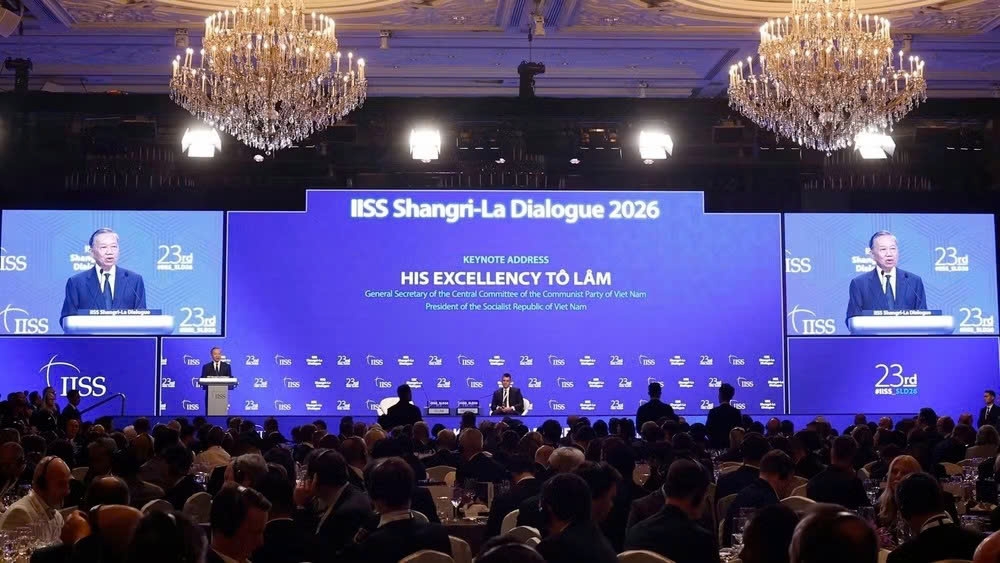
General Secretary of the Communist Party of Vietnam Central Committee and State President To Lam was delivering a keynote address at the 23rd Shangri-La Dialogue in Singapore on May 29. The Asia’s premier security forum, organised annually by the International Institute for Strategic Studies (IISS), was attended by senior leaders, defence ministers, scholars and strategic experts.
Three crises reshaping the world
Under the theme “Proactively Shaping Peace, Stability and Development in a World of Turbulence,” the Vietnamese leader argued that today’s instability reflects the convergence of three underlying crises: a crisis of the international order, a crisis of development models, and a crisis of strategic trust.
According to him, these crises are increasingly interacting with one another and are most visible in the Asia-Pacific - a region that is simultaneously the world’s most dynamic growth centre and a focal point of strategic rivalry.
He warned that many countries, particularly small and medium-sized states, are facing growing pressure from economic, technological, financial and security coercion, while shared spaces such as oceans, cyberspace, supply chains, digital infrastructure and submarine data cables risk becoming arenas of confrontation rather than connectivity.
Referring to recent disruptions affecting strategic maritime routes in the Middle East, the Vietnamese leader noted that conflict in one hotspot can rapidly affect global trade, energy security, logistics and broader economic and social stability.
Rules and dialogue as tools for risk management
Against that backdrop, the Vietnamese leader outlined several principles for building a peaceful, stable and resilient Asia-Pacific capable of managing risks early and effectively.
One of the central messages of the speech was the need to place international law and substantive dialogue at the heart of strategic competition management.
According to him, dialogue should not merely serve as a platform for restating positions, but as a mechanism to identify risks early, maintain communication during tensions, manage differences and prevent crises from escalating into conflict.
He stressed that a rules-based order should not belong to any exclusive group of nations, but must instead serve as a common foundation enabling countries of all sizes to coexist peacefully under international law and the Charter of the United Nations.
“Rules only have vitality when they are implemented consistently and translated into practical mechanisms such as early warning systems, emergency communications, incident management, self-restraint and verifiable cooperation,” he said.
The Vietnamese leader paid particular attention to maritime issues, emphasising that the seas and oceans are not merely strategic spaces or resources, but vital arteries for global trade, energy and supply chains. No country, he argued, would benefit if these shared spaces became venues for coercion, confrontation or displays of power.
Vietnam highlights ASEAN centrality and development-based security
Another major theme throughout the speech was the central role of ASEAN in the regional architecture.
The leader argued that the Asia-Pacific needs an open and inclusive regional structure centred on ASEAN. He reaffirmed Vietnam’s readiness to work with member states to preserve peace, expand prosperity corridors and promote inclusive development.
According to the Vietnamese leader, sustainable security cannot rely solely on military power or arms races, as today’s instability increasingly stems not only from military conflict but also from development disruptions and widening vulnerabilities.
He therefore called for more open and diversified supply chains, stronger connectivity infrastructure and deeper cooperation in finance, technology and human resources, alongside enhanced collaboration in disaster relief, healthcare, water security, food security, energy security, cybersecurity and the protection of critical infrastructure.
He emphasised that strategic trust can only be built sustainably when cooperation contributes directly to people’s livelihoods and security.
Vietnam signals clearer position on AI governance and emerging technologies
A notable part of the speech focused on Vietnam’s approach toward emerging technologies such as artificial intelligence, big data, quantum technologies, autonomous systems and cybersecurity.
The Vietnamese leader observed that these technologies are reshaping the global security environment and stressed the importance of dialogue on the use of AI in defence and security, particularly regarding meaningful human control over decisions with serious consequences.
He also underscored the need to protect data infrastructure, submarine cables and cyberspace, while enhancing transparency surrounding technologies that may affect strategic stability.
He stated that the defence industry should serve legitimate self-defense and regional stability, rather than becoming a driver of arms races.
Another striking aspect of the speech was Vietnam’s framing of “social security” in the digital age.
According to the leader, instability today does not arise only from warfare or cyberattacks, but can also begin with the erosion of social trust through disinformation, information manipulation, extremism and social olarization.
Protecting peace in the digital era, he argued, also means protecting truth, strengthening social trust and enhancing strategic communications and digital civic awareness.
“A society capable of distinguishing truth from falsehood, maintaining social cohesion amid disruptions and resisting manipulation driven by fear, hatred or division will form an essential foundation for sustainable security,” he said.
Preventive diplomacy as a strategic capability
Party General Secretary and State President To Lam further argued that the Asia-Pacific should view preventive diplomacy as a strategic capability rather than merely a reactive tool after crises emerge.
He called for more flexible consultation mechanisms, incident-response contact groups, semi-official dialogue platforms and confidence-building initiatives among militaries, law enforcement agencies, scholars, businesses and civil society organisations.
“The goal is to create diplomatic exit ramps before parties are drawn into spirals of escalation,” the Vietnamese leader said.
Concluding his remarks, the leader emphasised that Vietnam understands the value of peace through its own history and development journey. He stressed that Vietnam’s national interests are closely tied to regional peace, stability and prosperity, and that expanding cooperation, reducing risks and connecting legitimate interests are all part of Vietnam’s responsibility to the international community.
Q&A session clarifies Vietnam’s regional positioning
During the dialogue’s Q&A session, Party General Secretary and State President To Lam elaborated further on how Vietnam views its role within ASEAN and the broader regional architecture.
Responding to questions about governance reforms and their impact on foreign policy, he explained that Vietnam’s efforts to streamline the state apparatus, improve institutions and strengthen governance capacity are aimed at enhancing national competitiveness and resilience amid global volatility.
These reforms, he said, do not alter Vietnam’s independent, self-reliant and diversified foreign policy, but instead help the country implement that policy more effectively.
He also underscored that Vietnam does not seek to become a power centre within ASEAN, but rather aims to be a proactive, responsible and constructive member contributing to ASEAN unity and centrality.
Addressing questions about the Vietnam-China “3+3” strategic dialogue mechanism, the leader said the framework reflects Vietnam’s broader principles of strategic autonomy, self-reliance and proactive international integration.
He reaffirmed Vietnam’s commitment to international law, the UN Charter, peaceful cooperation and responsible global engagement.
On AI governance and emerging technologies, he outlined three core principles guiding Vietnam’s approach that are ensuring human responsibility and oversight; protecting civilian infrastructure and essential systems; and promoting transparency, information-sharing and international trust-building.
According to the Vietnamese leader, the more advanced technology becomes, the clearer and stricter human responsibility must be.
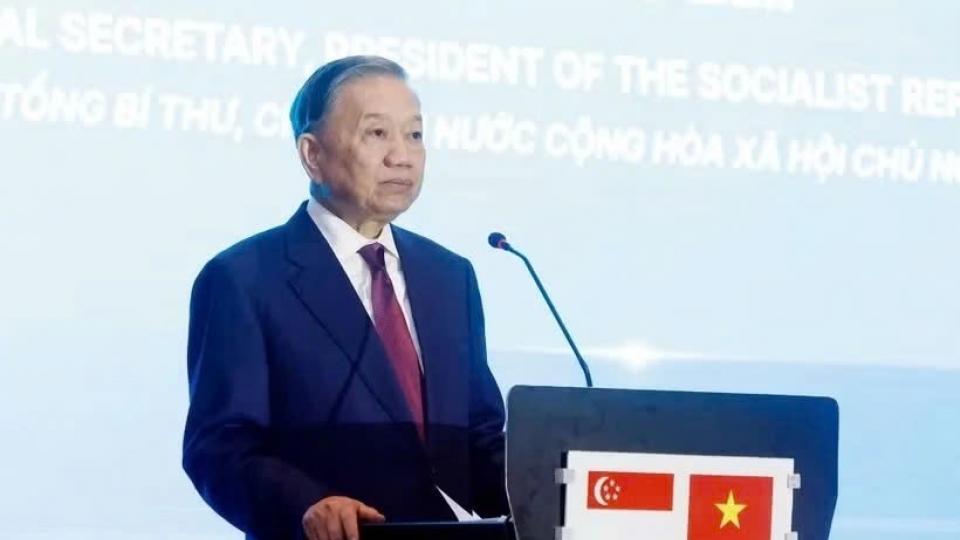
Vietnam and Singapore push beyond connectivity toward joint innovation
VOV.VN - Vietnam and Singapore should foster cooperation in science, technology and innovation, moving beyond traditional connectivity toward a new model centred on joint innovation, shared technological capabilities and long-term strategic development.


