




Vietnam and Singapore deepen digital era partnership

VOV.VN - Vietnam-Singapore relations are increasingly being redefined not merely as a bilateral partnership, but as a strategic cooperation model between two economies seeking to move faster in the digital era, green transition and intensifying global technology competition.

The message featured prominently during talks in Singapore on May 29 between To Lam, General Secretary of the Communist Party of Vietnam and State President, and Singaporean Prime Minister Lawrence Wong. The talks reflected a broader shift in bilateral priorities, with both leaders placing greater emphasis on future-oriented sectors such as digital governance, advanced technologies, artificial intelligence, clean energy and supply chain resilience.
Welcoming the Vietnamese leader on a state visit to Singapore and participation in the Shangri-La Dialogue, PM Lawrence praised the recent elevation of bilateral ties to a Comprehensive Strategic Partnership in March 2025, describing it as opening substantial room for future cooperation.
According to him, Vietnam-Singapore relations are now driven not only by growing political trust, but also by shared development visions and common needs to adapt to evolving global economic and geopolitical dynamics.
For Vietnam, Party General Secretary and State President To Lam reaffirmed that the country is entering a new development phase centred on building a knowledge-based, digital and green economy, with science and technology, innovation and digital transformation identified as key growth drivers.
Notably, he emphasised the determination to continue reforming the administrative system toward a leaner, more efficient and more effective governance model inspired by Singapore’s development experience.
The remarks reflected Vietnam’s view of Singapore not only as a leading investment partner, but also as a regional model for governance capacity, development management and state effectiveness.
If previous decades of bilateral cooperation were largely associated with Vietnam-Singapore industrial parks (VSIPs) and foreign direct investment flows, the current phase suggests both countries aim to move toward a deeper layer of partnership: jointly building ecosystems for the future economy.
The two leaders held extensive discussions on artificial intelligence, national data centres, high-performance computing, emerging technologies, digital transformation, green economy development, clean energy, logistics and strategic supply chains.
Leader To Lam proposed that Singapore continue supporting Vietnam in training high-quality human resources, particularly strategic-level officials and technology talent, while also assisting in the operation of Vietnam’s National Data Centre, High-Performance Computing Centre and Artificial Intelligence Centre.
In response, PM Lawrence praised the community of more than 22,000 Vietnamese students studying in Singapore and affirmed Singapore’s readiness to support Vietnam in developing talent for the digital economy and innovation sectors.
One notable outcome of the talks was the agreement to promote a Vietnam-Singapore technology connectivity initiative aimed at establishing a strategic science and technology ecosystem between the two countries. The initiative marked an important evolution in bilateral ties, from manufacturing cooperation toward technology and innovation partnership.
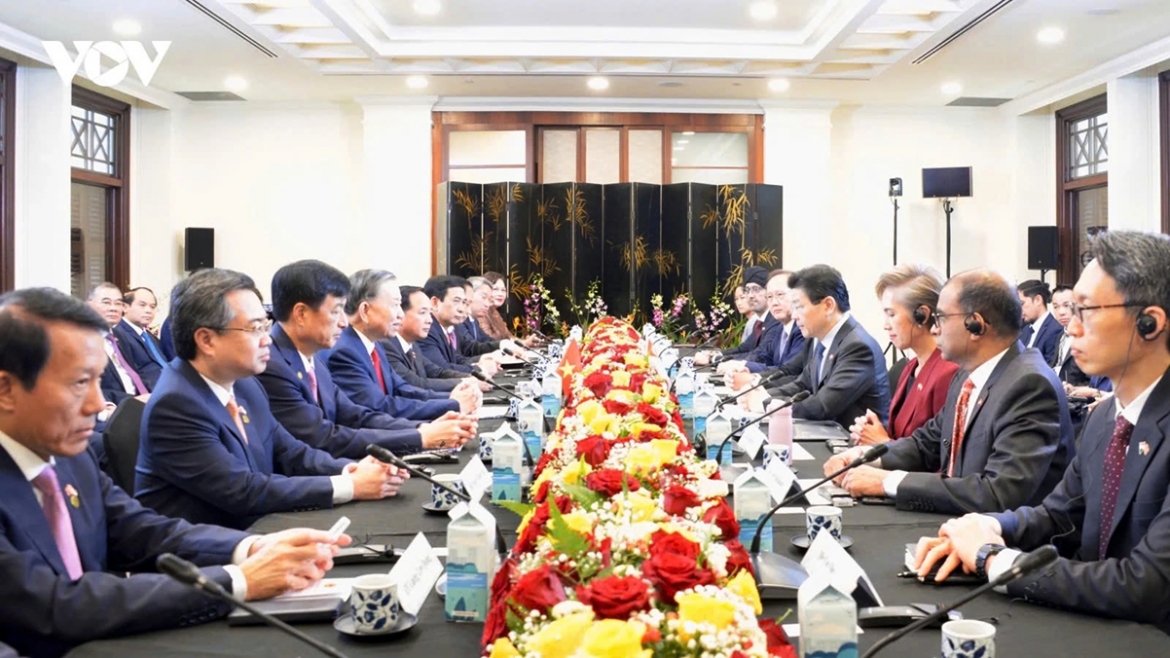
The two leaders agreed to deepen political trust through regular high-level exchanges, improve the effectiveness of bilateral cooperation mechanisms, and elevate strategic coordination through a new strategic dialogue mechanism between the Communist Party of Vietnam and Singapore’s People’s Action Party.
They also agreed to further advance the Green Economy-Digital Economy Partnership, particularly in clean energy connectivity projects, carbon credit exchanges, international financial centre development and next-generation VSIP projects linked to high technology and sustainable development.
Amid continued restructuring of global supply chains, Vietnam and Singapore also demonstrated growing attention to economic resilience. The two leaders agreed to strengthen cooperation in ensuring energy security, food security and regional supply chain resilience.
Alongside economic and technological cooperation, defence and security collaboration will continue expanding in line with rising political trust between the two countries. Both sides pledged to deepen coordination in combating cybercrime, drug-related crime and other non-traditional security challenges.
The leaders also emphasised the importance of social connectivity in the new stage of cooperation, vowing to strengthen people-to-people exchanges, cultural cooperation, education, tourism, aviation connectivity, logistics and maritime links.
From an economic perspective, current cooperation figures illustrate the expanding bilateral foundation. Two-way trade hit nearly US$12 billion in 2025, while Singapore remains Vietnam’s second-largest foreign investor with cumulative registered investment approaching US$100 billion.
Meanwhile, the VSIP network, long regarded as a symbol of bilateral economic cooperation, is expected to reach 30 industrial parks by 2026 as it marks 30 years of presence in Vietnam.
More importantly, however, the two countries are seeking to upgrade the nature of bilateral relations itself: from capital and manufacturing connectivity toward integration in technology, data, high-quality human resources and governance capacity.
At the regional and international levels, Vietnam and Singapore reaffirmed commitments to close coordination at ASEAN, the United Nations and other multilateral mechanisms while supporting ASEAN centrality amid intensifying strategic competition.
The two sides also reiterated the importance of maintaining peace, stability, security, safety and freedom of navigation and overflight in the East Sea, while resolving disputes peacefully in accordance with international law and the 1982 United Nations Convention on the Law of the Sea (UNCLOS).
Following the talks, the two leaders witnessed the signing of multiple cooperation agreements covering Party channels, judicial cooperation, supply chain recovery and new investment certificates for VSIP projects in Hue, Nghe An, Ninh Binh and Hai Phong.
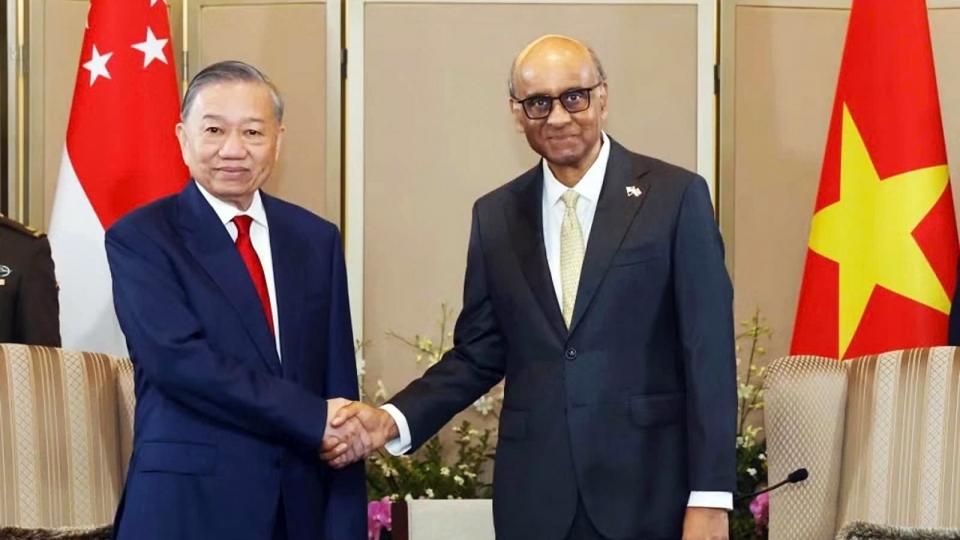
Vietnam and Singapore seek model partnership focused on innovation and green growth
VOV.VN - Vietnam and Singapore are seeking to build a model partnership for a new era in which national competitiveness is shaped not only by trade or investment flows, but increasingly by technology, innovation, clean energy and regional connectivity.


