Central Theory Council for 2026–2031 term holds first meeting

The Central Theory Council for the 2026–2031 term held its first meeting on March 17 at the Ho Chi Minh National Academy of Politics.
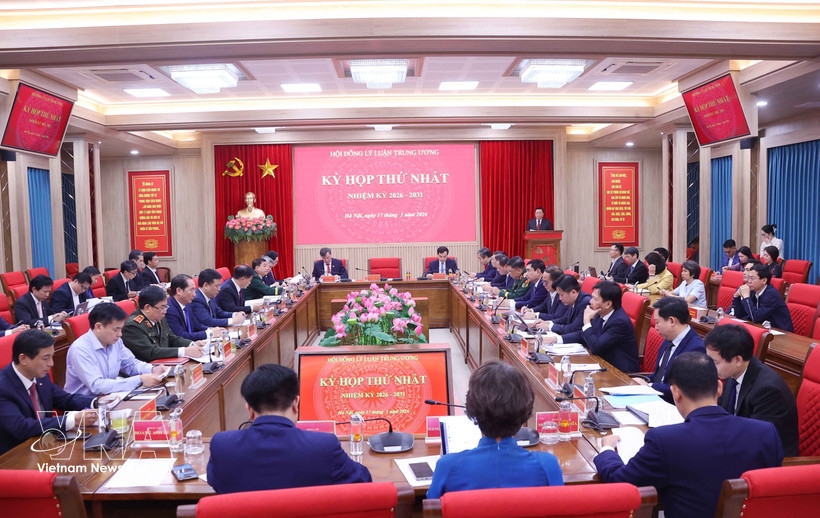
Addressing the event, Nguyen Xuan Thang, member of the 13th Party Central Committee's Politburo, Chairman of the council, emphasised that as the country enters a new stage of development, the Party’s theoretical work must “go ahead and lead the way” by providing scientific arguments to guide national development.
The council should continue strengthening its role as a core intellectual institution and strategic think tank of the Party. In the coming period, it should focus on clarifying major theoretical issues, addressing pressing practical challenges and intensifying the review of real-world practices, he stated.
Contributing ideas on renewing the council’s working methods in the new context, Huan highlighted emerging challenges, noting that the rapid development of artificial intelligence (AI) is fundamentally transforming the way political science research is conducted. Theoretical knowledge today is no longer generated solely by humans but is increasingly influenced by algorithms, leading to a stronger overlap between theoretical sciences and technological sciences.
He emphasised that political theory research in the new era must be grounded in clear political orientation while closely linked to practical realities and concrete actions. Social sciences and theoretical studies can no longer remain detached and wait for retrospective evaluations as in the past, but must accompany technological development in real time.
In particular, theory should be integrated into the design of technologies and algorithms to help establish ethical foundations, guide human behaviour and minimise negative impacts. To accomplish this task, stronger and more proactive coordination mechanisms are required between the council and specialised scientific research institutes.
According to him, whereas political theory previously focused mainly on viewpoints, guidelines and orientations, it now needs to be closely associated with concrete action programmes and practical implementation. Therefore, theoretical research must produce tangible outputs rather than remain at the level of general perspectives.
During the session, council members discussed and gave opinions on the draft working regulations of the council for the 2026–2031 term, the 2026 work programme and the overall work plan for the entire term.
The council also provided in-depth comments on two major proposals of historical significance: the draft outline for the report reviewing 100 years of the Communist Party of Vietnam’s leadership of the Vietnamese revolution (1930–2030) and outlining directions for national development over the next century (2030–2130), and the draft outline for the report reviewing 40 years of implementing the Platform for National Construction in the transitional period toward socialism.
Party’s Central Theoretical Council for 2026-2031 term set up
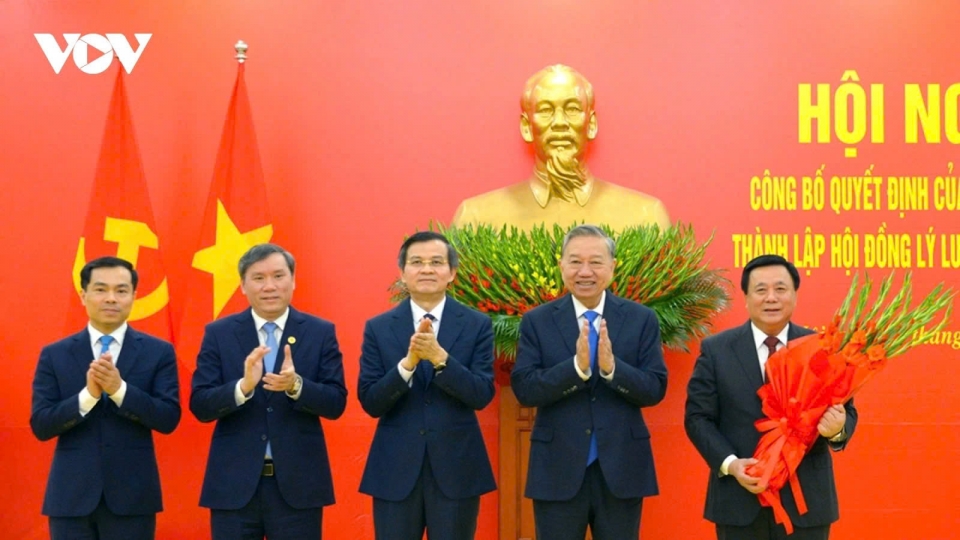
VOV.VN - The Politburo of the Communist Party of Vietnam has decided to establish the Central Theoretical Council for the 2026–2031 term, with an announcement made at a conference held at the Party Central Committee headquarters in Hanoi on March 10.