Vietnam positions itself in global AI supply chain

VOV.VN - While Vietnam does not manufacture leading-edge logic chips or high-bandwidth memory (HBM), it is enhancing its position in the AI supply chain by producing essential components that keep data centres running while becoming a major player in outsourced semiconductor assembly and testing (OSAT).

This assessment was made by Frederic Neumann, Chief Asia Economist and Co-Head of Global Investment Research, Asia at HSBC, and Justin Feng, Asia Economist at HSBC.
He pointed out that the AI supercycle is still roaring, for now. Electronics sector purchasing managers’ indices (PMIs) continue to signal strong operating conditions and expanding orders across industrial, consumer and computing products — globally and in Asia.
Vietnam may not produce leading-edge logic chips or high-bandwidth memory (HBM), but it does supply the less glamorous – yet essential – components that keep data centres running, such as server racks and printed circuit boards.
This did not happen overnight. Vietnam has spent years climbing a crowded Asian electronics ladder dominated by Japan, the Republic of Korea, Taiwan, mainland China, Singapore, Malaysia and Thailand. It has built formidable production and assembly capabilities in smartphones, audio equipment, displays, home appliances, lower-end chips and consumer electronics.
That industrial buildup has paid off handsomely. Last year, Vietnam exported US$160 billion of electrical and electronic machinery, equivalent to roughly 30% of its GDP. The country is enjoying a robust growth with a strong third-quarter GDP print, supported by trade, manufacturing and infrastructure investment
Foreign manufacturers have helped power that surge. Korean firms, such as Samsung and LG, built large industrial clusters and supplier ecosystems. More recently, mainland Chinese outbound direct investment (ODI) has added fresh momentum: over the past three years, mainland Chinese ODI flows into Vietnam totaled US$9 billion, making it one of Southeast Asia’s largest recipients.
Vietnam is benefiting from mainland China’s industrial reinvention — from the world’s factory floor to the world’s factory for factories, supplying the components and equipment for factories elsewhere. No Southeast Asian economy has recorded a larger increase in imports of Chinese intermediate components than Vietnam. Those inputs create manufacturing jobs and business opportunities, while helping Vietnamese firms integrate into fiercely competitive regional supply chains.
For Chinese manufacturers, Vietnam’s appeal rests partly on the electronics capabilities that earlier Korean investment helped establish. The country also offers a relatively young, lower-cost and adequately skilled workforce.
Yet Vietnam still largely handles final assembly, while Chinese and Korean companies supply higher value-added components and equipment. Long-term economic spillovers are not guaranteed, and the AI boom should not breed complacency. Investor concerns over capital spending and profitability are rising, while data-centre expansion faces tighter constraints on energy, land, water, regulation and manufacturing capacity.
Vietnam’s next move is to continue climbing up industrial supply chains. China offers a precedent, having evolved from assembler for foreign multinationals to competitor against global leaders. Vietnam has already recorded Asia’s largest increase in export complexity over the past decade, led by electronics, and its young industrial base is expanding as workforce across much of Asia is rapidly aging.
That advantage will endure only if Vietnam uses the AI moment to build capabilities, not merely capacity, by deepening domestic supplier networks and absorbing more foreign technical and commercial know-how.
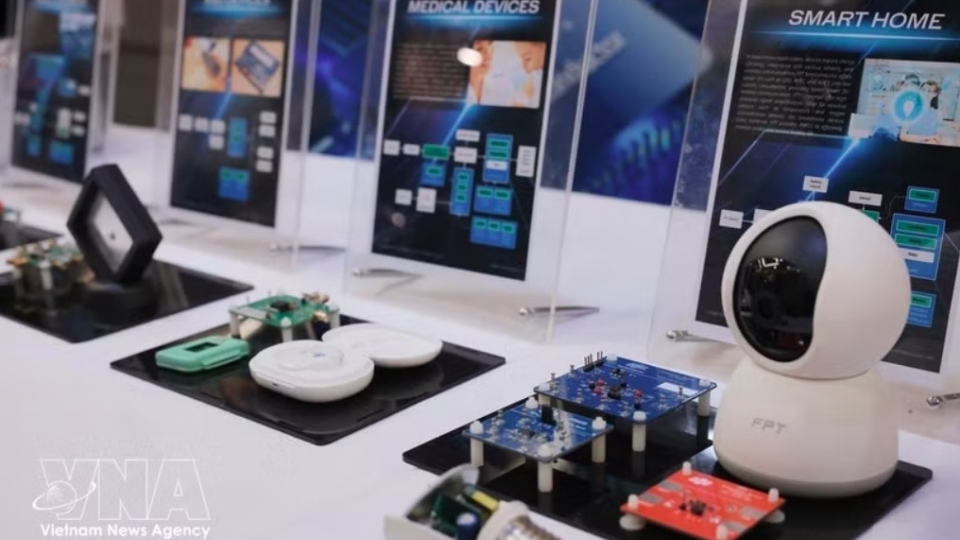
Vietnam should prioritise chip manufacturing, packaging: Japanese expert
As countries around the world step up efforts to build semiconductor capabilities to meet growing demand driven by artificial intelligence (AI), Vietnam should identify areas where it can develop competitive advantages in the value chain, with an initial focus on chip manufacturing and packaging.