India’s 2026 Budget unlocks broad opportunities for Vietnamese enterprises

India’s 2026–2027 union budget is opening up promising prospects for Vietnamese businesses, particularly as the South Asian economy accelerates reforms toward trust-based governance, according to Vietnamese Trade Counsellor in India Bui Trung Thuong.
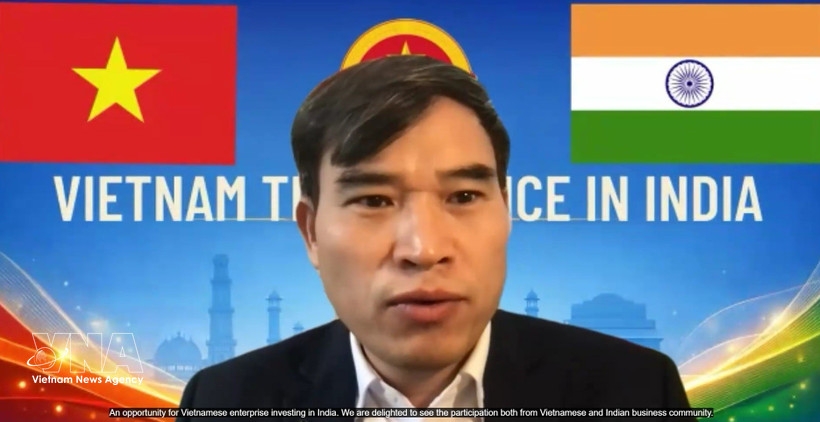
Speaking at an online seminar titled “India’s 2026 Budget and Opportunities for Vietnamese Businesses,” organised by the Vietnam Trade Office in India on March 19, Thuong highlighted that India's 2025 Income Tax Act, alongside streamlined and more transparent customs procedures, is a positive sign, creating favourable conditions for Vietnamese enterprises to scale up investment and business operations in the market.
Providing in-depth analysis, Manan Agarwal, Partner at KrayMan Consultants LLP, outlined four key pillars underpinning India’s development strategy. These include sustaining growth through high-tech sectors such as semiconductors, biopharmaceuticals, finance, tourism and education; strengthening growth foundations; advancing human-centred development through job creation and skills training; and promoting trust-based governance reform through digital transformation and artificial intelligence.
The budget also prioritises investment in strategic sectors, including data centres, digital services, semiconductor manufacturing, biotechnology and renewable energy, while reviewing the Foreign Exchange Management Act (FEMA) to facilitate smoother international capital flows.
He noted that India is undergoing a structural shift from reliance on fiscal incentives to building a trust-based, stable and transparent business environment. For Vietnamese enterprises, reforms such as simplified tax procedures and AI-enabled customs systems are expected to reduce compliance costs and shorten clearance times.
Beyond procedural improvements, India’s focus on high-growth industries opens new avenues for Vietnamese firms to participate in emerging global value chains. The extension of advance ruling mechanisms to five years further enhances legal certainty, enabling investors to plan long-term strategies with reduced risk.
As India sustains robust growth and continues to refine its legal framework for international investment, the current period is widely viewed as a “window of opportunity” for Vietnamese businesses to deepen market engagement, particularly in manufacturing, services and export-oriented sectors.
During the discussion session, enterprises raised practical concerns regarding company establishment procedures, tax obligations and access to government support schemes. The Vietnam Trade Office reaffirmed its commitment to providing ongoing guidance and support to Vietnamese businesses seeking to explore and invest in this dynamic market.

Vietnam, India strengthen cooperation on religion, ethnic minority affairs
A high-level delegation from Vietnam’s Ministry of Ethnic and Religious Affairs led by Minister Dao Ngoc Dung has visited India from March 17-19 for bilateral activities and to attend the Bharat Tribes Fest 2026 in New Delhi.