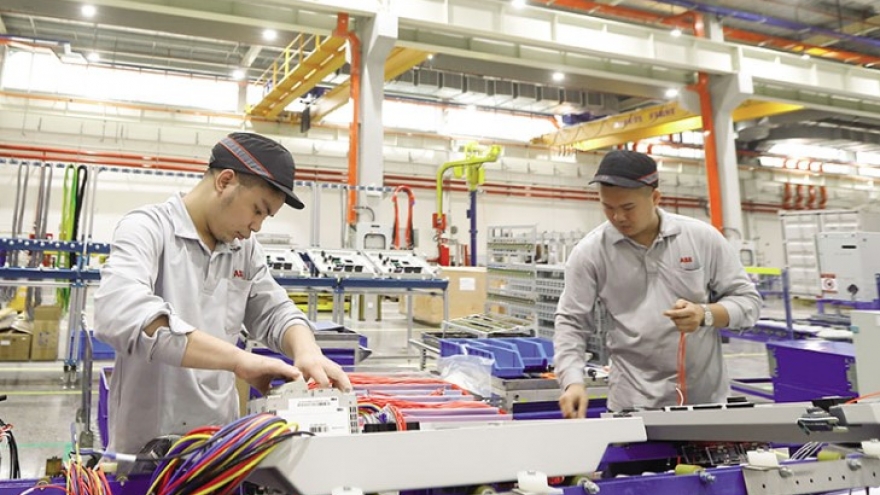
FDI disbursement reaches five-year high in four months

VOV.VN - Foreign direct investment (FDI) continued to perform strongly in Vietnam during January-April 2026, with realized FDI estimated at US$7.4 billion, up 9.8% from the same period last year.
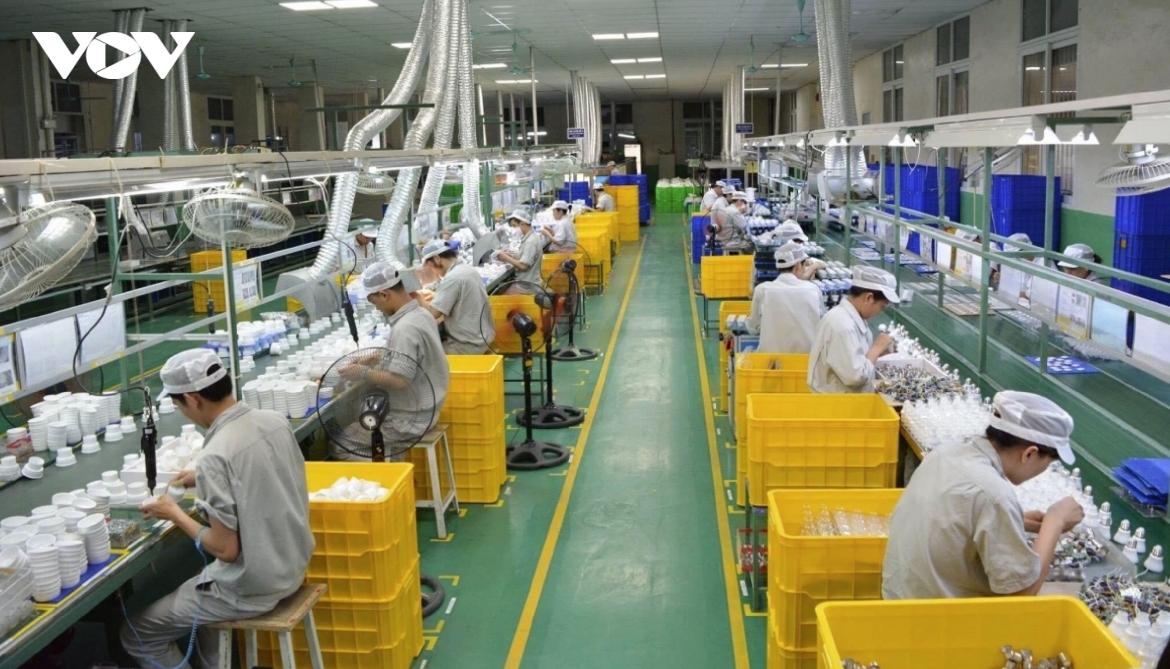
The figure marked the highest level for the same period in the past five years, showing sustained confidence among international investors in Vietnam’s business environment and long-term economic prospects.
According to an April 2026 and January-April 2026 socio-economic report released by the Statistics Office under the Ministry of Finance, total registered FDI in Vietnam had hit US$18.24 billion as of April 27, up 32% year-on-year.
Manufacturing and processing accounted for the largest share of realized FDI at US$6.12 billion, equivalent to 82.7% of the total. Other major sectors included real estate, and electricity, gas, steam and air-conditioning supply. Several large-scale projects have also taken shape in financial technology and manufacturing, particularly linked to the development of international financial centers in Ho Chi Minh City and Da Nang.
Nguyen Thuy Hanh, CEO of Standard Chartered Bank Vietnam, said the establishment of international financial centers could provide a strong foundation for attracting both direct and indirect foreign investment flows into Vietnam.
International investors would feel more confident investing in Vietnam as the legal and regulatory frameworks of such financial centers become more aligned with international standards, Hanh added.
Many experts forecast that FDI inflows into Vietnam are likely to reach around US$38-40 billion annually during the 2026-2030 period, supported by projects negotiated since late 2025 and by high-level commitments between Vietnamese leaders and foreign governments and major corporations that are gradually falling into place for implementation.
Foreign businesses have expressed confidence in Vietnam’s investment potential and business environment, while also proposing measures related to energy, high-tech industries, logistics, trade and finance. The Government has instructed ministries and agencies to urgently study, handle and provide written responses to specific recommendations, particularly those related to administrative procedures.
Prime Minister Le Minh Hung said institutional and legal reforms, along with the simplification of business conditions and administrative procedures, are among the Government’s top priorities.
He said deputy prime ministers had been assigned to work directly with ministers to accelerate the review and reduction of business conditions and administrative procedures, adding that the reforms would benefit the broader Vietnamese economy as well as foreign investors.
Vietnam is also shifting toward more selective foreign investment attraction policies, with incentives increasingly focused on performance-based and post-investment mechanisms rather than tax incentives alone, according to Conclusion No. 18 issued after the second plenum of the 14th Party Central Committee.
The northern province of Thai Nguyen has introduced a range of measures to attract investors, including faster site clearance, the preparation of cleared land, streamlined administrative procedures under a “green channel” mechanism, and proactive support for investors throughout project implementation. Transport infrastructure, particularly regional expressway connections, has also continued to improve.
To attract next-generation and high-tech FDI, Vietnam can no longer rely solely on low-cost advantages and must instead strengthen the internal capacity of its economy, experts said. Vietnamese firms need to shift from participation to a higher position in global value chains, gradually mastering technology and engaging in higher value-added activities such as design, research and development, and innovation.
According to Tran Toan Thang, Head of the International Cooperation and Integration Policy Department under the Institute of Strategy and Policy on Economy and Finance at the Ministry of Finance, future FDI attraction efforts would focus on sectors prioritized by Vietnam, including R&D, electronics, AI and other high-tech industries.
This year should mark the beginning of more substantive efforts to translate policy orientations into concrete institutional frameworks capable of attracting global FDI flows, he added.
With the Government’s policy measures and stronger implementation efforts by ministries, sectors and localities, Vietnam is expected to see a continued shift toward higher-quality FDI, particularly in high technology, green industry and renewable energy, helping support double-digit economic growth this year and in the years ahead.
Vietnam maintains FDI inflows as investment quality improves
VOV.VN - Amid fluctuations in global foreign direct investment (FDI) flows, with geopolitical tensions and trade uncertainty increasing, Vietnam has remained relatively stable while the quality of inflows is gradually improving and the country is moving deeper into global value chains.
FDI inflows surge 32% in four months, disbursement hits five year high
VOV.VN - Foreign direct investment (FDI) inflows into Vietnam continued to accelerate in the first four months of 2026, totalling US$18.24 billion, up 32% year on year, while disbursed capital rose to its highest level in five years, reflecting sustained investor confidence in the country’s economic outlook.