


Double-digit growth: A test of Government effectiveness

VOV.VN - Double-digit growth depends on local authorities’ ability to remove business obstacles, improve policy implementation and create a transparent business environment.

Double-digit economic growth is placing new demands on local authorities. However, according to Pham Thi Ngoc Thuy, executive director of the Office of the Private Economic Development Research Board (Board IV), businesses not simply look for policy announcements or reform commitments, but, more importantly, tangible changes in the way the government operates, particularly its ability to resolve difficulties quickly and effectively.
From the business community’s perspective, ambitious growth targets are prompting many local authorities to take more decisive action. Such changes only matter when they produce concrete improvements in the business environment.
Businesses need swift and practical action from authorities
According to Thuy, businesses can see tangible changes in local governance through simpler procedures, fewer overlapping inspections, lower informal costs and faster resolution of difficulties.
“Where local authorities truly treat businesses’ difficulties as their own, we believe the new 'flame' of growth can take hold in practice,” she told VOV in a recent interview.
The implementation of Decree 46 on food imports during the recent Tet holiday provides an example. When businesses encountered difficulties, many localities waited for guidance from higher-level authorities. But in Tay Ninh, the provincial People’s Committee and customs authorities proactively assessed the situation and found a solution that ensured state management requirements were met while facilitating businesses, allowing imported goods to pass through the border gate.
Local customs authorities also arranged round-the-clock staffing to assist businesses, particularly those importing fresh cassava, which could suffer losses if customs clearance was delayed. This is a clear example of prompt action that businesses could recognise through practical experience rather than communications.
She also cited improvements in land-related administrative procedures in Lao Cai. Under Directive No. 42-CT/TU of the Provincial Party Committee's Standing Board, together with decisions on document circulation and coordination in land administration, the locality has cut and simplified many previously cumbersome procedures. These changes save businesses time and costs, help unlock investment and strengthen confidence in the business environment.
The examples show that reform does not necessarily require major changes or grand declarations. It can begin with identifying obstacles, coordinating timely solutions and placing the legitimate interests of citizens and businesses at the centre of governance.
Accountability for implementation is decisive

To turn growth targets into tangible results, Thuy identified three interconnected priorities, namely removing institutional bottlenecks, strengthening accountability for implementation and creating a transparent, stable business environment. Of these, she considered implementation accountability the most critical area for a breakthrough.
“Institutions are a necessary condition, but accountability for implementation is a sufficient condition for unlocking resources among citizens, businesses and other stakeholders,” she stressed.
Even with a sound institutional framework and business-friendly policies, projects can still stall, capital flows remain constrained and business opportunities be lost if officials are hesitant, avoid responsibility for fear of making mistakes, pass the buck or pursue personal interests.
By contrast, when officials act decisively, take responsibility for the common good and put citizens and businesses first, local authorities and individual officials can proactively find flexible solutions within the law to address difficulties.
What businesses need most now, in her view, are decisive decisions made within the proper authority and at the right time.
This requires changes in the way authorities at all levels operate. Policy-making must go hand in hand with implementation, assigned tasks must carry clear responsibilities, and issues within an agency’s remit must be resolved promptly rather than passed between offices or left awaiting instructions when they can be handled locally.
As decentralisation and the delegation of power expand, implementation capacity must be measured not only by the completion of administrative tasks, but also by the ability to address problems proactively, coordinate resources and facilitate business operations.
Leaders must be architects who clear the way

Alongside individual officials' responsibilities, the role of local leaders is crucial to the effective operation of the government apparatus. As localities receive greater decision-making powers, the resolve, initiative and development-oriented leadership of those at the helm become key to turning policies into action.
According to Thuy, leaders must do more than approve decisions and oversee operations. They must clear the way, create favourable conditions and provide support so that their subordinates can carry out their duties with confidence.
“Leaders must be more than people who sign off on decisions. They must be 'architects' who clear the way and provide a secure foundation for their subordinates to focus on implementation with confidence and determination,” she said.
She argued that stronger decentralisation and delegation of power give local authorities greater autonomy while placing their leaders’ resolve to the test. In the pursuit of growth, provincial Party Committee secretaries and chairpersons of provincial People’s Committees cannot simply maintain a safe status quo; they must lead, shape development and inspire action throughout the administrative apparatus.
The initiative and commitment of leaders provide the confidence officials need to innovate, take bold action and accept responsibility. When leaders show determination, set clear directions and support efforts to resolve difficulties, implementation across local agencies is strengthened.
The ultimate goal, however, is not simply to bring about temporary improvements in administration, but to build a more effective governance system in which every official can exercise their capabilities and creativity for the common good.
The official referred to directives from General Secretary of the Communist Party of Vietnam Central Committee and State President To Lam on shifting the focus towards improving the quality of government operations, public service and the capacity to facilitate development. The leader called for fundamental changes in development thinking throughout the political system and society, and an end to risk-averse attitudes, short-term thinking and narrow, localised approaches.
From the business community's perspective, qualitative improvements in the government apparatus are the most lasting value that ambitious growth targets can generate.
“GDP figures and double-digit growth may be targets to achieve each year, but qualitative improvements in the government apparatus are the core of sustainable value, while a development-oriented public service culture is a lasting legacy,” Thuy stressed.
The governance system must therefore move away from a top-down, permission-based approach towards one centred on partnership and public service, with civil servants encouraged to innovate, take the initiative in resolving problems and act in the common interest. This is essential not only to improving the business environment, but also to strengthening the country’s endogenous capacity.
As the state sector shifts from managing to enabling development, and from a top-down, permission-based approach to partnership and public service, economic growth will be supported not only by short-term efforts but also by a sustainable governance framework.
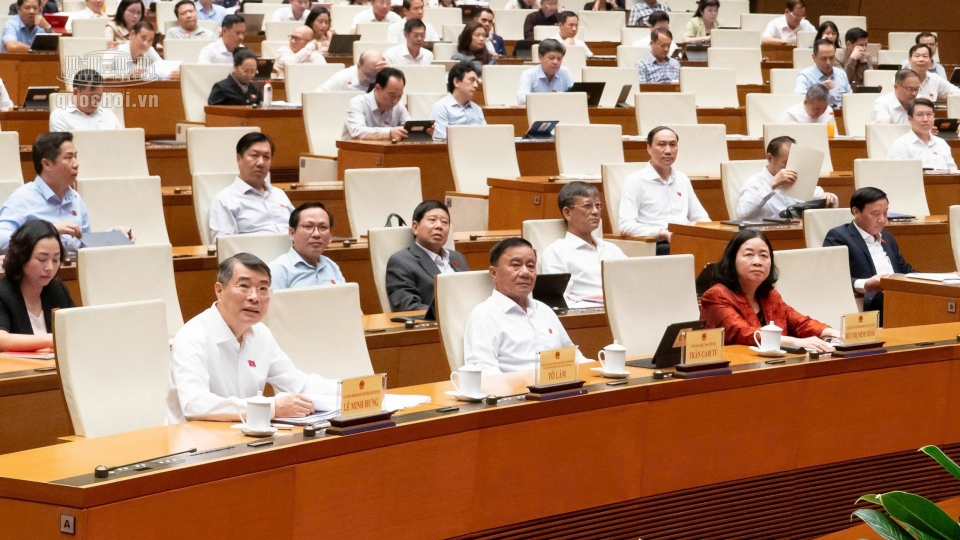
Double-digit growth ambition hinges on efficient capital, institutional reform
VOV.VN - Vietnam’s ambition to achieve double-digit economic growth will depend not only on mobilising more capital, but also on allocating resources more efficiently, boosting productivity and removing institutional bottlenecks, National Assembly deputies said during a plenary debate on October 30.


