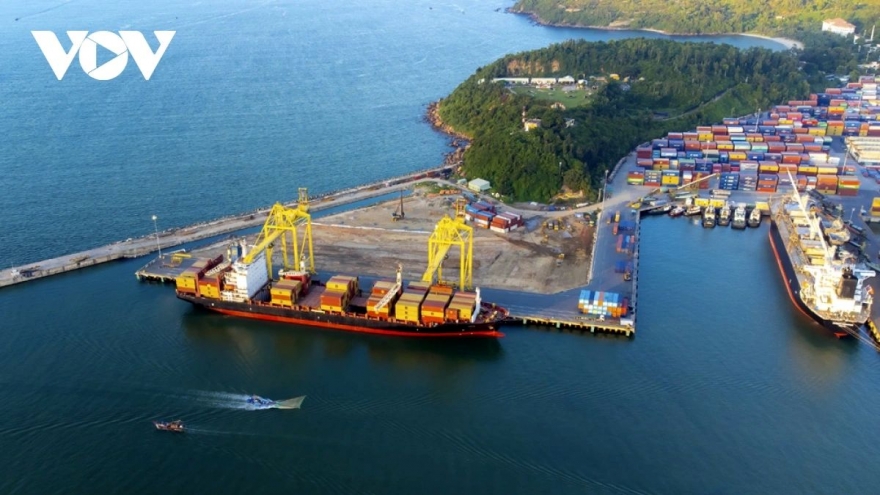
Container shipping rates inch up amid global maritime disruptions

Container freight rates are beginning to rise in Vietnam as geopolitical tensions and surging fuel costs disrupt global maritime transport, increasing pressure on shipping lines and logistics markets and signalling further volatility ahead.
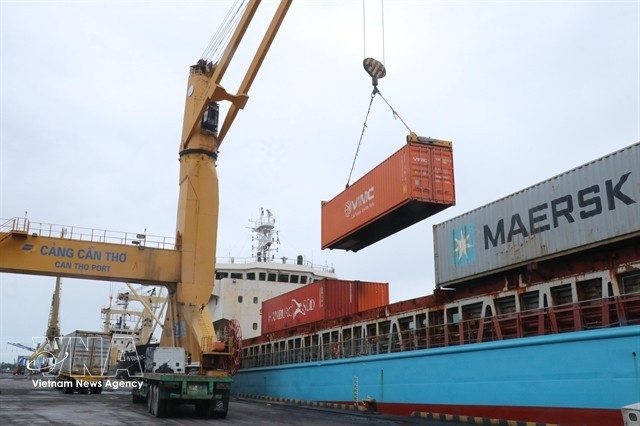
International container shipping has been affected by escalating conflicts in the Middle East, which have disrupted several major trade routes. Some vessels are unable to pass through the Strait of Hormuz, forcing carriers to reroute services.
To maintain operations, many shipping lines have diverted vessels around the Cape of Good Hope. The detour significantly lengthens transit times and raises operating costs for shipping fleets, placing upward pressure on global freight rates.
Data from Drewry show the latest reading of its World Container Index rose 8% week on week to US$2,123 per 40-foot container. The increase was mainly driven by higher rates on Asia–Europe and trans-Pacific routes.
Major shipping lines, including MSC and CMA CGM, have also announced higher Freight All Kinds rates starting March 22.
According to Drewry, spot freight rates on international routes may continue to climb in the coming weeks as shipping companies adjust capacity to cope with disruptions and rising operating expenses.
Fuel prices are also adding to the pressure. Data from Thurlestone Shipping indicate the price of low-sulphur fuel oil has surged from around US$521 per tonne to as high as US$822 per tonne, while marine low-sulphur diesel has at times reached US$1,383 per tonne.
In Vietnam, authorities say most international freight rates from the country to overseas markets have not yet seen significant adjustments. However, shipping lines whose vessels must reroute via the Cape of Good Hope have started imposing war-risk surcharges.
According to the Vietnam Maritime and Waterway Administration, most major carriers have temporarily suspended cargo services from Vietnam to the Middle East and are not accepting new bookings on those routes for the time being.
Domestic container freight rates rise
Amid rising international shipping costs, Vietnam’s domestic container transport market has also begun to see adjustments.
Hai An Transport and Stevedoring Joint Stock Company recently announced higher domestic container freight rates starting March 19.
Under the new tariff schedule, the rate for a loaded 20-foot container on the Hai Phong–Ho Chi Minh City route is listed at VND6.5 million per container, while the Hai Phong–Cai Mep route is priced at VND7.5 million. The Nghi Son–Cai Mep route costs around VND8.5 million per container.
For loaded 40-foot containers, the respective rates are VND9 million on the Hai Phong–Ho Chi Minh City route, VND10.5 million for Hai Phong–Cai Mep and VND11 million for Nghi Son–Cai Mep. Some routes such as Cai Mep–Da Nang and Cai Mep–Nghi Son are priced at about VND11.5 million per 40-foot container.
Compared with the tariff applied in March 2025, Hai An’s new price list represents an average increase of about VND1–1.5 million per container.
Similarly, Vsico Maritime Joint Stock Company has announced adjustments to its container freight rates from March 25.
The Hai Phong–Ho Chi Minh City route is priced at VND7 million per 20-foot container and VND10 million per 40-foot container. In the reverse direction, freight rates from Ho Chi Minh City to Hai Phong are listed at VND6 million and VND8.5 million per container, respectively.
Compared with the previous price declaration, Vsico’s freight rates have risen by more than 17% on average, with the Hai Phong–Ho Chi Minh City route for 40-foot containers increasing by as much as 25%.
In addition to the price adjustment, the company has applied a fuel surcharge since March 15. The shipping line said the measure reflects rising fuel costs linked to geopolitical tensions in the Middle East, which could persist in the near future.
According to maritime authorities, global shipping operates through an interconnected network. Any route disruptions or cost increases on key international corridors can create ripple effects across the wider logistics system, reducing fleet efficiency, extending transit times and pushing up transportation costs more broadly.
RoK opens new container shipping route to Vietnam
VOV.VN - The Republic of Korea (RoK)’s Port of Incheon Incorporated announced plans on May 24 to launch a new container shipping route from Incheon Port to various destinations throughout both Thailand and Vietnam.