Agriculture reputation index launched to improve market trust, funding access

The Vietnam Agriculture Reputation Index (VARI), a new programme to rate the credibility of agricultural businesses, and its portal were launched in Hanoi on May 22, a move expected to improve transparency, strengthen market trust, and ease access to finance across the sector.
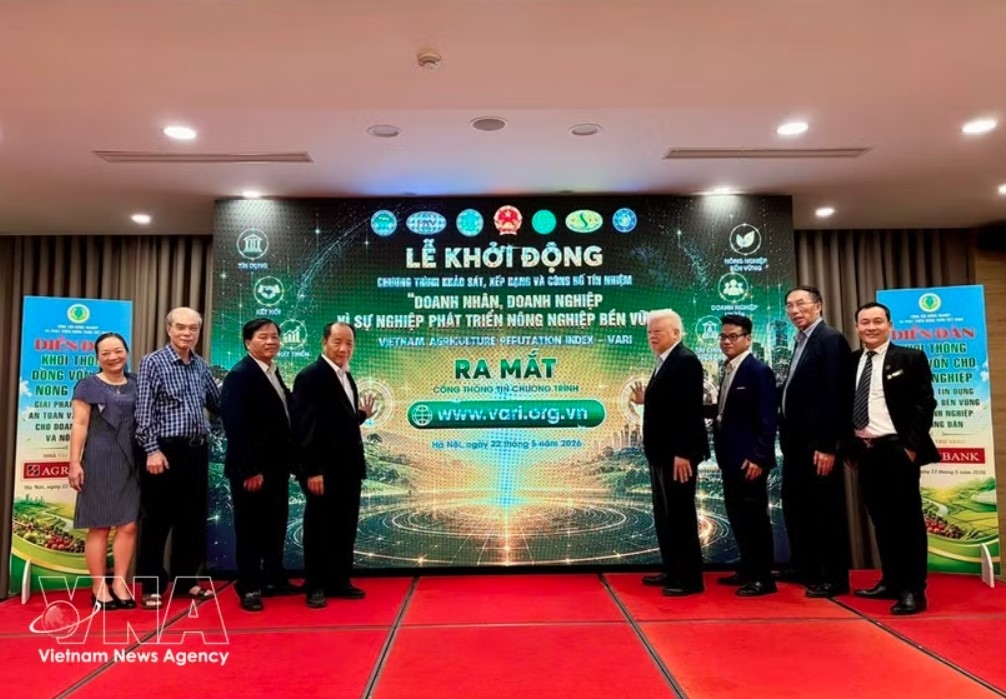
The initiative was unveiled at a forum on unlocking capital for agriculture, organised by the Vietnam General Association of Agriculture and Rural Development.
The VARI initiative is designed to research, survey and assess the credibility of enterprises and entrepreneurs in the agricultural sector in a scientific, objective and transparent manner. It aims to create a reliable reference system that helps consumers, farmers, partners and investors identify responsible businesses that uphold commitments and pursue sustainable development.
Ho Xuan Hung, chairman of the General Association, said the programme comes at a time when parts of the agricultural sector still face issues such as opaque information, substandard products and breaches of commercial commitments. Establishing standardised credibility criteria is expected to promote ethical business practices, foster fair competition and rebuild market confidence.
Beyond rankings, VARI is envisioned as a bridge connecting enterprises with investors, credit institutions and domestic and international partners. By enhancing credibility, reputable firms are expected to gain easier access to capital, markets and cooperation opportunities.
The launch also addresses a longstanding bottleneck - limited access to finance for agricultural enterprises, cooperatives and farmers. Participants at the forum stressed that capital flows into agriculture will remain constrained without greater transparency and reliable tools to assess business trustworthiness.
Hung noted that many businesses and farmers struggle to secure loans due to a lack of collateral, small-scale production and limited financial management capacity. At the same time, risks from natural disasters and disease outbreaks are rising, input costs are increasing, and market outlets remain unstable.
Sectors such as green agriculture, organic farming, circular economy models and high-tech agriculture face even greater challenges, as they require large upfront investment and long payback periods.
Export-oriented agricultural firms also face growing risks in international transactions. Recent cases have seen Vietnamese exporters suffer from delayed payments, goods appropriation or suspected commercial fraud by overseas partners, often using increasingly sophisticated tactics.
In this context, Hung emphasised that commercial banks should expand their role beyond lending to include support for international payments, credit guarantees, partner verification and risk prevention.
Nguyen Thi Thu Hien, president of the Board of Directors of the Institute of International Economic Law (IIEL), said Vietnam needs to develop a dedicated ESG index tailored to agriculture, aligned with international green taxonomy standards but simplified enough for large-scale farmers and cooperatives to apply. She noted that indicators should be quantified using technical metrics such as water savings or CO₂ emission reductions, providing a basis for banks to offer preferential green loans while easing collateral requirements.
Agricultural enterprises, she added, must adopt digital technologies and produce transparent sustainability reports to attract green finance and international funding, reducing reliance on traditional bank credit.
The launch of VARI and its portal is expected to provide a new communication and promotion channel for agricultural businesses, while fostering a more transparent and equitable business environment and enhancing the reputation of Vietnamese agricultural enterprises in global value chains.

Vietnam pushes digital traceability for agricultural exports
VOV.VN - Vietnam is accelerating the transition from manual administration to digital data management for farming areas and export packing facilities, as international markets continue tightening traceability and food safety requirements for imported agricultural products.