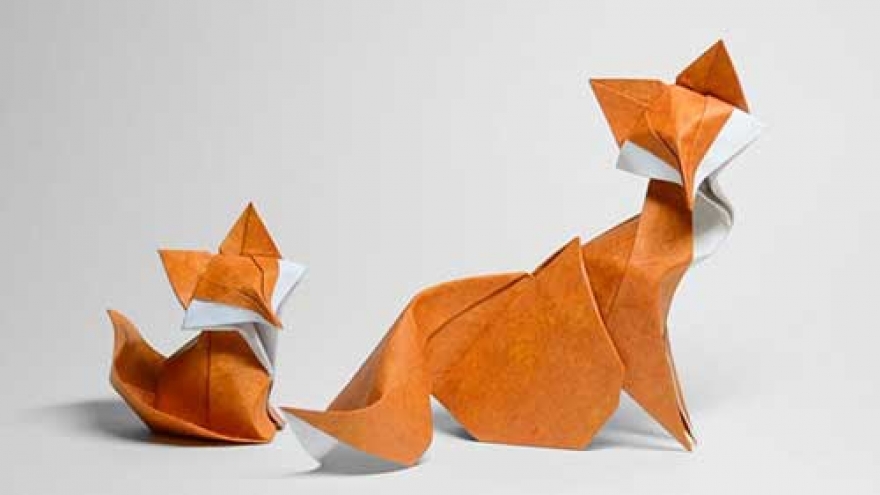
Vietnamese artists wing up Japanese origami art

“Wings” is depicting how Vietnamese artists have awaken their creativity to origami, the Japanese art of paper folding, which was introduced into Vietnam in the mid 1960s.
Fifty-two intricate origami animals and mythological figures with wings, including cranes, bugs, unicorns, angels and dragons being exhibited in the “Wings” tell about the love for origami art shared by Nguyen Linh Son, Nguyen Tuan Tai, and Le Duc Tho.
 |
|
An origami work on display (Photo: VNA)
|
Son, 32, has worked with origami for more than 10 years. He highlighted the applicability of origami art.
“The craft helps enhance mindfulness, patience and creativity of people who make it,” he said.
Son also attached significance to artists’ hand skills, saying “we just use papers as our tool to make origami works featuring real life objects, patterns or architecture.”
“The craft helps enhance mindfulness, patience and creativity of people who make it,” he said.
Son also attached significance to artists’ hand skills, saying “we just use papers as our tool to make origami works featuring real life objects, patterns or architecture.”
 |
|
The three artists are making giant horse model at the exhibition space (Photo: VNA)
|
According to Son, the crane is the symbol of origami art.
Traditionally, Japanese people believe that if one folds 1,000 origami cranes, their wish will come true.
Nguyen Tuan Tai, 22, has also been doing origami for almost ten years. He loves to make mythological figures.
“Mythological figures, such as angels, unicorns or dragons send the message of hope, luck and power. Those are the elements we need in our lives,” Tai said.
 |
|
Cranes by Nguyen Linh Son (Photo: VNA)
|
The artists, from AXA Studio are also making a giant horse model together inside the exhibition space. It is expected to be three metres high.
A timelapse video featuring the artists’ journey of making the giant horse will be screened on August 5.
As part of the 25-day event at the Vincom Centre for Contemporary Art at 72A Nguyen Trai Street, Hanoi’s Thanh Xuan district, there is also space for kids to make origami themselves.
 |
| Children learn how to fold paper at the exhibition (Photo: VNA) |
Their work will be displayed in a corner called “Happiness”.
Origami art is a crucial part of Japan’s cultural life. Origami works are usually displayed at traditional Japanese festivals and rituals.
Origami is also taught at nursery and primary schools in Japan, aiming to help enhance patience, discipline and creativity in children.