Unique folk games of Northwest highland ethnic groups

VOV.VN - Taking part in traditional festivals in Vietnam’s Northwest highlands is one of the goals many visitors set when exploring the region’s nature, culture and people. An indispensable part of those festivals, especially during the Lunar New Year (Tet) and spring celebrations, is the traditional folk games enjoyed by both local residents and visitors.
Courtship games at festivals
Among folk games in the Northwest highlands, courtship games attract large numbers of young men and women because of their particular appeal.
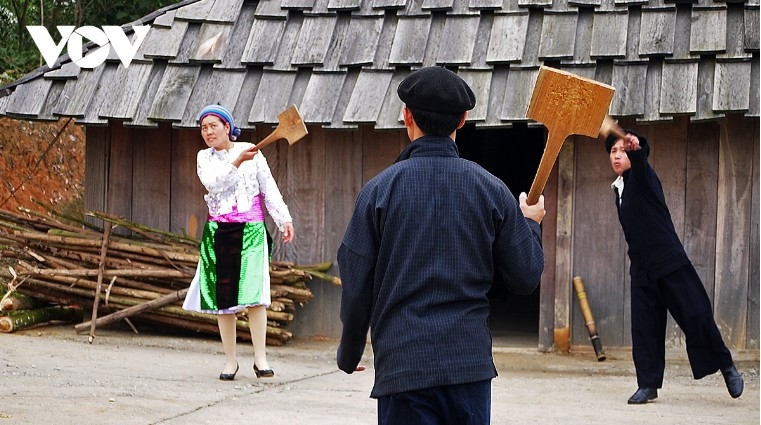
One of them is danh yen (a traditional shuttlecock game), a courtship activity that is also played as a competitive sport during festivals of the H’Mong ethnic group in the Northwest. When played in groups, young men and women bring their own handmade yen and divide into two teams, one male and one female, hitting the shuttlecock back and forth between them.
If played as a sport competition, the two teams hit the shuttlecock over a net about two metres high into the other side’s court, similar to badminton.
Danh yen can also be played by just two people, one male and one female, who play while talking and sharing their feelings. It offers them a chance to get to know each other and may lead to marriage. If they do not feel compatible, they decline politely so as not to hurt each other’s feelings, then find other partners to continue playing.
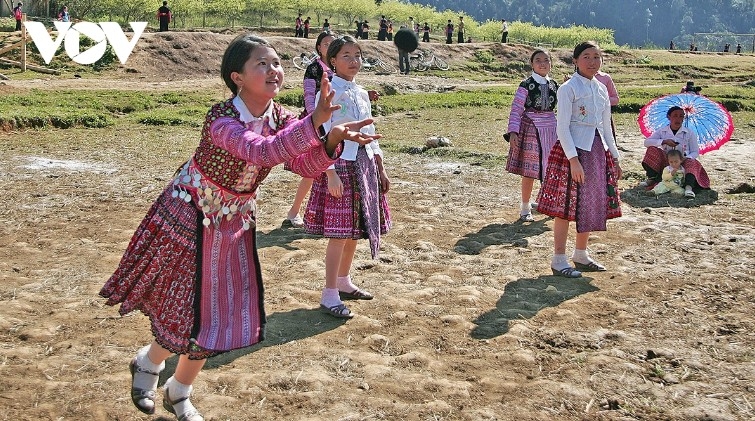
Another courtship game is dau pao, also known in some places as lai pao (throwing the pao ball), traditionally played during spring festivals. Like danh yen, dau pao is usually organised on a wide, level and cleared ground. In competitions, players are divided into two teams. The playing area is marked into two sections with a net in between, similar to a volleyball court.
As a courtship activity, dau pao reflects the joy of young men and women playing in groups and getting to know one another. If they are interested in each other, they throw a pao privately to the person they favour. If the other person agrees, they catch it; if not, they let it fall. For that reason, the H’Mong have a song when playing dau pao:
‘Anh ném pao, em không bắt
Em không yêu, quả pao rơi rồi
Em yêu người nào, em bắt pao nào…’
(You throw the pao, I do not catch it.
If I do not love you, the pao falls.
I will catch the pao of the one I love.)”
To ma le, a game of skill
To ma le (a traditional game played with wild forest fruits) is a distinctive folk game of the Thai ethnic community in the Northwest. It is organised during festivals and Lunar New Year celebrations.
In the Thai language, to ma le means playing ma le. Ma le is a type of wild fruit with a hard shell, round and flat like a small banh day (glutinous rice cake). The game is reserved for women during festivals.
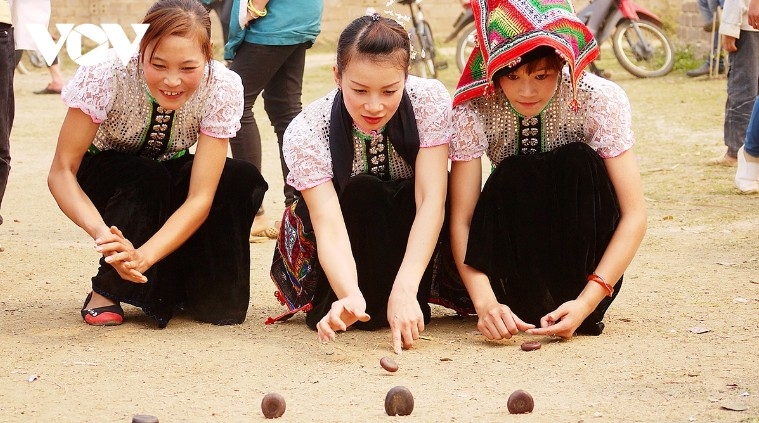
When playing to ma le, some ma le fruits are ground on one side so they can stand upright on the ground. These are called the “target.” Other round fruits are used as the “strikers” to hit the target. The playing ground is usually a small, flat area or even the space beneath a stilt house.
At least two people or two teams are required. The more participants there are, the livelier the game becomes. In competitions, only two teams take part, each with no more than 10 players so that each round does not last too long.
Stilt football, a distinctive sport
Elders in Na Bo village in Moc Chau district, Son La province, say the Thai people have played stilt football for a long time. In the past, the ball was woven from rattan. Later it was replaced with leather or rubber balls.
The game is played on a wide ground. Two teams compete in two halves under rules similar to regular football. The only difference is that all players stand on stilts during the match.
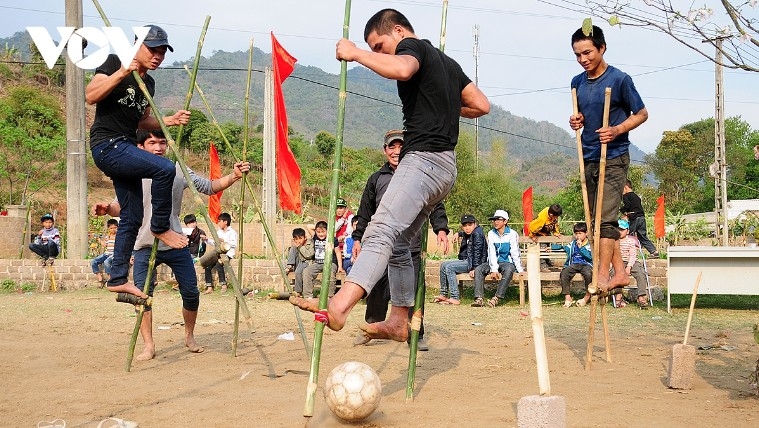
Stilt football is a sport reserved for men. It requires players to be skilful and steady, with well-practised stilt-walking skills. Walking on stilts is already difficult; running and controlling the ball during a match is even more challenging.
Nem con, a community-bonding game
Nem con (a traditional ball-throwing game played during festivals) is a popular folk activity. No one knows exactly when it began or who first created it, but over time it has remained one of the most widely preserved games in community life.
The game is open to everyone, regardless of age or gender. It symbolises wishes for good harvests, growth of all living things and hopes for a warm and prosperous life. For that reason, it is usually played during festivals and Lunar New Year celebrations.
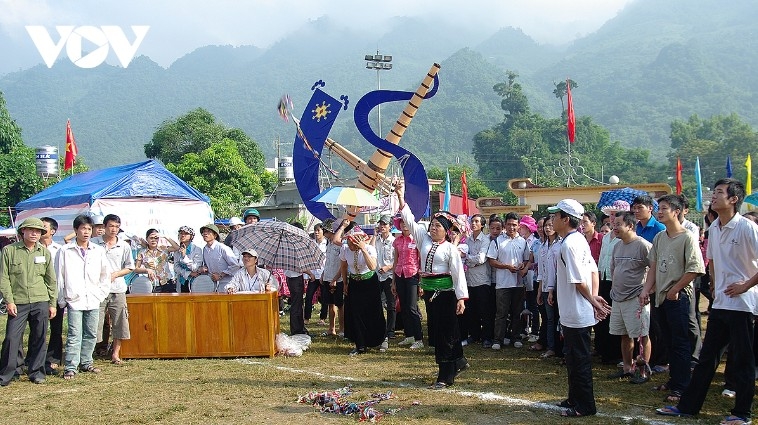
The con ball is spherical, sewn from pieces of multicoloured cloth about the size of a child’s fist. Inside are rice grains and cotton seeds- rice sustains life, while cotton provides fibre for weaving. The ball is decorated with coloured fabric tassels that help guide its direction in flight.
The playing ground is a wide field. In the centre stands a tall bamboo pole. At the top is a circular con ring, with red paper on one side symbolising the sun and yellow paper on the other symbolising the moon. Players stand at the throwing line and try to throw the ball through the ring at the top of the pole.
The game begins with a ritual. A shaman presents two con balls in a ceremony between heaven and earth, praying for peace in the village, good harvests and prosperity for every household. After the ritual, the shaman throws the two consecrated balls into the crowd, and people scramble to catch them, marking the opening of that year’s nem con festival.
Festival of folk games for children
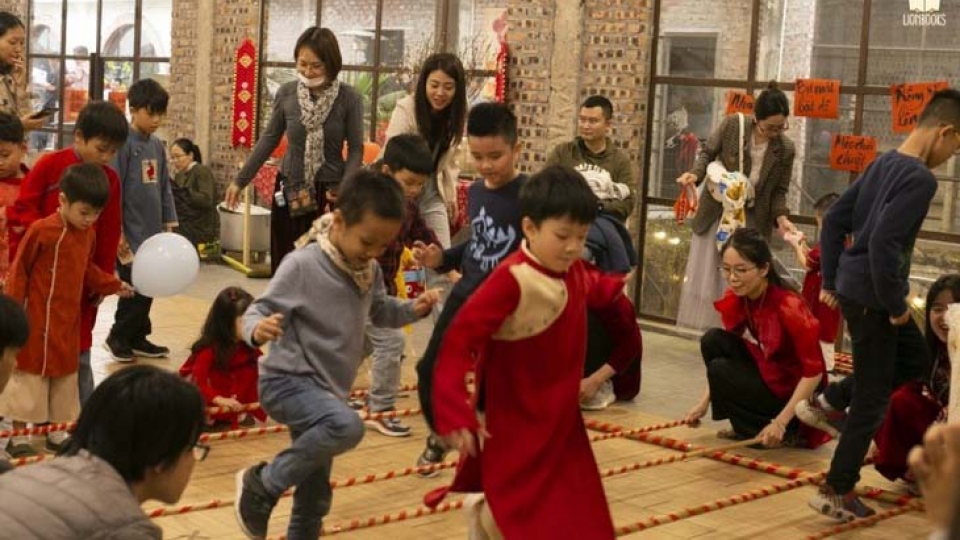
VOV.VN - Lionbooks Children's Bookstore has organized a Tet program in Hanoi to bring children and their families to an attractive playground of 20 folk games and activities.