
WB, Vietnam promote cooperation initiatives on water, agriculture, environment

VOV.VN - Deputy Prime Minister Tran Hong Ha met Mariam J. Sherman, World Bank Country Director for Vietnam on March 27 in Hanoi to advance cooperation initiatives in water resources, agriculture and the environment.
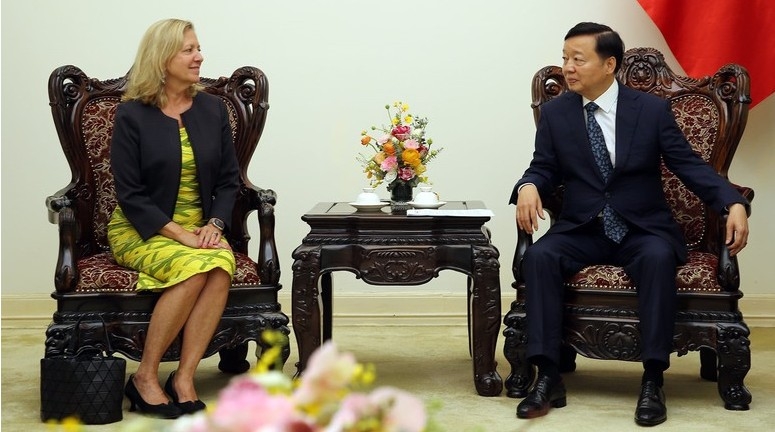
The Deputy PM spoke highly of the World Bank (WB) as a leading development partner that has supported Vietnam in areas such as infrastructure, institution building, human resources development and sustainable development.
In agriculture and the environment, WB projects have provided practical support for irrigation systems, water resources management and water supply, particularly in rural areas and the Mekong Delta, contributing to water security, dam safety and sustainable development.
WB-supported programmes and projects, including ODA, concessional loans and technical assistance, have contributed to ensuring water security, food security, agricultural development, improved livelihoods and stronger resilience to climate change.
He affirmed Vietnam’s support for WB initiatives in the water sector such as “Water for the Future” and the Country Water Compact, and said these initiatives are in line with Vietnam’s practical needs.
Regarding water resources, he said Vietnam attaches particular importance to ensuring transboundary water security, especially in the Mekong and Red River basins. These two basins are of significant importance and, if managed effectively, could account for 40-50% of sustainable water use.
He proposed that the WB increase support in both technical design and financing for Vietnam in integrated river basin management and water management solutions, which are key factors for socio-economic policy planning and sustainable security and defence.
Regarding the programme to develop one million hectares of low-emission rice in the Mekong Delta, Ha said the Government has assigned the Ministry of Agriculture and Environment as the lead agency to coordinate implementation, with funding from the WB and the central budget.
In response, Mariam J. Sherman thanked the Deputy PM for the meeting and hailed Vietnam’s consensus and strong commitment to WB cooperation initiatives in water resources management. She said participation in global initiatives not only helps improve the country’s image but also creates opportunities for Vietnam to access resources and expertise from the WB.
She added that the WB can provide a comprehensive support package, including technical expertise, financial support and international experience, to help Vietnam effectively implement cooperation initiatives in water security, agriculture and the environment.
The WB is also working to mobilise more resources from the private sector to support development goals in the coming period.
Discussing cooperation directions, Deputy PM Ha said the private sector is being given greater priority in access to development resources. He noted that when the private sector participates in major projects, especially in the water sector, mechanisms should ensure conditions comparable to those for state-owned enterprises.
For commercially oriented projects, the approach should be appropriate and different from that for public infrastructure projects.
He said the Government is working to improve mechanisms related to access to credit, loans and associated conditions, and proposed that the WB work with Vietnam to review and adjust policies that remain problematic.
In water resources management, he said Vietnam can contribute practical experience to global initiatives but still needs support from international organisations and experts. A key need is to strengthen capacity for climate-resilient planning, shifting from a disaster response approach to multi-purpose water infrastructure planning linked to adaptation.
Citing Hanoi’s planning, he underscored the need for an integrated approach, starting from planning the Red River basin as a basis for urban planning and long-term development. However, Vietnam still lacks capacity in this area and requires technical support from the WB to develop projects and corresponding financing needs.
He also laid stress on the urgent issue of managing reservoir systems, including hydropower and multi-purpose irrigation reservoirs, which requires research and the development of effective coordination mechanisms with technical support from the WB.
It is essential to boost close coordination among agencies such as the Ministry of Finance and the Ministry of Agriculture and Environment in defining criteria for selecting priority projects and clarifying areas requiring WB support, including technical assistance and loans, to ensure consistency in implementation, Ha emphasized.

Hanoi, WB strengthen global partnership on infrastructure development
VOV.VN - Chairman of the Hanoi People’s Committee Tran Sy Thanh and World Bank Country Director Mariam J. Sherman have agreed to deepen cooperation on urban infrastructure development, with a particular focus on the Ngoc Hoi-Hanoi Station railway line.

Vietnam likely to become high-income country if it fosters strategic drivers, says WB
VOV.VN - Vietnam can fully realise its goal of becoming a high-income country by 2045, provided it stays committed to pursuing two strategic drivers - institutional reform and green development, according to the World Bank (WB).
