


Vietnamese worker makes history at Japan’s TETSU-1 Grand Prix

VOV.VN - A 33-year-old Vietnamese worker has made history by becoming the first foreign national to win Japan’s TETSU-1 Grand Prix, a national reinforcing steel skills competition.
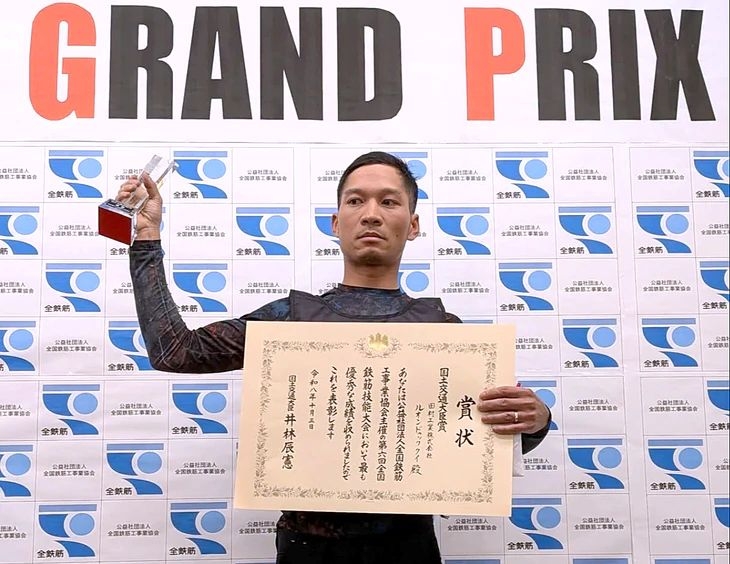
Luong Duc Quy, who works for Tamura Kogyo in Osaka, won the sixth edition of the competition held on October 3 at the Fuji Training Centre in Fujinomiya, Shizuoka Prefecture. He completed the challenge in 46 minutes and 45 seconds, the fastest time among 34 finalists.
Organised by the Japan Reinforcement Contractors Association (JRCA), the competition requires participants to assemble reinforcing steel structures quickly and accurately, with rankings determined by both precision and completion time.
The challenge is based on Japan’s national Grade 1 reinforcing steel assembly skills test, with an additional layer of reinforcing bars. The standard completion time is 80 minutes, while contestants who exceed 100 minutes are disqualified.
Misreading technical drawings or using the wrong materials can also result in elimination. Rankings are determined by combined scores for accuracy and working time, with accuracy taking priority in the event of a tie, followed by age.
Quy finished 33 minutes and 15 seconds ahead of the standard time, completing the task about 42% faster.
The Vietnamese worker has been living in Japan for 11 years and spent two weeks preparing for the competition. Although it was his first time competing in TETSU-1 Grand Prix, he entered with the ambition of winning the title.
The competition is designed to showcase a trade whose contribution is often difficult for the public to see. Once a building is completed, reinforcing steel is concealed inside concrete, leaving little visible evidence of the work required to assemble it.
Naosuke Niizuma, the competition’s organising committee chair, said the quality of construction continued to depend on workers’ practical knowledge, experience and skills, even as the industry adopted more mechanisation and digital technologies.
The contest also aims to encourage younger people to learn the trade and give workers an opportunity to demonstrate their abilities regardless of nationality. Organisers hope that recognition of skilled craftsmanship will help workers take pride in their profession and support the transfer of expertise to future generations.

Japan sees record number of foreign workers, Vietnamese top the list
VOV.VN - Japan’s rapidly ageing population and severe labour shortages have pushed the number of foreign workers to a new record.

