


Vietnam-UK education cooperation: From market to partnership

VOV.VN - In the UK’s updated International Education Strategy, Vietnam continues to be classified as a key priority market, alongside India, Indonesia, Nigeria, and Saudi Arabia. Along with this position comes a notable shift in the UK’s approach: moving from seeking a student recruitment market toward building a partnership.
At the root of this change lies a detail that seems merely administrative: for the first time, the UK Foreign, Commonwealth & Development Office (FCDO) co-owns the International Education Strategy, alongside the Department for Education and the Department for Business and Trade.
Having three ministries jointly responsible for one strategy shows that education is being elevated to the level of foreign policy in the UK. Dr. Dao Thi Hong, First Secretary in charge of Education and Student Management at the Embassy of Vietnam in the UK, calls this a "three-legged stool" model: the Department for Education maintains training standards, the Department for Business and Trade handles the growth puzzle, and the FCDO turns education into a diplomatic tool.
When all three support one strategy, she notes, education is no longer the sole business of the education sector, but has been placed at the center of the UK's global engagement policy.
A shift in mindset
On that foundation, Dr. Dao Thi Hong believes that six months is not enough for British universities to completely change their operational models, but it is enough to see a shift in mindset: from "Market Opportunity" (seeking a recruitment market) to "Partnership Opportunity" (building strategic partners). Education is no longer a story of exporting services, but a bridge to build sustainable international relations.
That shift is showing up in specific ways. UK universities now approach Vietnam with government backing, with Ambassadors acting as focal points to promote cooperation, instead of individual schools finding their own way. The focus is also no longer self-funded student recruitment, but deeper forms of engagement such as opening branch campuses, offering dual degrees, enhancing vocational skills, and joint research in key areas like artificial intelligence (AI), green energy, and biomedicine.
Overarching all of this is a commitment to quality standards: programs brought to Vietnam must pass strict UK accreditation while working toward degree equivalence recognition with Vietnam’s Ministry of Education and Training. Those orientations are supported by a practical determination. The UK sets a goal to increase education exports to £40 billion per year by 2030, an ambition that forces resources into key markets, with Vietnam being one of them.
Evidence of lasting cooperation
However, the most convincing proof of a strategy lies not in documents, but in relationships that are strong enough to prove their own value. The 15-year cooperation between the National Economics University and the University of the West of England (UWE Bristol) is one such example. Through joint programs, the two universities have trained more than 1,180 students and built a shared research ecosystem together.
What creates value is not the numbers, but the form of cooperation. The two universities do not stop at issuing degrees, but conduct research together, co-publish scientific works, and jointly train doctoral candidates. Dr. Dao Thi Hong assesses this as "one of the most successful and sustainable educational cooperation models" between the two countries.
A major trend is also taking shape behind those stories. In the 2024/25 academic year, about 3,725 Vietnamese students went to the UK to study; meanwhile, 13,285 studied UK programs right in Vietnam. Both streams are increasing, but the balance is tilting toward UK education coming to learners right in Vietnam. This is a direction that, if proactively selected, Vietnam can use to expand opportunities to access international education at home, contributing to improving the quality of human resources.
The necessary and sufficient conditions
Even so, the picture is not only bright. Post-study work visas, long a familiar advantage of UK education, are being tightened: reduced from 2 years to 18 months for bachelor's and master's degrees for applications submitted from January 1, 2027 (doctoral degrees remain 3 years). Therefore, sustainable attraction cannot rely on an immigration policy, but must come from training quality and the professional future that learners see behind the degree.
And this is where Dr. Dao Thi Hong re-examines the problem thoroughly. Vietnam's continued inclusion in the priority group, according to her, is only a "necessary condition." The "sufficient condition" lies on our side, in the capacity to set strategic problems, choose partners, and design win-win cooperation models. The door is wide open, but stepping through it with the mindset of "being chosen" or "proactively choosing" is a question that only Vietnamese education can answer for itself.
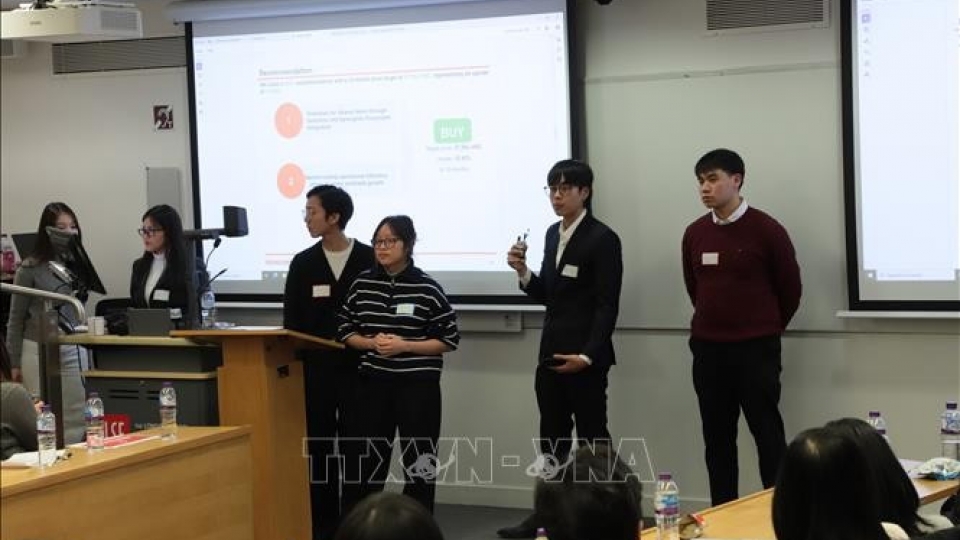
Vietnamese students shine at financial analysis competition in UK
A large number of Vietnamese students in the UK have demonstrated their financial analysis skills at the finals of Stock Pitch Competition 2025, organised by The Project Darts at the London School of Economics and Political Science (LSE).


