


Vietnam proposes transnational task force to combat online scams

VOV.VN - Senior Lieutenant General Nguyen Van Long, Vietnam's Deputy Minister of Public Security, has proposed that participating nations establish specialized joint task forces to verify, investigate, and dismantle complex transnational scam syndicates, aiming to enhance multilateral law enforcement coordination.
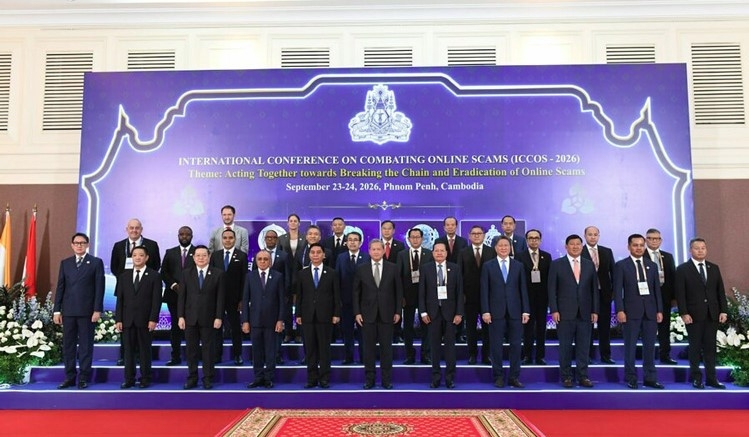
The proposal was put forward on September 23 in Phnom Penh at the opening of the 2026 International Conference on Combatting Online Scams (ICCOS-2026). The two-day conference runs through September 24, drawing delegations from 27 countries, six international organizations, and approximately 500 delegates.
Addressing the plenary session, Deputy Minister Nguyen Van Long stressed that online fraud has evolved into a global crisis rather than a localized challenge. Combating this form of criminality is vital for safeguarding citizens' lives and assets, securing national development foundations, and protecting cyberspace integrity.
Vietnam is concurrently deploying comprehensive measures to contain and repel online fraud, Long noted. He outlined three strategic priorities for international cooperation: establishing regular exchanges of preventive expertise and models, upgrading legal frameworks to fortify cybersecurity, and instituting rapid, continuous communication channels among law enforcement agencies. Within this framework, the country’s proposed specialized joint task forces are designed to streamline intelligence sharing and accelerate joint investigative operations targeting sophisticated transnational networks.
Long also urged nations to expedite ratification procedures for the United Nations Convention against Cybercrime (the Hanoi Convention), reaffirming Vietnam's readiness to partner with governments, international organizations, and the private sector to promote a secure, wholesome digital ecosystem.
Host Prime Minister Hun Manet affirmed that Cambodia will not serve as a safe haven for cyber scam operations, pledging a zero-tolerance policy focused on smashing criminal networks and preventing recidivism.
Describing scam syndicates as complex cross-border criminal ecosystems, Hun Manet called for reinforced rapid-response communication channels among law enforcement agencies, real-time intelligence sharing, coordinated asset tracing and freezing, and deeper collaboration with banks, telecom operators, technology platforms, and crypto exchanges. He also underscored the imperative to protect victims and facilitate their safe repatriation.
Delphine Schantz, Regional Representative for Southeast Asia and the Pacific of the United Nations Office on Drugs and Crime (UNODC), applauded Cambodia's efforts while emphasizing the necessity of escalated action across national, regional, and international tiers. Cyber scam losses across East Asia, Southeast Asia, Australia, and New Zealand currently surge to approximately US$114 billion annually and continue to expand.
Schantz asked countries to build a shared understanding of evolving criminal trends, strengthen enforcement capabilities, share actionable intelligence, and integrate private sector actors, particularly fintech enterprises and social media platforms, into efforts to intercept and trace illicit financial flows.
ICCOS-2026 focuses on formulating regional and global responses to online scams, leveraging technology for crime prevention, strengthening cyber resilience, and bolstering multilateral cooperation against transnational crime.

Online scam ring busted after defrauding victims of over US$39 million
VOV.VN - Vietnamese police have dismantled a major online scam ring allegedly responsible for defrauding thousands of victims across Vietnam of more than VND1 trillion (over US$39 million).

Vietnam steps up crackdown on tech-enabled trafficking, online scam rings
Vietnam will intensify efforts to dismantle criminal networks that exploit digital technologies to carry out online scams and human trafficking, while strengthening victim protection and raising public awareness under a nationwide campaign marking the 2026 World Day Against Trafficking in Persons.

83 Chinese nationals found preparing alleged online scam operation in HCMC
VOV.VN - Ho Chi Minh City police have uncovered a suspected transnational online fraud operation after discovering 83 Chinese nationals renting an entire hotel and allegedly preparing transnational cyber scam activities.


