Toward “Vietnam 2045”: Vietnam-UK Talent Bank takes shape

VOV.VN - A seminar in London has set out a concrete plan to connect Vietnamese students and scholars in the United Kingdom, aiming to build a Vietnam–UK Talent Bank as part of efforts toward the “Vietnam 2045” vision.
At a time when technology is changing by the day and knowledge has become a measure of national competitiveness, the idea of “Vietnam 2045” is no longer a distant plan but a practical concern for the younger generation. That future is being shaped through the study and research efforts of Vietnamese students around the world, including those in the United Kingdom, where thousands are engaging with international academic standards.
The “Vietnam 2045” seminar, held in London on March 22 by the Vietnamese Students’ Association in the United Kingdom (SVUK), which attracted more than 14,000 students, was not merely an academic event. More importantly, it was a space where young Vietnamese intellectuals actively took part in serious discussions on the country’s development path.
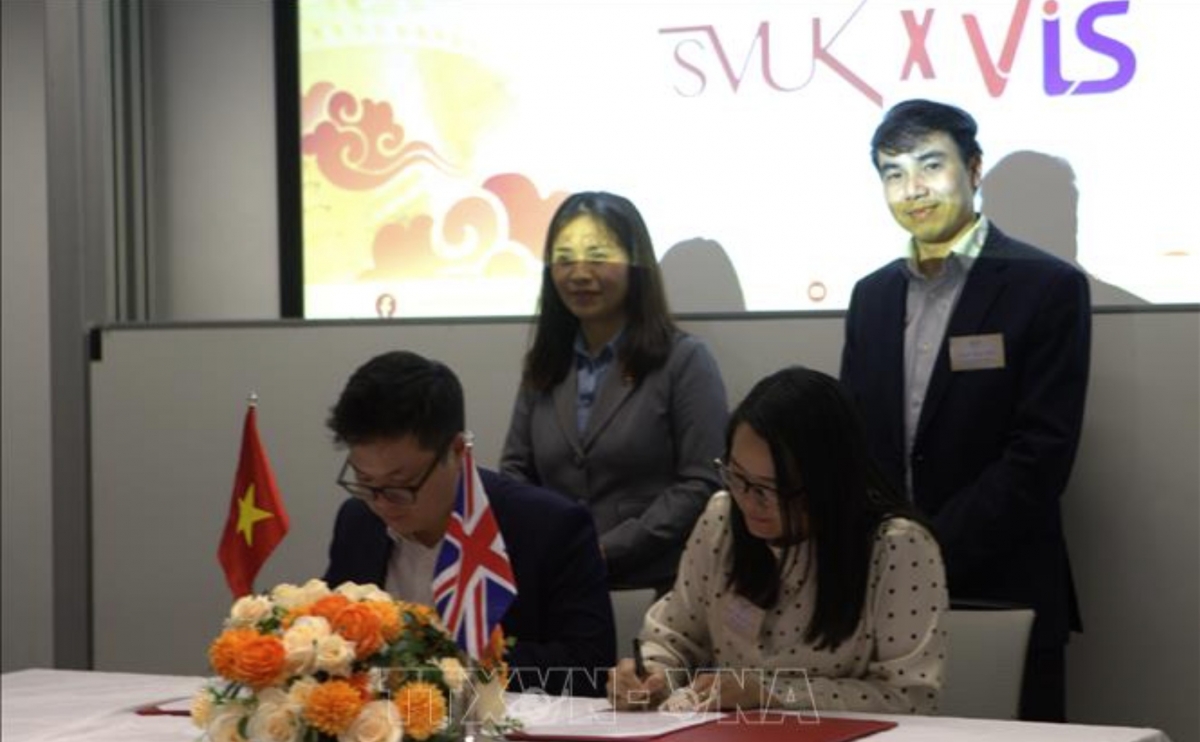
At the centre of the event was a memorandum of understanding (MOU) between SVUK and the Vietnamese Intellectual Society in the UK and Ireland (VIS). This MOU serves as a blueprint for a Vietnamese knowledge ecosystem in the UK, with a vision to 2030 of building a “Vietnam-UK Talent Bank” – a network in which every individual, from first-year students to leading experts, has a place within a closely connected system. Importantly, the MOU does not stop at general statements but is backed by specific programmes that can be put into operation immediately.
The first is the “UK-VN Mentoring Program”, a mechanism that may appear simple but is in fact groundbreaking: Vietnamese professors and experts will directly mentor students. In a context where many Vietnamese students in the UK are not even aware that Vietnamese professors are teaching at their own universities, establishing a structured mento-mentee network is a way to fill this gap in intellectual connection. This is more than academic support; it is a long-term process of nurturing thinking, direction and aspiration.
The second is the “Elite Scholars Lab”, designed for the most outstanding students and researchers. Leading professors will work directly with these “seeds” through research projects and practical activities. As they mature, these individuals are expected to return and continue supporting the next generation, either as mentors or through practical contributions to education and research in Vietnam.
The third programme, “Career Bridge & Research Symposium”, is an annual scientific and career-oriented event, with SVUK responsible for operations and VIS connecting with businesses and partner universities. This shows a practical way of working: knowledge is not just for research; it must be translated into professional capability and concrete contributions to the economy.
Taken as a whole, the MOU goes beyond an immediate need, linking students with professors, and lays the foundation for a continuous intellectual value chain, in which knowledge is accumulated, transferred and renewed across generations.
Speaking to the press in London, Dao Thi Hong, First Secretary in charge of education and student affairs at the Vietnamese Embassy in the United Kingdom, stressed that linking Vietnamese intellectuals abroad with domestic development needs must move beyond formal approaches toward a genuinely functioning ecosystem.
This requires three elements: specific “orders” from within the country, an intergenerational expert network, and the building of digital infrastructure for knowledge. The aim, she said, is to ensure Vietnamese knowledge is always present and effectively utilised in the country’s development, regardless of where individuals are based.
Nguyen Thuy Ba Linh, Associate Professor specialising in biomaterials and tissue engineering at University College London and Vice President of VIS, said Vietnamese students in the UK have a distinct advantage: they understand domestic realities while also accessing international knowledge and educational thinking. If these two elements are combined, they can help deal with very specific problems in Vietnam. She added that the current generation of students also has a new advantage through early exposure to artificial intelligence.
However, what matters is not just acquiring knowledge, but knowing how to turn research results into practical applications. When research is developed into products, or even start-up projects, it creates economic value while also helping meet domestic needs, create jobs and attract international investment.
In this context, the “Vietnam 2045” seminar, with themes including biomedicine, innovation, fintech and artificial intelligence, is not merely a series of discussions but becomes part of a structured ecosystem where ideas are nurtured, tested and developed into real contributions to the country.
Cao Quoc Dung, President of SVUK, said what students need at this stage is more opportunities to directly contribute to national development. Platforms such as the “Vietnam 2045” seminar help students engage with practical development issues, thereby gaining a clearer understanding of the goal of turning Vietnam into a developed, high-income country by 2045 and identifying their role in that process.
“Vietnam 2045” is being built through concrete connections, measurable programmes and long-term commitments among Vietnamese intellectual organisations in the UK. The most notable point is that when today’s students are nurtured by Vietnamese professors within a systematically designed ecosystem, they will not only succeed individually, but also become part of an ongoing intellectual current serving the country.
Vietnamese students shine at financial analysis competition in UK
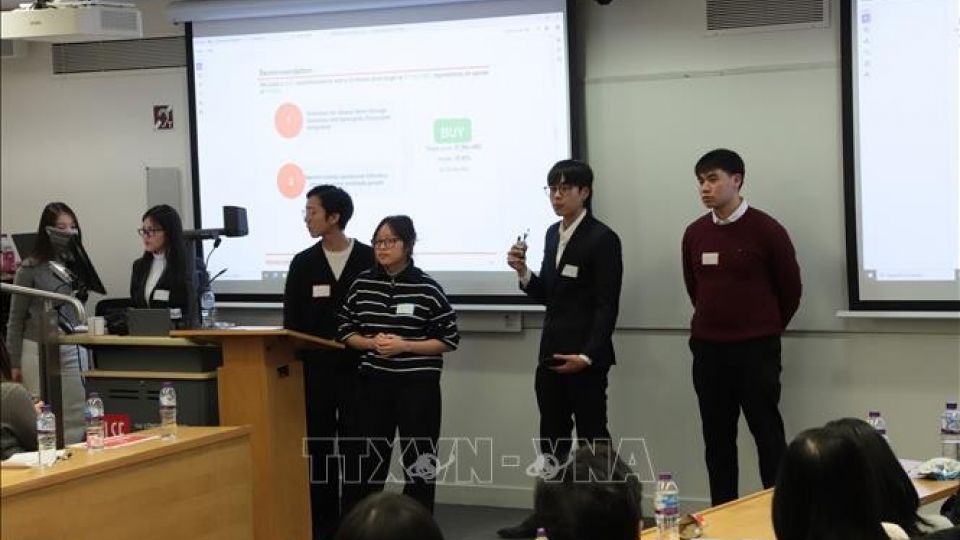
A large number of Vietnamese students in the UK have demonstrated their financial analysis skills at the finals of Stock Pitch Competition 2025, organised by The Project Darts at the London School of Economics and Political Science (LSE).