Seminar examines governance and legal challenges in Vietnam’s AI adoption

VOV.VN - Over the past decade, digital technologies have become an integral part of Vietnam’s socio-economic life. Among them, artificial intelligence (AI), particularly generative AI, has seen rapid and widespread adoption in recent years.
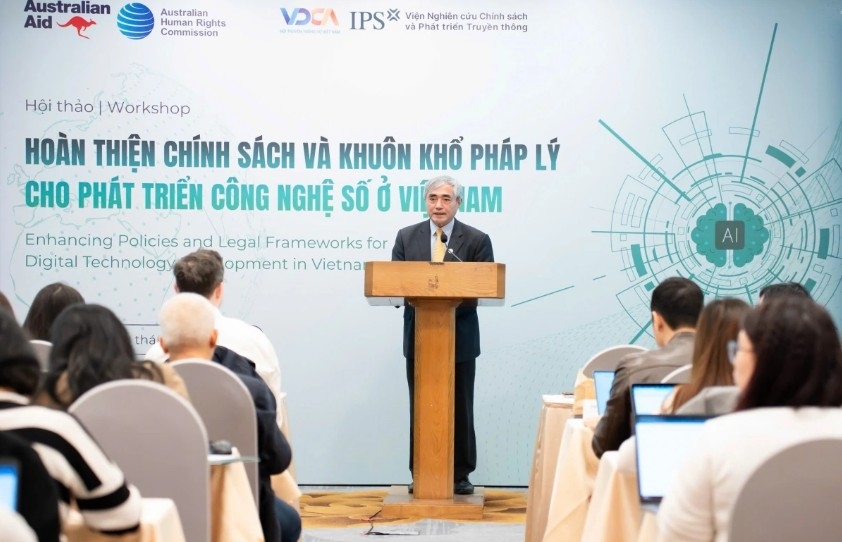
Digital technologies are increasingly acting as a key driver of economic growth, innovation and improvements in public service delivery in Vietnam. However, amid the fast development of emerging technologies, especially AI, big data, digital platforms and online interaction models, the country is faceing an urgent need to refine its policy framework and legal architecture in a flexible, inclusive and practical manner.
These issues were discussed at a seminar “Enhancing Policies and Legal Frameworks for Digital Technology Development in Vietnam”, held in Hanoi on December 18.
Speaking at the event, Nguyen Minh Hong, Chairman of the Vietnam Digital Communications Association, said Vietnam is witnessing the rapid expansion and maturation of its digital ecosystem and digital economy.
According to the Southeast Asia Digital Economy Report, Vietnam’s digital economy is valued at nearly US$40 billion, ranking third in Southeast Asia, while recording growth of 17% compared with 2024, the fastest pace in ASEAN.
Alongside these achievements, the development of digital technologies also presents major challenges, particularly in ensuring ethical and responsible use, and in making sure all segments of society, including vulnerable and disadvantaged groups, can participate in and benefit from technological progress.
In 2024, the Politburo issued Resolution No. 57 on breakthroughs in science and technology development, innovation and national digital transformation, reaffirming strategic priorities for technological advancement, including digital technologies.
The National Assembly has also passed a series of key laws, such as the Law on Artificial Intelligence, the Law on Science, Technology and Innovation, and the Law on Personal Data Protection, forming a more comprehensive legal framework for digital development.
Nguyen Minh Hong said the seminar aimed to review Vietnam’s recent policy progress while focusing on core issues including the protection of human rights in the digital environment, international experience in AI governance, and key features of Vietnam’s AI Law.
Technological progress must go hand in hand with human rights protection

Joe Bourke, Second Secretary at the Australian Embassy in Vietnam, said digital technologies and AI offer significant development opportunities but also pose challenges related to human rights and governance. He stressed that technological advancement must be accompanied by robust safeguards for human rights.
Australia has recently introduced an AI governance approach based on risk assessment, encouraging public agencies to proactively adopt AI while strengthening supervision to mitigate potential risks, he said.
Bourke added that Australia stands ready to cooperate with Vietnam and other countries by sharing experience in promoting the responsible use of digital technologies and AI, thereby strengthening public trust in emerging technologies.
From a human rights perspective, Joanna Mansfield, Director of International Engagement at the Australian Human Rights Commission, underlined the importance of striking a balance between innovation and human rights protection.
She noted that emerging technologies, including AI, carry risks of misuse if not properly governed, and therefore should be developed to serve people rather than undermine or erode fundamental rights.
Integrating human rights considerations from the design stage, ensuring transparency and accountability, and paying close attention to the protection of vulnerable communities are becoming increasingly essential in the current context, she said.
While AI is advancing rapidly, the safe, ethical and responsible use of the technology remains a relatively new challenge. Vietnam is still in the early stages of building a comprehensive AI governance framework. As AI applications continue to expand, broader awareness of risks, safety standards and privacy protection needs to be strengthened to ensure user safety in the digital environment.

Public sector in Vietnam holds great potential for AI adoption
VOV.VN - A survey on AI applications in Vietnam’s public sector reveals limited adoption, lack of legal frameworks, and insufficient risk assessment, despite the technology’s transformative potential.