Nordic countries, Vietnam share experience in decentralisation in digital era

VOV.VN - An annual international scientific seminar on successful decentralisation in the digital era, sharing experience between Vietnam and Nordic countries, was held in Hanoi on the morning of March 18, marking Nordic Day (March 23).
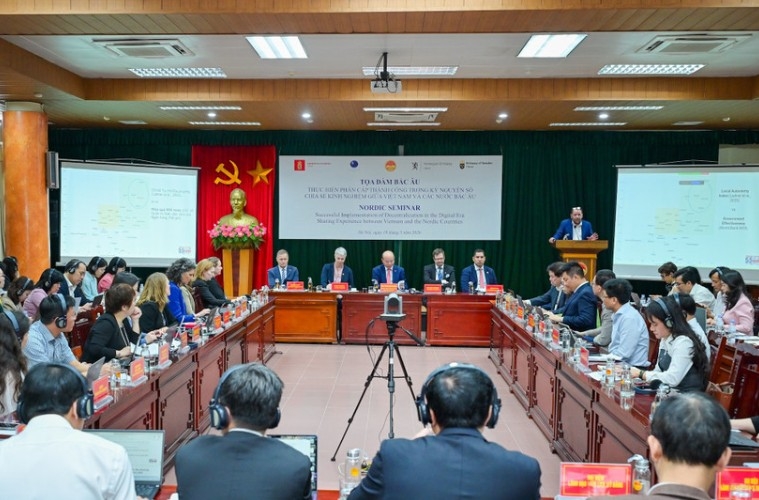
The event was co-organised by the Ho Chi Minh National Academy of Politics and the embassies of Denmark, Finland, Norway and Sweden to support administrative reform and digital transformation in Vietnam.
The event provided a forum for policymakers, scholars and experts to exchange experience in high-level governance, in line with the Party and State’s current strategic decisions, particularly Resolution No. 57 on breakthroughs in science, technology, innovation and national digital transformation, and Resolution No. 66 on reforming law-making and law enforcement to meet development requirements in the new era.
In his opening remarks, Associate Professor, Dr. Le Hai Binh, member of the Party Central Committee and Standing Deputy Director of the Ho Chi Minh National Academy of Politics, said that amid a complex global context, the prevailing trend is to strengthen decentralisation and delegation of authority to build a dynamic, modern and effective system of national governance. Vietnam is implementing reforms to streamline its organisational structure, shifting from a four-tier system to a three-tier structure, with a two-tier local government model driven by national digital transformation.
He said the core of decentralisation lies not in the simple transfer of authority, but in designing an institutional system and operating a policy framework that ensures a balance between control of power and the promotion of local dynamism, creativity and autonomy, as well as between decentralisation and national unity.
At the seminar, ambassadors and experts from Nordic countries presented keynote papers on topics including tax reform and decentralisation, digital welfare systems and the care economy, as well as demographic perspectives related to welfare and social protection systems.
Nordic ambassadors shared the view that decentralisation in the digital era goes beyond transferring authority and involves strengthening public trust, enhancing accountability and improving service quality.
Norwegian Ambassador Hilde Solbakken shared experience in applying technology to respond to population ageing, noting that in Norway digitalisation has helped modernise the welfare state by making services more accessible, while stressing that technology alone is insufficient and must go together with strong data protection, inclusive design and public trust.
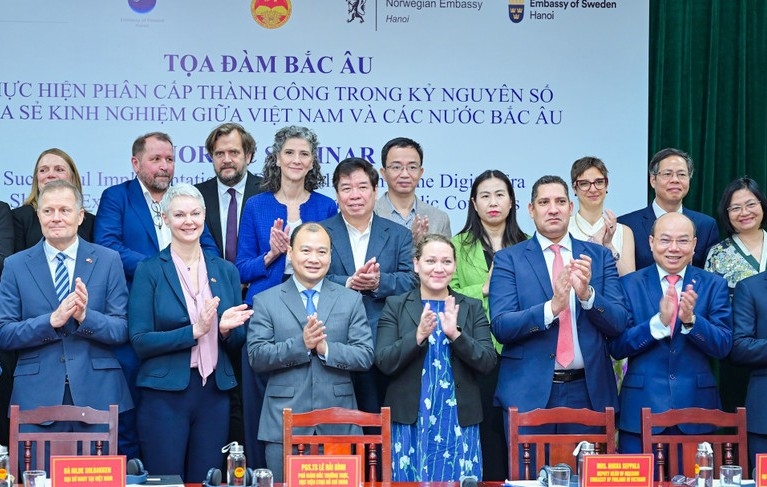
Danish Ambassador Nicolai Prytz highlighted the importance of a transparent tax system, stating that user-friendly digital solutions are essential to help taxpayers comply with their obligations more easily.
Swedish Ambassador Johan Ndisi shared views on administrative supervision, saying Sweden’s experience indicates that decentralisation supported by digital transparency does not weaken oversight but improves the precision of administrative management.
Finnish Ambassador Pekka Voutilainen emphasised the human factor, noting that combining technology with trust-based governance and education helps strengthen democratic institutions and makes public governance more flexible in a changing environment.
The seminar included plenary sessions in the morning, with afternoon sessions focusing directly on two core areas: universal welfare and social protection in the context of decentralisation, including healthcare, education and pensions; and tax reform and decentralisation through the expansion of the tax base using transparent digital tools.
Party leader hails contributions of Vietnamese communities in Nordic countries
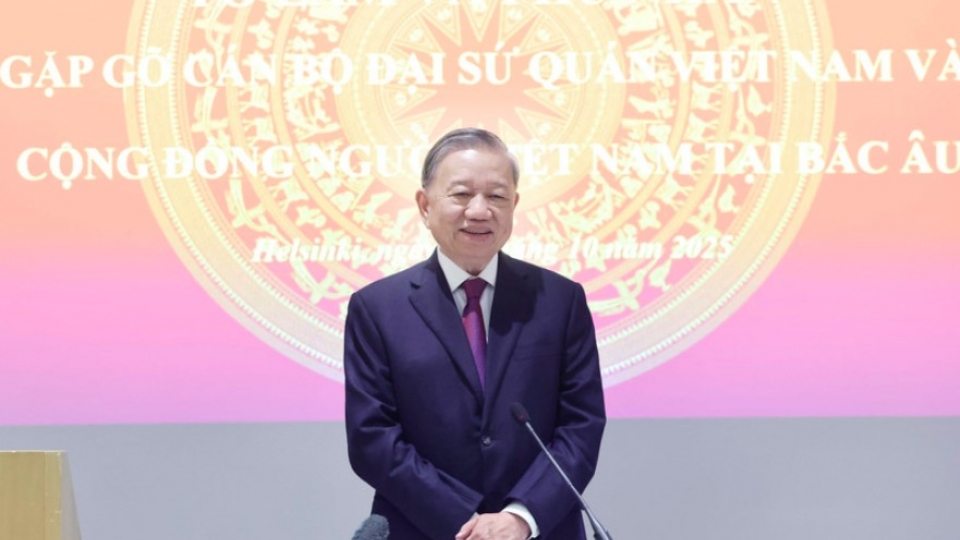
Party General Secretary To Lam, his spouse, and the high-ranking delegation of Vietnam had a meeting with representatives of the Vietnamese embassies and communities in Finland, Demark, Sweden, and Norway in Helsinki on October 21.