IP mechanisms need refinement to facilitate strategic technologies

Vietnam is moving to refine its intellectual property (IP) framework for strategic technologies, shifting from a protection-focused approach to one that enables value capitalisation and commercialisation, as policymakers seek to bridge the persistent gap between research and the market.

As strategic technologies evolve, IP is no longer seen solely as a legal shield but increasingly as a tool to unlock market value. However, a significant gap remains between research and commercialisation, requiring more flexible mechanisms that promote benefit-sharing and risk acceptance.
The transition is reflected in the Party’s and State’s policies, notably Resolution No. 57-NQ/TW of the Politburo and provisions under the 2025 Law on Science, Technology and Innovation, alongside the laws amending and supplementing articles of the Law on IP and the Law on Technology Transfer. These reforms signal a move from administrative control toward market-oriented exploitation, granting greater ownership and usage rights over research outcomes to host institutions while encouraging stronger participation of businesses.
Le Hoang Long, director of the IP Office of Vietnam under the Ministry of Science and Technology, said IP plays a critical role in socio-economic development. While the agency previously focused on establishing ownership rights, it has recently expanded its scope to promoting the commercialisation and commercial use of IP assets, as well as protecting IP rights.
Statistics from the office show a sharp rise in the number of inventions. In 2025, Vietnamese individuals and organisations filed 2,288 patent applications, up 36% year-on-year, while 1,108 patents were granted, a surge of 134.2% – far exceeding the average annual growth target of 16–18% set under Resolution 57.
A pilot survey also indicates improving commercialisation prospects, with around 8.56% of patents having market potential, close to the 8–10% target. Experts view this as a promising sign, particularly given that technology commercialisation in Vietnam is still at an early stage.
To accelerate this trend, Assoc. Prof. Dr Phan Tien Dung, head of the technology application and deployment division at the Vietnam Academy of Science and Technology, stressed the need to refine IP mechanisms for research outcomes of strategic technologies in a way that promotes commercialisation, co-ownership, and flexible exploitation, rather than relying primarily on administrative controls.
Enterprises should be allowed to engage early in research and development, and share ownership, benefits, and responsibilities for IP generated from strategic technology projects, he suggested, adding that policy design for technology transfer and commercialisation should adopt two parallel approaches based on the maturity of technologies and technology development targets.
Universities and research institutes, as key sources of knowledge and innovation, are under increasing pressure to bring research outcomes to market. A representative from the Vietnam National University, Ho Chi Minh City has proposed a mechanism be issued to allow such institutions to pilot business models for public IP assets to remove administrative bottlenecks and create a safe legal space for scientists to commercialise their work.
One major challenge is the lack of a clear mechanism to value in-kind contributions from businesses—such as equipment, labour, and infrastructure—within public-private partnerships.
At the same time, the State should continue sharing risks in the commercialisation of strategic technologies through co-investment funds, technology guarantees, pilot support, and controlled risk acceptance, particularly in early development stages.
Experts added that the evaluation of research outcomes should go beyond patent counts or transfer deals, focusing instead on technological mastery, spillover effects, socio-economic impact, and contribution to national technological self-reliance.
The State should take the lead in commissioning and using innovative products to create a “lead market”, helping enterprises to refine technologies before scaling up commercially.
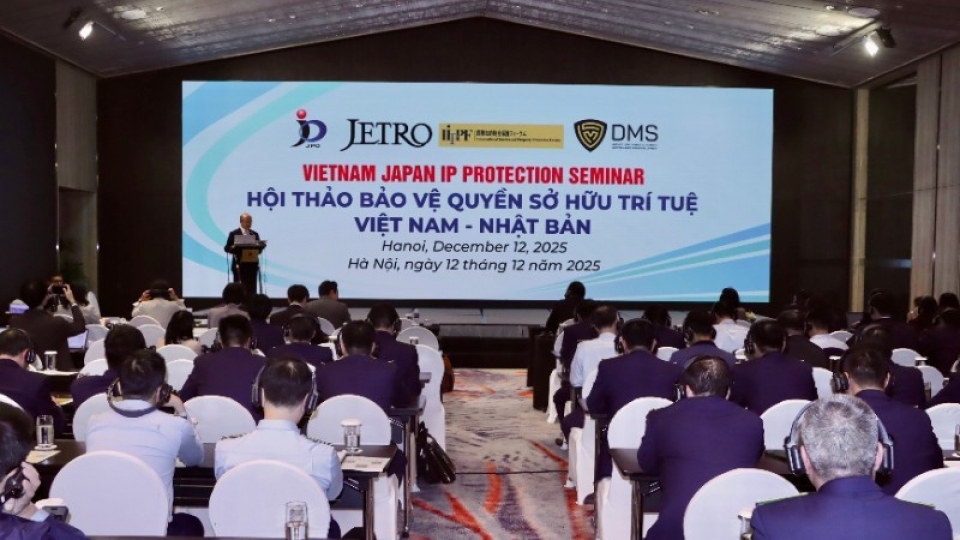
Vietnam, Japan enhance cooperation in intellectual property protection
A Vietnam-Japan intellectual property (IP) protection workshop was held in Hanoi on December 12 to enhance professional exchanges between Vietnam’s market surveillance forces and Japanese organisations and businesses.