


CCS/CCUS essential for Vietnam to achieve net-zero emissions by 2050

As Vietnam steps up efforts to reduce greenhouse gas emissions, particularly in the energy, industrial and waste sectors, carbon capture, utilisation and storage (CCUS) projects are emerging as one of the essential solutions for achieving its net-zero emissions target by 2050.
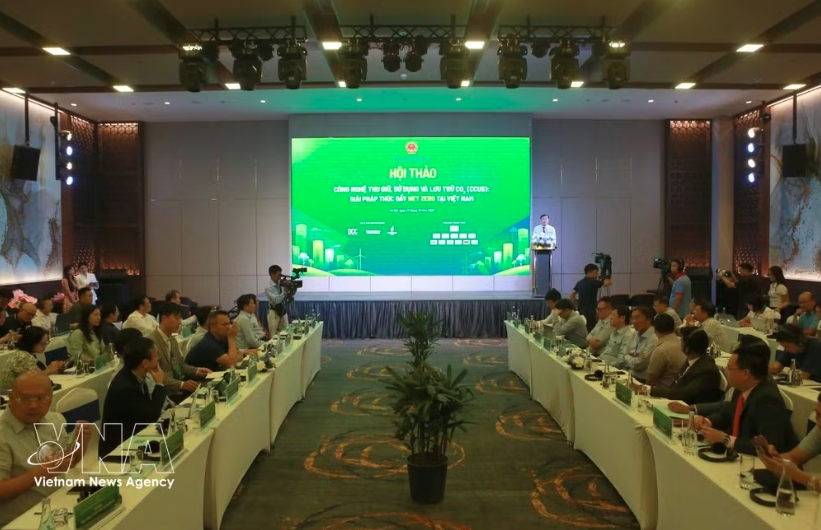
CCS/CCUS essential to achieving net zero
At a seminar entitled “Carbon Capture, Utilisation and Storage Technology (CCUS): A Solution to Accelerate Net Zero in Vietnam” held on October 27, Dr Nguyen Huu Luong, an expert at the Vietnam Petroleum Institute (VPI), said the International Energy Agency (IEA) has identified four pillars for achieving net-zero emissions - electrification powered by clean energy, energy efficiency, the development of low-carbon products and fuels, and reductions in methane emissions and leakage.
To achieve net-zero emissions by 2050 rather than 2070, the IEA has also stressed that CCUS deployment must double and become an essential part of the transition, he said.
Research jointly conducted by the Vietnam National Industry-Energy Group (Petrovietnam) and the Japan Organisation for Metals and Energy Security (JOGMEC) has identified Vietnam as having some of Southeast Asia's most promising CO2 storage potential, estimated at up to 71 billion tonnes.
The potential is concentrated in three geological basins, with the Red River Basin has the largest estimated capacity, at 39 billion tonnes. Vietnam could also utilise more than 1 billion tonnes of CO2 storage capacity in depleted oil and gas fields, Luong said.
Ta Dinh Thi, Vice Chairman of the National Assembly's Committee on Science, Technology and Environment, said Vietnam has introduced various policies and guidelines on climate change response, energy security and marine economic development, identifying CCS/CCUS as a solution for reducing greenhouse gas emissions. Notably, the amended Law on Oil and Gas adopted in 2026 includes provisions related to carbon capture and storage, establishing a legal basis for such activities in the oil and gas sector.
Sharing this view, Darshil Korde, Head of Sustainability at ISSPL Limited, said the CCUS value chain could potentially be deployed in Vietnam's major-emitting industries, including cement, steel, chemicals and hydrogen production, oil refining and petrochemicals, and thermal power generation.
Vietnam's domestic carbon market is also following a clear roadmap, Korde noted. The official carbon exchange began trial operations on June 29, 2026, and is scheduled to remain in the pilot phase through December 31, 2028, before moving towards full operation in 2029.
State, international support needed
Although Vietnam has several of the necessary conditions for deploying CCS/CCUS, experience from countries in the region and around the world shows that government support is essential during the initial stages of such projects.
Dr Nguyen Thanh Tung, Deputy Director of VPI, said CCS/CCUS projects are unlikely to generate significant direct economic returns in their early stages. Policies are therefore needed to encourage demand for low-carbon products, including cement, electricity, iron and steel, thereby creating economic incentives for businesses to participate in the CCUS value chain.
Nguyen Tuan Quang, Director of the Department of Climate Change under the Ministry of Agriculture and Environment, said efforts should focus on several key measures to advance CCS/CCUS.
Regarding the legal framework, relevant provisions on CCUS should be studied and incorporated into legislation on environmental protection and climate change response as soon as possible.
In terms of technology and training, the State should establish legal mechanisms to encourage the transfer of advanced technologies and the application of international scientific advances suited to Vietnam's conditions, he added. Outlining priority measures for CCS/CCUS deployment, Luong Quang Huy, Head of the Greenhouse Gas Emissions Management and Ozone Layer Protection Division under the Department of Climate Change, said Vietnam needs international assistance in technology, technical expertise and finance to gradually carry out pilot projects.
On this basis, CCUS is being considered for inclusion among the greenhouse gas mitigation measures in Vietnam's nationally determined contribution (NDC), subject to international support.
Tung of VPI proposed establishing a dedicated regulatory framework for CCS after the pilot phase. He noted that capture accounts for 60–80% of total costs, while the amended Law on Oil and Gas adopted in 2026 mainly addresses the storage stage.
From the business perspective, Le Van Nghi, Chairman and General Director of QIS Global, called for a clear implementation roadmap and stable policies to give businesses the confidence to make long-term investments.
Rather than starting with large-scale projects, Vietnam should prioritise small, modular technologies that can be commercialised and readily integrated into existing factories, he said.

Vietnam eyes link between green credit and carbon market to unlock funding
Vietnam is moving to link green credit with its carbon market, a step expected to free up additional funding for the green transition and give banks a firmer basis to assess and manage capital flows to emissions-reduction projects.

