High-quality human resources seen as key to Vietnam’s high-income goal by 2045

VOV.VN - Improving the quality of human resources, particularly high-quality talent, has been identified as a core task and a key factor in Vietnam’s efforts to become a developed, high-income country by 2045.
The draft Political Report of the 13th Party Central Committee to the 14th National Party Congress sets out the goal of building a modern national education system on par with regional and global standards. A central focus is training high-quality human resources to international benchmarks to meet the development needs of strategic industries and technologies.
Targeted training mechanisms for priority sectors
Discussing the issue, Do Viet Tuan, PhD, from the Vietnam National Academy of Education Management, said that to avoid falling behind, Vietnam is impossible to continue to rely on advantages such as low-cost labor or natural resources. Human capital, he said, is an internal strength and a key driver of innovation and productivity growth.
To develop high-quality human resources, Vietnam needs a coordinated set of solutions and a national strategy for technology and strategic industrial talent. Priority areas should be clearly identified, including artificial intelligence (AI) and big data, semiconductors and microchips, biotechnology, new energy, advanced materials, education technology, cybersecurity and automation.
Do Viet Tuan underlined the need to link human resource targets with socio-economic development planning and national digital transformation programs. In particular, he called for the introduction of a state “commissioning” mechanism under which the government places training orders with universities and research institutes.
Training, he said, must respond to concrete strategic demand rather than the existing supply capacity of educational institutions.
At the same time, reforming education to meet international standards is a critical task. Vietnam needs to benchmark curricula against reputable international accreditation systems such as ABET, AACSB and CDIO, depending on the field. International competency frameworks from organizations such as the OECD or UNESCO should be incorporated into learning outcomes, alongside the expansion of bilingual programs or full English-medium instruction at undergraduate and postgraduate levels in priority disciplines.
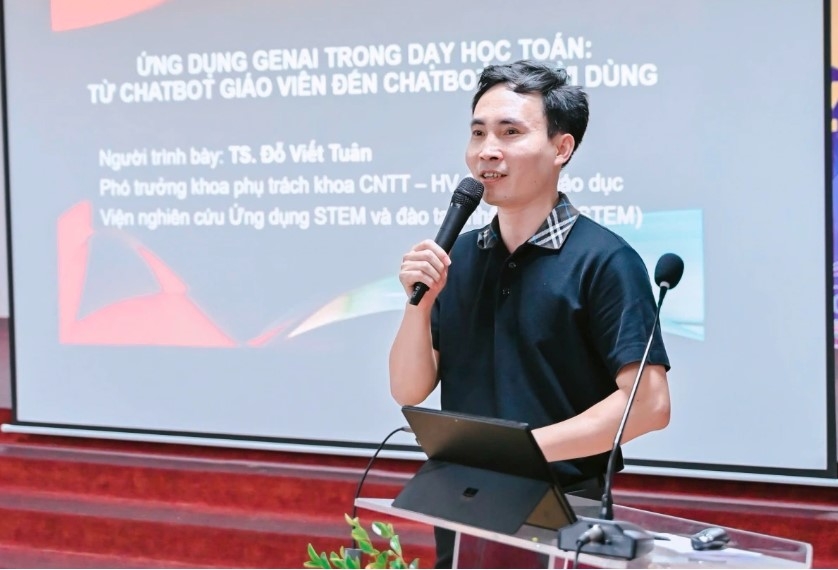
“Educational institutions need to shift decisively from knowledge transmission to capacity development and innovation. The share of project-based learning, research and design thinking should be increased. Integrating real business problems into formal curricula is essential,” Do Viet Tuan said.
Developing lecturers and innovation ecosystem
Within the group of solutions to improve human resource quality, Do Viet Tuan placed particular emphasis on developing teaching staff and researchers who meet international standards. He said specific policies are needed to attract overseas Vietnamese scientists and invite international experts to participate in teaching. Research, teaching and technology transfer should be connected as a single, coherent chain.
In addition to remuneration policies, he said assessment frameworks for lecturers should be built around research capacity and their ability to train talent for industry. Educational institutions should also establish close linkages within an ecosystem involving the state, universities and businesses.
Enterprises, he said, need to take an active role in co-designing curricula, assessing student competencies and commissioning research. This symbiotic model, together with the development of innovation centers and AI laboratories within universities, is critical to training “the right people, with the right skills, at the right time.”
Focused investment and AI adoption to leapfrog development
Amid rapid AI advancement, Do Viet Tuan said universities need to move quickly to apply AI and big data in governance and training. AI should not be treated solely as a field of study, but as a tool to personalize learning pathways, forecast workforce demand and upgrade the entire education system.
In parallel, international cooperation needs to become more substantive through joint degree programs, co-supervised doctoral training or student internships at major global technology corporations. These approaches, he said, offer Vietnam a way to learn and pursue a “leapfrogging” strategy in emerging fields.
Finally, the expert called for major reform of financial mechanisms. Investment, he said, needs to be focused and targeted to avoid fragmentation. The state should expand national scholarship programs for students in strategic fields tied to service commitments to the country. At the same time, flexible financial mechanisms are needed to support university innovation and technology startups within the academic environment.
10-year scheme for training high-quality human resources abroad approved
The Prime Minister on December 10 issued a decision approving a scheme to send Vietnamese citizens to study in Russia, China, Eastern European countries, and former Soviet Union countries during 2026–2035.