


Vietnam makes significant contributions to CLMV, ACMECS cooperation

Vietnam has played an active and responsible role in promoting Mekong sub-regional cooperation over the past two decades, particularly through the Cambodia-Laos-Myanmar-Vietnam (CLMV) and Ayeyawady-Chao Phraya-Mekong Economic Cooperation Strategy (ACMECS) mechanisms, said a Cambodian scholar.
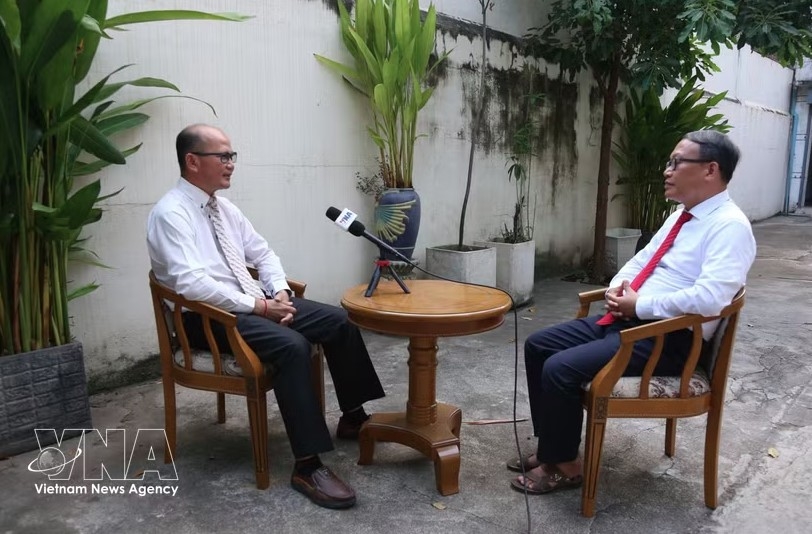
The assessment was made by Uch Leang, Acting Director of Asian, African, and Middle East Studies at the International Relations Institute of Cambodia (IRIC) under the Royal Academy of Cambodia (RAC), in an interview granted to the Vietnam News Agency ahead of the 12th CLMV Summit and the 11th ACMECS Summit, scheduled for November 28 in Vietnam.
He said the country's role in connecting Mekong nations and promoting cooperation has become increasingly important amid strategic competition among major powers, climate change, water security challenges, digital transformation and global supply chain restructuring.
The scholar, who is also President of the Cambodia Alumni from Vietnam Association (CAVA), held that Vietnam's key contribution lies in translating political and diplomatic commitments into practical cooperation programmes in economic development, trade, infrastructure connectivity and sustainable development.
Within CLMV, Vietnam has helped initiate initiatives, institutionalise cooperation and narrow development gaps. In 2010, it proposed the CLMV Economic Ministers' Meeting, thus enhancing coordination in the economy, trade, investment and integration. It has also actively contributed to action plans and cooperation in customs, agriculture, tourism and human resources development.
Uch Leang highlighted the CLMV scholarship programme, which provides 20 scholarships annually for students from each of Cambodia, Laos and Myanmar, as a practical, long-term initiative. He stressed that narrowing development gaps requires not only infrastructure investment or trade growth but also improvements in human resources quality and each nation's domestic capacity.
Within ACMECS, which brings together Cambodia, Laos, Myanmar, Thailand and Vietnam, Vietnam has focused more on promoting economic integration and connectivity among economies at different development levels. While CLMV emphasises building capacity and narrowing development disparities, ACMECS centres on tapping complementary advantages, developing economic corridors and advancing cross-border connectivity, the scholar said.
At the 10th ACMECS Summit in November 2024, then Prime Minister Pham Minh Chinh proposed six orientations to boost sub-regional cooperation, including stronger national, regional and international connectivity, greater engagement by governments, people and businesses, and closer links between economic development, stability and security. Vietnam also pledged to donate US$10 million to the ACMECS Development Fund, demonstrating its commitment to implementing joint programmes.
Vietnam's geo-economic location, seaports, transport networks and economic hubs also give it an important role in connecting Cambodia and Laos with international markets, logistics centres and shipping routes.
From Cambodia's perspective, Uch Leang said stronger transport, logistics, border trade and economic corridor links among Vietnam, Cambodia, Laos and Thailand will generate tangible benfits for the entire region, helping expand markets, reduce transport costs, attract investment and facilitate deeper participation in regional supply chains.
He also highlighted Vietnam's role in promoting complementarity among Mekong cooperation mechanisms, including CLMV, ACMECS, the Greater Mekong Subregion Cooperation and Mekong–Japan Cooperation. Better coordination will help prevent overlapping initiatives or fragmented resources while maximising support from development partners, international financial institutions and the private sector.
However, cooperation still faces challenges, including development disparities, inadequate infrastructure and logistics connectivity, complicated customs procedures and non-tariff barriers. Climate change, declining Mekong water resources, natural disasters and transnational crime also require closer coordination.
Looking ahead, Uch Leang outlined three priorities for Vietnam. These include promoting substantive economic connectivity, with priority given to transport infrastructure, logistics, cross-border trade and regional value chains in agricuture, agricultural processing, supporting industries and energy; expanding cooperation in water security, environmental protection and responses to non-traditional security challenges; and boosting human resources development, digital transformation and capacity building for small and medium-sized enterprises.
That will lay a stepping stone for the Mekong economies to enhance their competitiveness and adapt to regional economic changes, he added.
He noted that Vietnam and Cambodia share many common interests in improving CLMV and ACMECS cooperation. Vietnam is an important partner in trade, investment, agriculture, infrastructure and human resources development, while a stable Cambodia with stronger connectivity with regional economic corridors will also benefit Vietnam.
The scholar called on the two countries to enhance coordination in cross-border projects, particularly in transport, logistics, agricultural trade, energy and sustainable management of Mekong water resources.
Assessing Vietnam's contributions, Uch Leang described the country as a proactive member that has made important contributions in terms of political and diplomatic engagement, economic development, and regional strategic connectivity.
However, he stressed, Vietnam's role should not be measured simply by the number of initiatives or joint statements at high-level meetings, but by its ability to turn commitments into tangible benefits for member countries.
He expressed his hope that Vietnam will continue to serve as a connector that helps build consensus and coordinate initiatives to foster a more integrated, balanced and resilient Mekong sub-region in the face of new challenges, contributing to peace, stability and shared prosperity across ASEAN.
Vietnam, Laos look to stronger cooperation under CLMV and ACMECS frameworks
VOV.VN - The Lao side expects the upcoming official visit to Vietnam to deeply consolidate political trust, promote substantive cooperation and close coordination between the two countries as well as within the CLMV and ACMECS cooperation frameworks.


