
Vietnam committed to promoting human rights

Vietnam is running for a seat at the United Nations’ Human Rights Council for the 2014-2016 term in an effort to help the international community promote human rights.
The candidacy demonstrates both Vietnam’s determination and responsibility in implementing human rights and its desire to share its experience in the field.
The international community has endorsed Vietnam’s achievements in securing and promoting human rights in civil, political, economic, cultural and social affairs.
Vietnam stipulates human rights in a clear and detailed manner in its Constitution and laws, underlining that ensuring human rights is always the Party and State’s consistent policy.
The country has been fulfilling its commitments to human rights by implementing people-centred policies that benefit people, especially the poor. It has made significant progress in poverty reduction, education, health care, job creation and in improving people’s living conditions and social welfare.
Despite impact from the global economic and financial crisis, Vietnam has maintained an annual economic growth rate of 6 percent, creating a firm foundation for ensuring people’s fundamental rights.
The Government has given priority to legal and administrative reforms to increase people’s rights, including the right to supervise the implementation of laws and the right to access information.
Maintaining economic growth, ensuring social equality and upholding the law are the three main pillars of Vietnam’s development strategy.
Over recent years, the National Assembly, together with various agencies, have completed and issued legislations to ensure human rights, such as the laws on complaints and denunciations, civil procedures and tertiary education.
In Vietnam, people enjoy their fundamental rights during elections, and when taking part in State and social management. The high turn-out at elections is evidence of the people having their full rights.
The country has always attached a great deal of importance to freedom of religions and beliefs. Since the promulgation of the decree on religion in 2004, it has made positive changes in religious affairs, allowing the people to practise their religion in respect for the State’s religious policies and laws and social order.
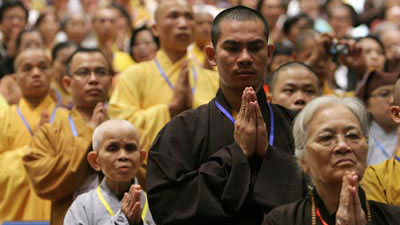 |
Vietnam successfully organised Vesak Day in May 2008 with tens of thousands of Buddhist dignitaries and followers taking part alongside nearly 2,000 international delegates from 71 countries, territories and international organisations. That was why the country was chosen to host the World Buddhist Summit in 2010.
The Vietnamese Constitution states that citizens have the right to freedom of speech and publication according to the law. These rights are shown through the rapid development, diverse forms and rich content of the mass media. The country has almost 17,000 licenced journalists, over 700 print newspaper agencies, 70 central and provincial radio and television stations, over 80 e-newspapers and thousands of websites.
Vietnam has also registered the fastest growth of Internet users in Asia with 30.8 million users in October 2012.
The country has also recorded some remarkable achievements in poverty reduction. Within the past five years, the poverty rate fell to 9.5 percent while healthcare services have constantly improved.
In 2000, Vietnam met the international standard for literacy and primary education unversalisation. The Government has issued and implemented many policies on education, especially for children of ethnic minority groups and in disadvantaged areas.
Vietnam is one of the first six countries in the world to take part in the Convention to Eliminate Forms of Discrimination against Women. It now ranks 40th out of 188 nations around the world in the number of female parliamentarians to be elected.
The country has also taken an active part in and responds to regional and international activities to promote human rights through conferences, workshops on human rights and dialogue between different beliefs.
With its achievements in human rights, Vietnam hopes to contribute more to the UN Human Rights Council, to ensure a world of peace, prosperity and equality.