


Singapore media highlight first Singapore-Vietnam Strategic Dialogue

VOV.VN - Top Singaporean news agencies and press outlets prominently covered the official visit to Singapore by Politburo member and standing member of the Communist Party of Vietnam (CPV) Central Committee’s Secretariat Tran Cam Tu to co-chair the First Singapore-Vietnam Strategic Dialogue on August 24-25.
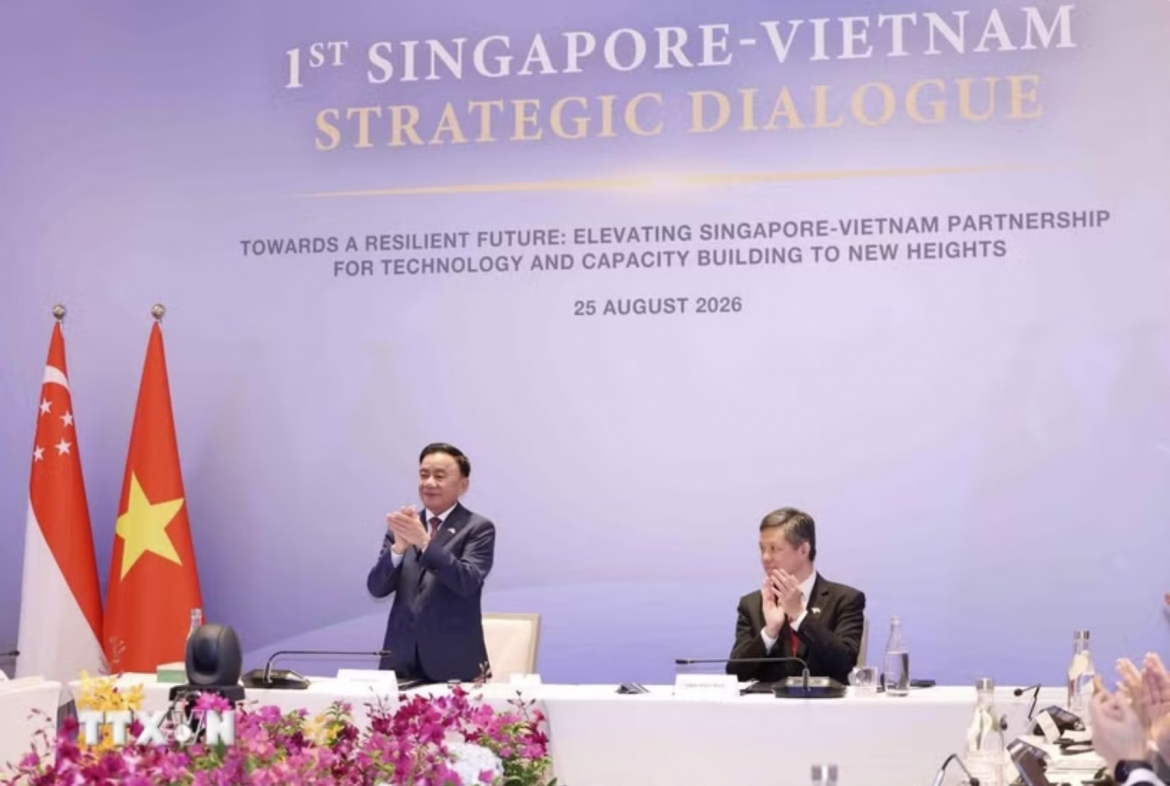
The Straits Times published an article titled S’pore and Vietnam agree to deepen leadership exchanges, expand tech cooperation” . This outcome was achieved within the framework of the First Singapore-Vietnam Strategic Dialogue on August 25, when both sides announced a Joint Statement on Technological Connectivity Strategy.
Singapore’s Coordinating Minister for Public Services and Minister for Defence Chan Chun Sing, who co-chaired the Strategic Dialogue with Permanent Member of the Secretariat Tran Cam Tu, stated that the two nations established this new high-level mechanism because strong bilateral ties have laid the foundation for the two Southeast Asian neighbors to look toward the future together.
Singapore and Vietnam share a warm, long-standing friendship built on mutual trust nurtured by generations of leaders from both countries. Both sides hope the next generation of leaders will also forge close ties. This new forum will serve as a venue to exchange views on emerging challenges and identify areas where the two countries can cooperate.
The Strategic Dialogue was created during the state visit to Singapore by Vietnamese General Secretary and President To Lam in May 2026, following the upgrade of bilateral diplomatic relations to a Comprehensive Strategic Partnership in 2025.
Speaking at the Dialogue, Minister Chan Chun Sing remarked that the quality and governance capacity of governments will increasingly distinguish successful nations from the rest. This unfolds amid a complex international environment where many conditions that once supported economic growth are weakening, while boundaries between economic policy, technology policy, and national security are increasingly blurred.
Aspirations across social strata are also diversifying, while the rise of artificial intelligence (AI) and other technologies presents both vast opportunities and new risks and divisions. Singapore advocates targeted investment in leadership development, viewing this as a national strategic capability, while placing special emphasis on identifying and nurturing leaders with integrity, sound judgment, and the acumen to weigh the long-term interests of the country.
The city island state also aims to develop “pi-shaped” leaders who possess deep knowledge and expertise in one or two domains, alongside broad understanding to grasp interdisciplinary issues, coordinate across agency boundaries, and connect differing perspectives. This becomes increasingly vital as many challenges facing governments today do not fall neatly within the domain of a single ministry or sector. Good outcomes depend not only on talented individuals with deep expertise, but also on teams capable of mobilizing resources and coordinating across the entire government apparatus.
Standing member of the Secretariat Tran Cam Tu noted that Vietnam pays special attention to learning from Singapore’s experience in building an inclusive public administration and effective national governance, as well as methods for training leaders with the vision and capacity to meet development requirements in the new era.
Both countries also need to expand cooperation among mass organizations and youth groups, while strengthening coordination in information, publicity, and education. Vietnam’s priority is training potential leadership and management personnel, especially those planned for leadership positions and outstanding young graduates, to meet the country’s medium- and long-term development needs.
Regarding technology cooperation, the Vietnamese leader suggested that both sides leverage the role of the State, the scientific community, and enterprises to translate ideas into commercial applications. The goal is not only to attract investment or transfer technology, but also to jointly research, develop, master technology, and build innovative products and ecosystems to serve the development of both countries and contribute to the region.
Minister Chan Chun Sing agreed that utilizing technology also carries an international cooperation aspect. To unleash the potential of AI, facilitate cross-border data flows, and integrate digital economies, nations need a common approach and enhanced interoperability and connectivity between systems where possible. Singapore and Vietnam share many common interests and challenges.
Minister Chan Chun Sing expressed hope that this inaugural Dialogue will mark the beginning of more regular and substantive exchanges between the two countries.
Emphasizing governance capacity and leadership training, news outlet CNA published an article titled “Government quality, capability set successful nations apart in a contested world,” while Lianhe Zaobao carried a piece titled “Government governance capacity will decide a nation’s success or failure: Need to train leaders with both depth and broad vision.”
These articles focused on Minister Chan Chun Sing’s remarks at the Strategic Dialogue, noting that geopolitical competition is blurring the lines between economics, technology, and national security. Decisions on supply chains and investment are increasingly driven by strategic factors beyond trade. For Singapore and Vietnam, two small, open, and trade-dependent economies, institutional capacity and governance are increasingly important. Singapore focuses on training leaders with deep expertise in one or two fields alongside vision broad enough to handle interdisciplinary issues.
Leaders do not necessarily need to be technology experts, but they must understand enough to identify opportunities, assess risks, and decide how to apply technology.
Meanwhile, news site AsiaOne highlighted government quality and public trust with an article titled “Government quality, capability will distinguish successful nations from others.”
The article focused on three main points from Minister Chan Chun Sing’s address: strong institutions help nations anticipate change and adapt to external shocks; policy stability, management efficiency, and public service quality directly impact competitiveness and long-term corporate investment decisions; and public trust helps governments build consensus, mobilize society, and implement difficult yet necessary reforms. Singapore and Vietnam can exchange experience in identifying and training leaders and sending officials to join each other’s leadership development programs.
Both governments can build a common approach, increase system connectivity, facilitate cross-border data flows, and advance digital economic integration. Both Vietnam and Singapore recognize that long-term success depends on regional stability, capable governments, and good investment in innovation and technology.
Singapore’s experience and AI-era workforce puzzle for Vietnam
VOV.VN - The rapid development of artificial intelligence (AI) and high technology is deeply transforming workforce requirements, from training methods and skills to be equipped for workers to the overall employment structure in the economy.


